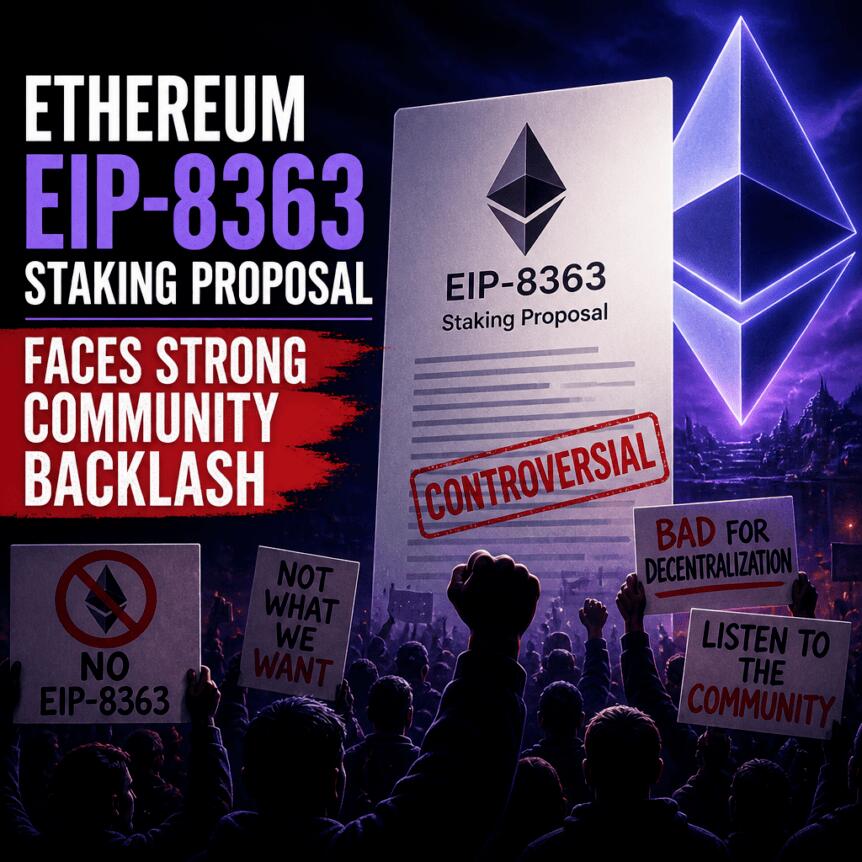
Ethereum is once again wrestling with its core incentive design. A proposed upgrade, EIP-8363 (“Tapered Issuance Burn”), would gradually reduce staking rewards as more Ether is locked up, with the idea of cutting new protocol issuance to zero once staking reaches a specified threshold.
The controversy is not abstract: Ether’s stake rate, DeFi’s reliance on staking derivatives, and institutional demand for predictable monetary policy all collide in the debate. Supporters argue that beyond a certain point, additional staking delivers diminishing security benefits—while critics warn that reducing issuance could destabilize parts of Ethereum’s financial plumbing and undermine trust in how the network governs its money.
Key takeaways
- EIP-8363 would taper validator rewards as staking participation rises, ultimately aiming to stop issuance when a target staking level is reached.
- Proponents say Ethereum has crossed into a zone where extra staking is less valuable for security and more harmful for non-stakers.
- Critics—including DeFi and institutional voices—argue the change could weaken decentralization, disrupt lending markets, and introduce “yield governance risk.”
- Opponents also contend that Ethereum’s inflation is already low and that market forces will likely slow staking further without altering issuance.
- The proposal’s timing is also drawing fire, with critics questioning its publication close to the Aug. 6 deadline for the next Ethereum upgrade proposals.
What EIP-8363 proposes—and why it sparked pushback
EIP-8363, published on the Ethereum Magicians forum (https://ethereum-magicians.org/t/eip-8363-tapered-issuance-burn/29263), is designed to rein in staking rewards as more ETH gets locked to secure the network. According to the proposal’s framing, the policy would eventually reduce new issuance to zero once 50% of Ether’s supply is staked.
Among the proposal’s authors are Ethereum Foundation researcher Justin Drake and ETHCC co-founder Jerome de Tychey. Their argument is that Ethereum has reached a point where incremental security gains from additional staking are no longer proportional to the issuance granted to validators. In their view, paying for security “beyond what the network needs” becomes a subsidy to existing staking participation at the expense of holders who are not staking.
But many in the ecosystem dislike what they see as a potential shift in Ethereum’s monetary logic. Mike Silagadze, founder of Ether.fi, criticized the idea on social media, saying it would be harmful to decentralization, adoption, and the network’s credibility.
“This is so disappointing on every level. […] This is bad for decentralization, this is bad for Ethereum adoption, and this is bad for the credibility of the network.”
Dr. Steve Berryman, Bitwise’s head of client partnerships for Ethereum, similarly argued that institutional adoption depends on certainty, and that changing issuance at the margin would introduce uncertainty that institutions are unlikely to tolerate.
“Institutional adoption requires certainty and playing with the issuance at the margin would cause uncertainty and institutions hate uncertainty.”
Is Ethereum already “over-staked”? The numbers behind the debate
Current network participation provides the backdrop for the disagreement. According to Validator Queue data (https://www.validatorqueue.com/), Ethereum has roughly 41.5 million ETH staked, yielding about 2.67% and representing around 34.07% of total supply.
Supporters of EIP-8363 maintain that while more staked ETH generally makes attacks harder, there comes a point where the extra security is increasingly marginal. The proposal, in that sense, targets the incentive mechanism: it aims to stop rewarding additional staking once Ethereum is already sufficiently hardened.
However, opponents challenge the premise that issuance is functioning as a meaningful “stealth tax” on non-stakers. Berryman argued that the market may naturally approach a ceiling in staking participation as yields fall, without needing changes to Ethereum’s issuance policy. He also suggested that participation growth has been influenced by institutional entrants—mentioning players such as Bitmine and BlackRock—and that after those entities complete their staking allocations, staking rates could plateau again.
Another dissenting view comes from commentator Leo Lanza, who opposes the proposal and disputes the idea that Ethereum’s inflation materially harms non-stakers. Lanza pointed out that Ethereum’s annual inflation is below 1% and compared it to gold’s supply growth range of roughly 1% to 2% annually, arguing that markets can solve the problem without protocol-level adjustments.
“The free market already solves this […] Let the market adjust.”
DeFi and decentralization concerns: the risks critics emphasize
Even if tapering issuance curbs unnecessary rewards, critics argue it may introduce second-order effects. A central concern is that staking is deeply embedded in Ethereum’s decentralized finance ecosystem through staking derivatives and related collateral usage. Silagadze argued that a policy like EIP-8363 would “kill a huge chunk of DeFi which is built around the staking ecosystem.”
Stani Kulechov, founder of Aave, raised additional worries. In his view, reducing staking rewards could encourage investors who treat ETH as a yield-bearing asset (or “ETH beta”) to rotate into alternative yield strategies—effectively punishing Ethereum for its growth. Kulechov’s concern is that the network could lose liquidity and composability that are tied to staking-linked yields.
“My concern is… those who are fine with ETH beta and yield might also sell ETH for other yielding assets […] Ethereum should not be punished for its growth.”
Technical stakeholders also caution against simplistic security arithmetic. Greg Koumoutsos, technical research lead at the Lido Labs Foundation, said that a staking ratio around one-third of supply does not appear unhealthy, while agreeing that thinking proactively about excessive staking is reasonable. More importantly, he argued the proposal oversimplifies what issuance is paying for—suggesting the broader system benefits include decentralization, operator diversity, censorship resistance, and network resilience.
“Ethereum is not only paying for slashable ETH; it is paying for decentralization, operator diversity, censorship resistance, and network resilience.”
In other words: lower issuance is not automatically a superior security policy unless those trade-offs are explicitly accounted for.
Who pays the price if rewards fall? The decentralization angle
Critics also argue that lowering rewards could affect validator participation patterns in ways that increase concentration. Koumoutsos noted that independent validators do not benefit from the same economies of scale as large staking businesses, exchanges, or institutional operators. If protocol rewards drop, he said, marginal solo validators could exit, leaving a thinner base of independent operators.
“A solo validator has real costs: some ideological solo stakers may remain, but many marginal solo validators will not, and fewer new ones will enter, if any.”
He added that large centralized platforms may be motivated by factors beyond yield—such as customer retention, regulatory positioning, and product integration—making them less likely to reduce staking even if rewards decline. Within delegated staking, the same dynamic could tilt incentives toward custodial products rather than onchain staking protocols, which tend to face higher ongoing maintenance, governance, and upgrade responsibilities.
Predictability versus adaptation: the governance-risk dispute
Supporters of EIP-8363 argue that stronger long-term monetary characteristics for Ether are worth the adjustment, while opponents counter that constant tweaking of Ethereum’s monetary policy undermines one of its biggest selling points: predictability.
Berryman said institutions care more about certainty than about marginal changes in staking yield, describing adjustments to the issuance curve as “yield governance risk.” His argument is less about absolute reward levels and more about whether the network’s monetary rules can be relied upon.
“It’s not broken, why try and fix it?”
Silagadze echoed the idea from an adoption perspective, arguing that any change with far-reaching implications—especially those affecting DeFi—could harm confidence among large institutions or nation-state actors that view Ethereum as a stable governance environment.
Beyond the substance of the proposal itself, the rollout has drawn procedural criticism. According to the reporting, EIP-8363 was published just two days before the Aug. 6 deadline for proposals to be considered for the next Ethereum network upgrade. Silagadze argued that a change with wide-ranging consequences should not have been introduced on such a short timeline.
That pressure highlights a broader tension in Ethereum governance: monetary and security incentives are interconnected, so every adjustment inevitably creates winners and losers across staking, DeFi, and institutional markets.
Readers should watch how the debate evolves in the lead-up to the relevant upgrade timeline—especially whether proponents adjust the scope or mechanics of tapering to address concerns about DeFi collateral effects, validator participation, and institutional predictability.