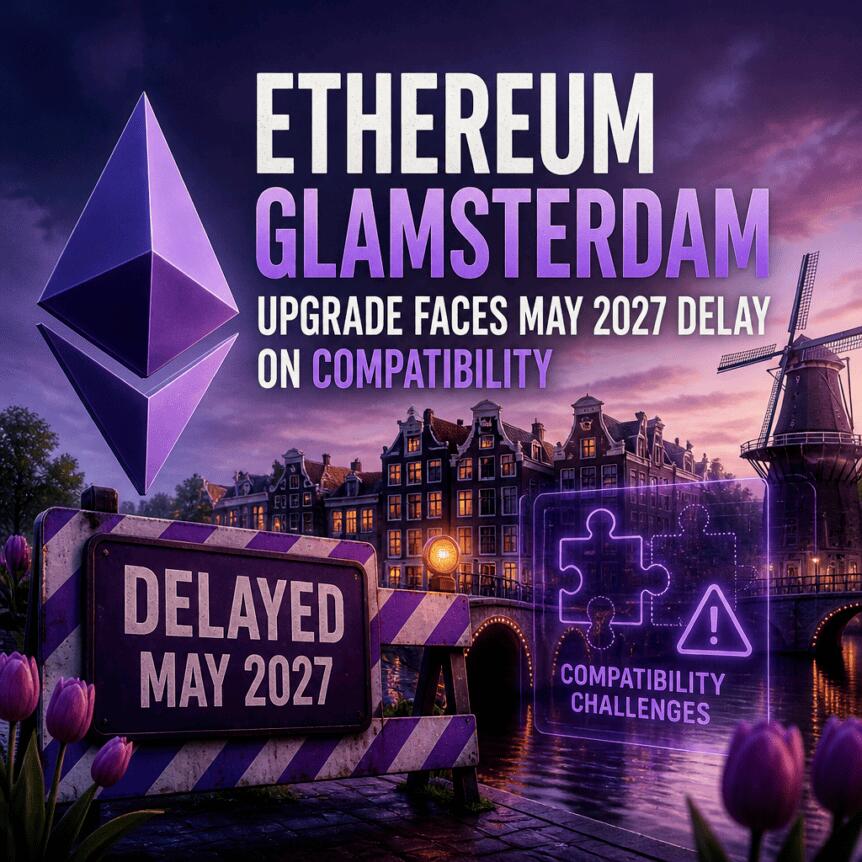
Ethereum developers are weighing whether the network’s upcoming “Glamsterdam” hard fork should be delayed as they try to balance capacity and efficiency improvements against smart contract compatibility risks. Discussions at Thursday’s All Core Developers meeting suggest Glamsterdam’s mainnet activation could slip as far as May 2027 if developers decide to alter the fork specifications to address issues raised by security researchers.
The debate centers on how Ethereum’s gas pricing would change under the proposals that make up Glamsterdam—specifically EIP-8037 and <a href="https://eips.ethereum.org/EIPS/eip-8038. While the upgrade aims to improve how the network allocates resources, critics warn that the way gas is repriced could affect contracts that rely on certain assumptions, potentially creating new attack surfaces.
Key takeaways
- All Core Developers discussed postponing or modifying Glamsterdam due to smart contract compatibility concerns tied to gas repricing proposals EIP-8037 and EIP-8038.
- ChainSecurity previously warned in October that gas pricing changes could disrupt existing contracts; researchers later cataloged examples of potentially affected behavior.
- Developers reported contacting at least 50 affected companies, with high-impact fixes expected around mid-December and some medium-impact work stretching into early January.
- Even under current specifications, mainnet activation could be as early as mid-January 2027; waiting for decisions could push timing into late February, early March, or as far as May if changes are adopted.
- Ethereum’s next planned hard fork, Hegotá, may see its scope adjusted to accelerate post-quantum security efforts, but no decision was reached.
Why Glamsterdam timing depends on gas pricing changes
Glamsterdam is designed to increase Ethereum’s throughput and efficiency through a planned hard fork. However, the upgrade’s rollout has become entangled with security work that focuses on how existing smart contracts may behave after gas pricing changes.
According to prior reporting, ChainSecurity flagged in October that changes related to gas pricing could disrupt smart contract logic and potentially expose deployed applications to exploitation. The issue is not simply whether contracts will “break,” but whether they could violate assumptions—often described as invariants—that developers have built into their systems.
The risk has been studied through multiple rounds of analysis. In October, researchers identified 13 real-world examples of contracts that could be affected. A later investigation, referenced during the planning process, looked at eight smart contract invariants that might be disrupted by the upgrade.
At Thursday’s meeting, developers also discussed the trade-off that complicates decision-making: changing the specifications to protect certain contracts could inadvertently harm others. One developer warned that “every spec change could, again, break new invariants that we are not aware of breaking yet,” capturing the core uncertainty facing the team.
Impact assessment: who might need fixes, and when
To reduce uncertainty ahead of any hard fork, developers said the Ethereum Foundation and security teams—including ChainSecurity and Dedaub—collectively contacted at least 50 affected companies.
The projects were categorized by impact level. Developers stated that three projects were deemed high impact, with fixes completed or expected by mid-December. For medium-impact projects, timelines reportedly extend to Jan. 10.
That schedule matters because hard fork readiness depends not only on client implementation but also on whether contract operators have time to patch vulnerabilities or adjust deployed logic. If the compatibility review and remediation work takes longer than expected, Ethereum may need to shift activation to avoid deploying the upgrade when the ecosystem is not fully prepared.
Activation scenarios: mid-January is no longer a hard guarantee
Under Glamsterdam’s current specifications, developers indicated mainnet activation could occur as early as mid-January 2027. But timing is now tied to how quickly teams can reach agreement on whether to keep the existing spec or modify it.
Thursday’s discussion outlined the consequences of postponing that decision. If developers wait until January to finalize the approach, activation could move to late February or early March. If modifications are adopted—aimed at reducing compatibility risks—developers suggested the timeline could extend further, potentially landing in April or May 2027.
Notably, no decision on the specification has been reached yet. For market participants and ecosystem users, that uncertainty is important: hard fork timelines influence everything from client upgrade planning to the operational risk calculus for teams running smart contract infrastructure.
Hegotá may shrink to prioritize post-quantum security
In a separate track, developers discussed the scope of Ethereum’s next planned hard fork, Hegotá, as the network seeks to accelerate its transition to post-quantum cryptography.
During the meeting, teams considered postponing some Ethereum Improvement Proposals to focus resources on post-quantum features. However, other developers argued that narrowing the scope would bring limited benefits unless it also meaningfully shortened the overall rollout timeline.
A key point of friction involves compatibility concerns tied to EIP-8151, a proposal intended to protect accounts migrating to post-quantum security. A preliminary review reportedly found a potentially large number of existing smart contracts that could be affected by changes related to the proposal, complicating whether it can be included in Hegotá as currently planned.
No final decision was reached on Hegotá’s scope. Client teams are expected to submit their positions ahead of further discussions scheduled for two weeks from the meeting.
For readers watching Ethereum’s roadmap, the main question isn’t just whether Glamsterdam and Hegotá arrive on schedule, but how aggressively developers will trade speed for compatibility. Over the next few weeks, the community should focus on whether the Glamsterdam spec is adjusted and how teams evaluate new invariants that could emerge from any changes—alongside whether Hegotá’s post-quantum priorities can progress without creating additional upgrade friction.