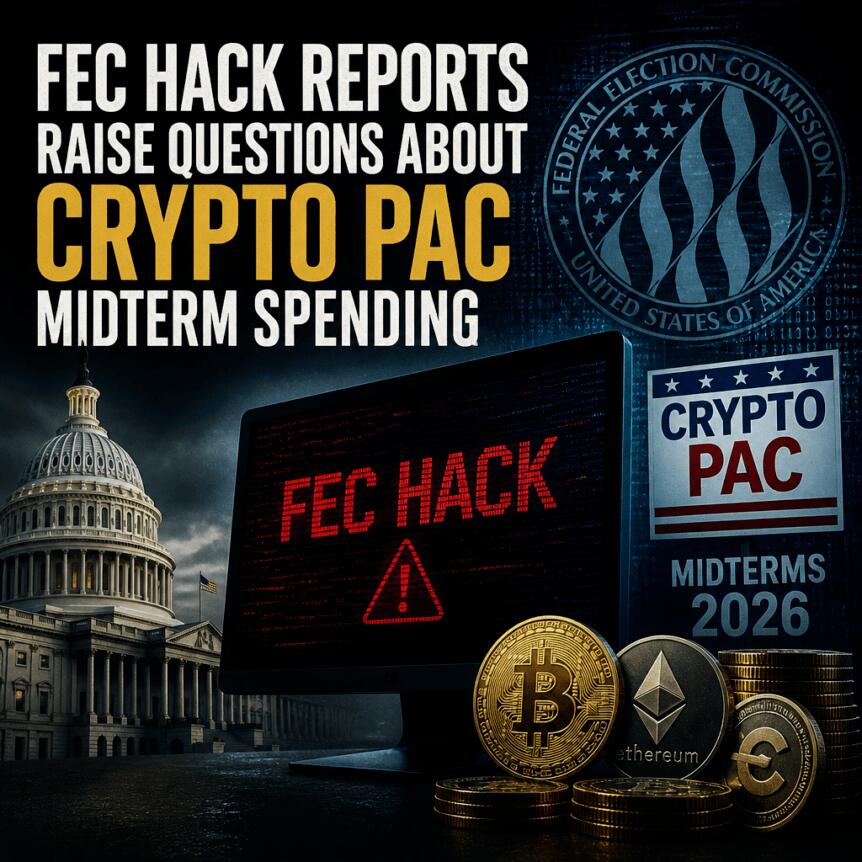
The U.S. Federal Election Commission’s electronic filing system was taken offline after reports of a hack, raising concerns that some late-cycle campaign spending by super PACs and other political committees may not be visible to the public in time for the 2026 midterm elections.
As of Tuesday at 7:48 pm UTC, the FEC said it was still dealing with an “electronic filing system outage” while working to restore service. While campaign finance data for super PACs and other entities remained accessible, the disruption has renewed scrutiny around how quickly spending is reported and whether the final days before Election Day could be undercounted in real time.
Key takeaways
- The FEC reported an “electronic filing system outage” after reports that the filing site was targeted by hackers.
- Although existing campaign finance data appears available, the outage could delay visibility into last-minute expenditures.
- Super PACs generally must file certain spending within 24 hours once funds are used (for qualifying amounts), leaving limited reporting time when systems fail.
- Separately, Reuters reported the disruption was tied to a hacker targeting the FEC website, citing an email.
What the outage means for last-minute super PAC spending
The FEC’s electronic filing interruption comes with a reporting clock that can be tight for super PACs and candidates during an election cycle. Under U.S. campaign finance rules referenced in the filing process described in the report, super PACs are required to report certain expenditures within 24 hours of funds being used, assuming the spending meets a minimum threshold of $1,000 or more.
For candidates for House and Senate seats, the expectations are also time-bound: contributions of $1,000 or more are typically reported within 48 hours during the 20 days leading up to an election. That framework is intended to make major political flows trackable as they occur—so a system outage during the final stretch can create a blind spot.
The report highlighted that, with six days until Election Day, FEC filings showed no expenditures since Sunday from several cryptocurrency-industry-aligned super PACs: Fairshake, Defend American Jobs, Protect Progress, Fellowship, and the Digital Freedom Fund.
At the time of publication, Cointelegraph said it reached out to Fairshake for comment but did not receive an immediate response.
Known disclosures show continued activity—at least until filings lagged
While the outage raised questions about what might be missing from public reporting in the last days, some committees’ prior disclosures illustrate the scale and speed of political advertising and messaging ahead of the midterms.
In one example, the Digital Freedom Fund—launched by Gemini co-founders Cameron and Tyler Winklevoss—reported on Sunday that it had spent more than $572,000 on text messages to support Republican Senate candidates. The majority of those message-related expenditures were reported as being tied to efforts to bolster Ken Paxton’s campaign in Texas, according to the committee’s filing referenced in the report.
Another committee, Protect Progress, reportedly showed an earlier pre-outage expenditure totaling more than $50,000 for a direct mail campaign supporting Representative Aisha Wahab in California’s 14th district, based on its most recent expenditure disclosed prior to the reported FEC outage.
These examples underscore a key tension for observers: even when major spending is actively occurring, disruptions to the filing system can delay when that activity becomes verifiable to the public.
Crypto policy stakes rise as legislative efforts stall
The 2026 midterms are politically significant for the digital asset industry, in part because many crypto-aligned groups are focused on whether Congress and state legislatures adopt or expand rules governing digital asset markets.
Earlier coverage in the report noted that lawmakers in Congress did not advance a crypto market structure bill in September. In response, Fairshake and other industry advocates reportedly supported the reelection of politicians who voted in favor of that proposed legislation. That broader political strategy helps explain why crypto super PACs remain heavily engaged across key races leading into the final stretch of the election.
When major digital asset policy fights are tied to election outcomes, the timing of campaign disclosures matters. Investors, traders, builders, and users often track where political money is going—particularly when it signals which lawmakers may be positioned to influence regulatory frameworks in the next policy cycle.
Hacker disruption reported by Reuters; security implications linger
Reuters reported on Tuesday that the FEC disruption was tied to the FEC website being targeted by a hacker or hackers, citing an email. Reuters’ reporting added another layer to the outage narrative by suggesting a security incident rather than a purely technical failure.
The report also stated that an FEC spokesperson told Cointelegraph that the agency’s IT staff were “actively working to restore service.” For political finance watchdogs and campaigns that depend on timely filings, the key question now is whether restored service will be followed by catch-up filings—and how quickly the public record will reflect spending that occurred during the outage window.
Ohio as a reminder of how quickly crypto PAC spending can shift
The report pointed to a pattern seen in prior cycles: crypto-aligned PAC spending can move swiftly as electoral dynamics change from one election to the next.
In 2024, Fairshake spent about $41 million opposing Senator Sherrod Brown’s reelection bid against Republican Bernie Moreno. Brown ultimately lost his seat, but the report noted that he later announced he would run against incumbent Jon Husted in 2026—prompting another round of election spending related to the same major political figures.
Before the FEC outage, the report said Fairshake had reported $56 million on media to oppose Brown and support Husted, while the Digital Freedom Fund disclosed more than $7 million in expenditures for the same Ohio race. The juxtaposition of rapid policy-and-election alignment with shifting candidate matchups highlights why missing last-day disclosures could be especially consequential in high-profile contests.
For readers watching the 2026 midterms, the immediate priority is clarity on how the FEC will account for filings missed or delayed during the outage—and whether catch-up reporting will restore a complete picture of late spending. Longer term, the alleged hack raises questions about resilience in election-adjacent infrastructure, especially for systems that underpin real-time transparency.