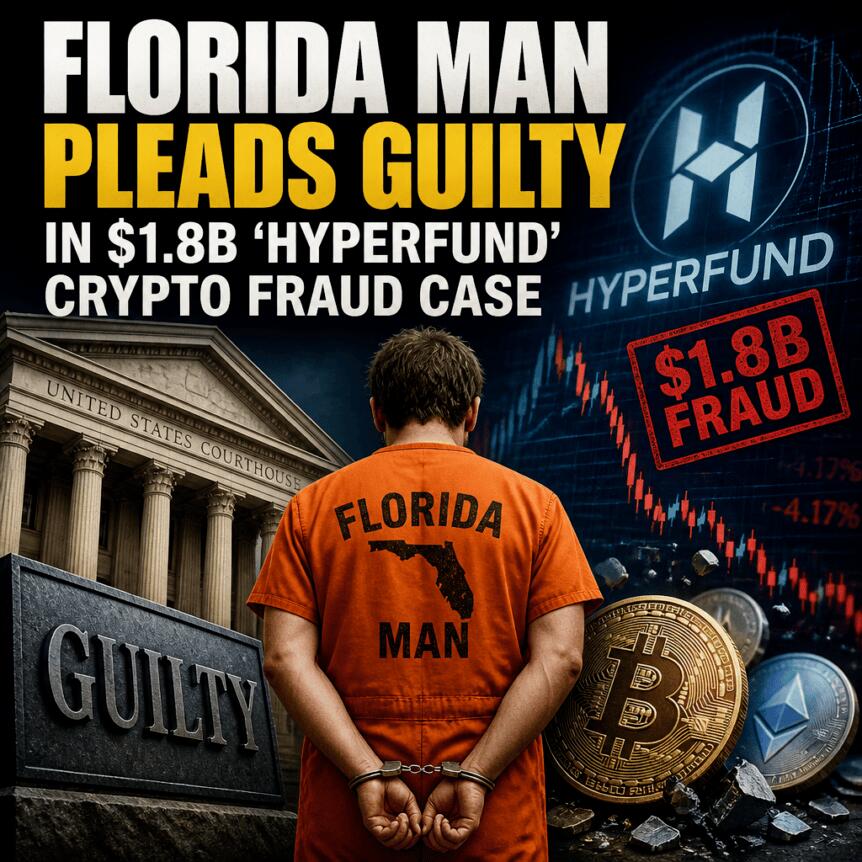
A Florida man known in crypto circles as “Bitcoin Rodney” has pleaded guilty to participating in a large fraudulent crypto scheme tied to HyperFund, according to the U.S. Department of Justice. Rodney Burton entered the plea in federal court in connection with an alleged conspiracy to operate an unlicensed money-transmitting business used to promote the platform.
Prosecutors said Burton helped provide unlicensed money-transmitting services to advance HyperFund, described as a global wire-fraud operation that affected thousands of investors. The U.S. Attorney’s Office for the District of Maryland said the guilty plea was announced by U.S. Attorney Kelly O. Hayes, along with agents from the Washington Internal Revenue Service Criminal Investigation unit and Homeland Security Investigations, New York.
Key takeaways
- Rodney “Bitcoin Rodney” Burton pleaded guilty to conspiracy involving an unlicensed money-transmitting business connected to HyperFund.
- Prosecutors allege HyperFund promised investors daily returns while purportedly lacking the mining revenue used to justify payouts.
- Burton is accused of promoting the scheme using investor funds to enrich himself between June 2020 and January 2022.
- HyperFund’s collapse in November 2022 followed multiple rebrands, including a DeFi ecosystem relaunch as HyperFund.
- Burton faces up to five years in federal prison; sentencing is scheduled for July 23.
Guilty plea tied to unlicensed money transmission
In the government’s account, Burton conspired to provide money-transmitting services without the required authorization, which prosecutors framed as a mechanism used to facilitate HyperFund’s broader fraud. The statement from the U.S. Attorney’s Office for the District of Maryland emphasizes that Burton’s role was not limited to marketing—federal prosecutors describe his conduct as part of the infrastructure used to support the operation.
According to the DOJ announcement, Burton promoted HyperFund and used investor funds during the period from June 2020 to January 2022. Prosecutors also stated that Burton controlled multiple companies that were represented as consulting-related entities, and that he personally received at least $7.8 million in proceeds from the scheme.
The case adds another layer to the government’s ongoing focus on fraud networks that use financial rails—especially those operating without appropriate licensing or oversight. While crypto fraud prosecutions often center on misrepresentations to investors, this matter also targets how money moved through the scheme.
HyperFund’s claimed returns and alleged fake mining revenue
Prosecutors said HyperFund falsely promised investors daily passive returns ranging from 0.5% to 1%. Federal authorities alleged that the platform claimed those payouts came from cryptocurrency-mining revenue, even though prosecutors said the underlying revenue source did not exist as represented.
That mismatch—high-frequency returns supported by alleged income that investors could not verify—has been a common feature of many crypto investment scams. In this case, the government’s filing ties those promises to a broader wire-fraud scheme, with Burton’s activities presented as assisting the operation.
The DOJ described HyperFund as one of the largest crypto fraud schemes, indicating that it impacted thousands of investors. Earlier coverage by Cointelegraph has also grouped similar large collapses into the “Ponzi-style” category, including OneCoin (reported to have taken over $4 billion) and BitConnect (estimated to have caused more than $2 billion in investor losses), though those comparisons are drawn from the wider historical pattern of fraud.
How HyperFund evolved—and why the timeline matters
HyperFund did not appear in the market as a single static product. Prosecutors said HyperCapital launched in January 2022 as a DeFi ecosystem and was later relaunched six months afterward as HyperFund. After additional rebrands, federal authorities said the scheme collapsed in November 2022.
For investors and compliance professionals, rebranding can matter because it can signal an attempt to reset reputational risk, change marketing language, or adjust the narrative as scrutiny increases. In HyperFund’s case, the government’s timeline suggests the operation continued through multiple iterations until it ultimately unraveled.
Earlier in the case, federal prosecutors in Maryland announced charges in January 2024 against two other individuals connected to the alleged scheme. The DOJ announcement said the defendants were Sam Lee, an alleged co-founder, and Brenda Chunga.
Other defendants and sentencing outlook
According to the U.S. Attorney’s Office for the District of Maryland, Lee, a 35-year-old Australian, and Chunga of Maryland were charged with conspiracy to commit securities fraud and wire fraud. Prosecutors said Chunga’s sentencing has been delayed multiple times and is currently scheduled for June 29. Lee, according to the DOJ statement, had not been found guilty at the time of the announcement.
Burton, meanwhile, faces a maximum sentence of five years in federal prison for conspiracy to operate an unlicensed money transmitting business. The government states sentencing is scheduled for July 23, following Burton’s guilty plea.
For readers watching crypto enforcement, the case underscores that authorities are pursuing not only the “front-facing” marketing of fraudulent platforms but also the financial and corporate mechanisms they used to operate. As proceedings continue against other alleged participants, the details of how funds were moved—and how the promised returns were financed—may further clarify the alleged mechanics of HyperFund.
Next, investigators and prosecutors will likely focus on how the scheme’s money flows worked in practice and whether additional participants or entities remain tied to the operation—points that could become clearer as Burton’s sentencing approaches and related court proceedings move forward.