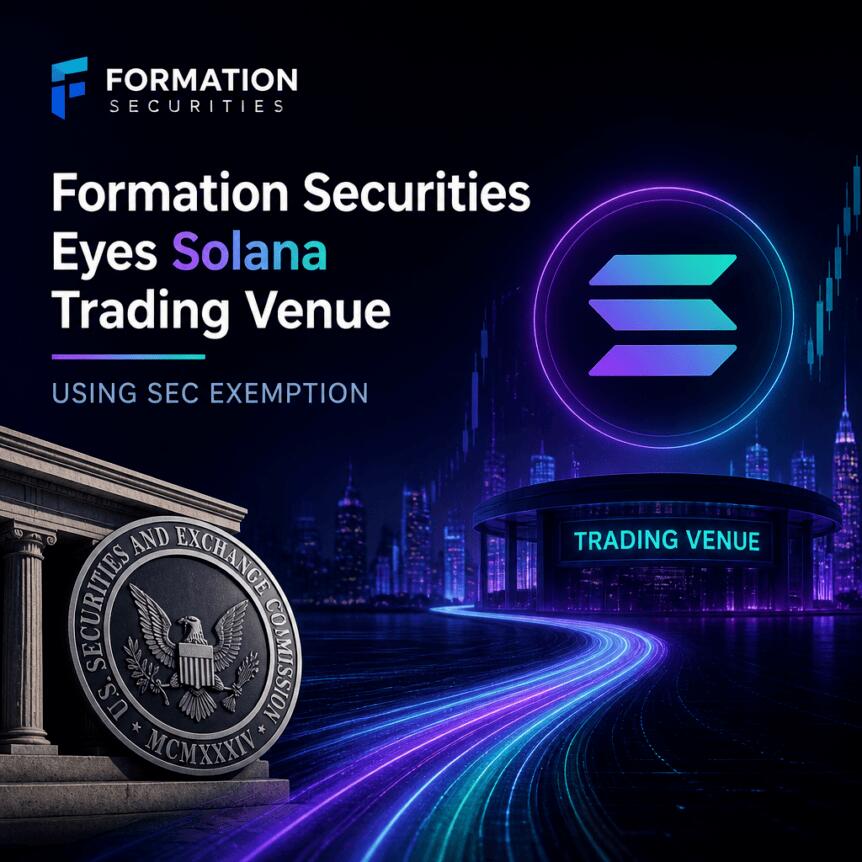
Formation Securities, a newly formed firm built around technology licensed from decentralized exchange Orca, has informed the US Securities and Exchange Commission (SEC) of plans to launch a tokenized-stock trading venue on Solana in early 2027. The company says the platform would start with tokenized shares of Galaxy Digital, Exodus Movement, and Forward Industries.
In its notification to the regulator, Formation Securities points to the SEC’s “Innovation Exemption,” a temporary framework announced in September that is designed to let verified investors trade certain US-listed shares in an alternative venue while preserving core shareholder rights such as voting and entitlement to dividends. If approved to proceed, the venue would rely on onchain mechanics—including automated market maker (AMM) functionality—while using stablecoins and other eligible assets for settlement.
Key takeaways
- Formation Securities says it plans to launch a tokenized securities trading venue on Solana in early 2027.
- The initial marketplace would include tokenized shares from Galaxy Digital, Exodus Movement, and Forward Industries, according to the firm.
- The SEC’s Innovation Exemption, announced in September, would allow verified investors to trade certain US-listed shares around the clock while retaining shareholder rights.
- Formation says the venue would use AMM technology and aim for onchain settlement, with traditional transfer agents continuing to maintain official shareholder records.
- Regulatory timelines under the exemption include a 30-day post-notification window for issuers to object before third-party tokenized shares can be traded.
A Solana-first venue built for onchain settlement
Formation Securities’ proposal centers on using Solana as the underlying blockchain for a tokenized equities venue. The firm says it has licensed technology from Orca, a decentralized exchange, as part of its approach to bringing securities trading mechanics onchain.
According to Formation Securities’ SEC filing notification, tokenized shares would be available at launch from multiple issuers—specifically Galaxy Digital, Exodus Movement, and Forward Industries. The company also expects other market participants to contribute tokenized assets, noting that Superstate and Securitize are anticipated to make tokenized shares available on the marketplace.
Mechanically, Formation describes a structure where investors could hold securities in their own wallets. Trades would then settle onchain using stablecoins and other eligible settlement assets, while the transfer-agent layer remains offchain in the sense that traditional transfer agents would continue to maintain official shareholder records. The goal, as framed by Formation, is to preserve companies’ direct relationships with shareholders even as trading becomes more automated and potentially available around the clock.
The SEC’s Innovation Exemption and the issuer notification window
The planned venue would operate under the SEC’s temporary Innovation Exemption. The exemption—announced by the SEC in September—seeks to enable testing of tokenized securities trading in a controlled way, including requirements tied to investor eligibility and notification procedures for issuers.
Formation’s approach matters in part because the exemption includes a defined process for issuer involvement. Under the framework, trading venues must notify issuers in writing and wait at least 30 calendar days before trading tokenized shares issued by unaffiliated third parties. That waiting period provides companies with a structured opportunity to raise objections.
Nasdaq previously cautioned in September that tokenized stock trading could carry unforeseen consequences, including effects on liquidity, price discovery, and long-term shareholder value. That warning underscores why the 30-day window is more than a formality for issuers: it is the point where concerns can be formally surfaced before trading begins.
Growing friction around tokenized shares
Formation Securities’ issuer-facing model is emerging during a period of heightened debate over how publicly traded shares should be represented and traded using blockchain infrastructure. As of early November, more than 50 companies had objected to having their shares tokenized on OKXICE, a proposed venue backed by crypto exchange OKX and New York Stock Exchange parent Intercontinental Exchange, according to earlier coverage by Cointelegraph.
The accumulation of objections suggests that tokenized securities are not just a technical question; it is also a corporate governance and market-structure issue for public companies. The core tension is how tokenization affects trading quality, shareholder experience, and the ways liquidity and price discovery may shift once shares can be transferred and settled onchain rather than solely through traditional market plumbing.
Formation’s emphasis on maintaining transfer-agent recordkeeping appears designed to directly address at least one aspect of that tension: ensuring the official ledger and corporate relationship structures remain intact even if the trading layer moves onchain.
Why Solana’s equity token footprint is attracting attention
Formation’s move also lands in a market where Solana already has meaningful traction in tokenized equities. According to RWA.xyz data cited in the announcement, tokenized stock value on Solana is approximately $575 million as of Monday. For comparison, the same dataset shows roughly $747 million on Ethereum and $1.7 billion on BNB Chain.
Those figures highlight a broader industry pattern: tokenized securities activity is concentrated on a handful of chains with strong onchain liquidity and active infrastructure. A Solana venue could therefore benefit from existing ecosystem momentum, including demand for tokenized assets and the availability of onchain settlement rails.
Still, the shift from “tokenized stock value” to a fully functioning SEC-regulated trading venue is not automatic. The Innovation Exemption process includes specific checks—particularly around investor verification and issuer notification—and issuer objections remain a key variable that could affect deployment timelines and the range of tokenized assets available when trading opens.
Investors, token holders, and issuers watching this development should focus on two things next: whether Formation’s SEC notification process proceeds without material friction from affected companies, and how the venue’s planned onchain AMM trading and settlement model performs in practice under the exemption’s constraints. With tokenized equities still working through regulatory and corporate concerns, each new venue filing is a real test of whether the market can scale without undermining traditional shareholder protections.