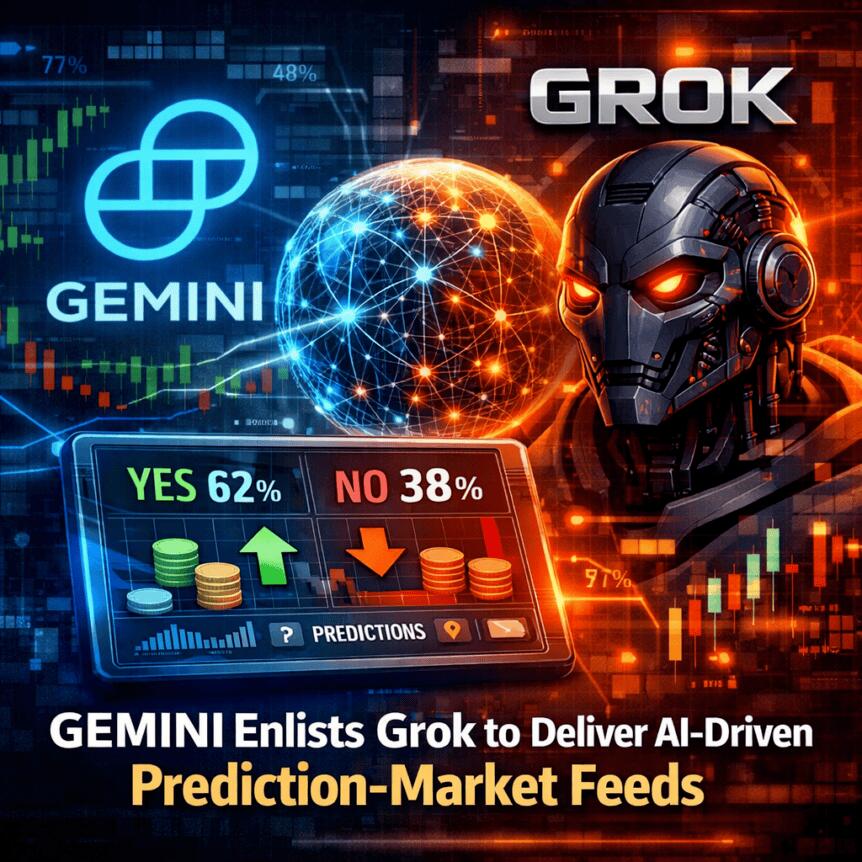
Gemini is expanding its use of artificial intelligence to power its prediction markets platform, unveiling an AI-driven feature called Command Center. The tool, built in partnership with SpaceXAI’s Grok, curates personalized feeds for users by surfacing markets based on open positions and watchlists across crypto, sports, commodities, politics, economics, and culture. Gemini described Command Center as a way to meet users where they are, rather than forcing them to sift through social feeds for relevant events.
The Command Center is powered by Grok, an AI model developed by SpaceXAI, a division of Elon Musk’s SpaceX that also operates the social platform X. The integration marks another step in a broader industry push to blend prediction markets with AI-driven discovery as crypto volumes remain pressured by a sluggish market cycle.
Gemini’s move comes amid a wider shift among crypto venues toward diversified services beyond spot and derivatives trading. In recent weeks, Gemini rolled out a feature that enables users to connect AI models such as ChatGPT and Claude to their trading accounts, allowing the system to monitor markets and even execute trades autonomously on behalf of users.
Key takeaways
- Gemini launches Command Center, an AI-powered feed that personalizes prediction-market content using Grok from SpaceXAI.
- The tool surfaces markets across multiple domains based on users’ positions and watchlists, reducing the need to chase information in social feeds.
- In the latest quarterly results, Gemini’s prediction markets generated $400,000 in revenue from about 20,000 users, as the company grows beyond crypto-native trading.
- Overall quarterly revenue rose 42% year-on-year to $50.3 million, while net loss narrowed to $109 million, down 27% annually, signaling a narrowing but still sizable loss as the firm expands services.
Gemini’s AI-driven push expands beyond simple trading
Gemini framed Command Center as a way to surface intelligence most likely to inform users’ next move, tailored to their open positions, watchlists, and past prediction activity. By indexing a broad swath of markets—from digital assets to athletics and culture—the feature aims to help traders and casual users alike identify opportunities they may have missed in a crowded information landscape.
The integration with Grok indicates a continued appetite among crypto platforms to embed AI that can interpret user context and deliver relevant signals. This follows Gemini’s recent announcement that users can connect AI models to their accounts to monitor markets and automate certain trading actions, a capability that could redefine how retail and professional traders interact with volatile markets.
Financial snapshot: prediction markets gain traction, but still lag leaders
Gemini’s quarterly results highlight a bifurcated landscape for crypto companies broadening into prediction markets. The firm reported that its prediction markets platform brought in $400,000 in revenue from roughly 20,000 users in the quarter. While this is a meaningful milestone for a platform within a larger, crypto-focused exchange, it remains a fraction of the activity seen on market leaders Kalshi and Polymarket, which have outsized volumes and participation in the sector.
On the company-wide level, Gemini disclosed total revenue of $50.3 million for the quarter, up 42% year over year. The firm also narrowed its net loss to $109 million, a 27% improvement versus the prior year. The numbers illustrate a company in transition: expanding from a crypto-centric trading venue into a broader financial services provider with AI-assisted prediction markets and related tooling.
The broader market backdrop underscores why Gemini and peers are pursuing diversification. A combination of reduced trading volumes and tight margins in traditional crypto trading has pushed several exchanges to explore new revenue streams, including prediction markets, AI-assisted services, and non-spot offerings. In this environment, platforms that can deliver unique, user-centric AI features while maintaining regulatory and risk controls may differentiate themselves from competitors.
Related coverage in the crypto press has also highlighted regulatory scrutiny surrounding Gemini’s broader operations, including moves by the U.S. Commodity Futures Trading Commission regarding settlements. The ongoing regulatory discourse adds a layer of complexity for exchanges venturing into prediction markets and AI-enabled trading tools, shaping what products can be offered and under what terms.
What to watch next
As Gemini expands its AI-enabled feature set, observers will watch user adoption of Command Center and the extent to which it drives engagement in prediction markets. The pace at which traders embrace automated AI-assisted trading and personalized market feeds could influence future revenues in the segment and shape competitive dynamics with Kalshi, Polymarket, and other prediction-market operators. Regulatory developments will also be a key tailwind or headwind for broader rollout, depending on how policymakers balance risk, consumer protection, and market liquidity.