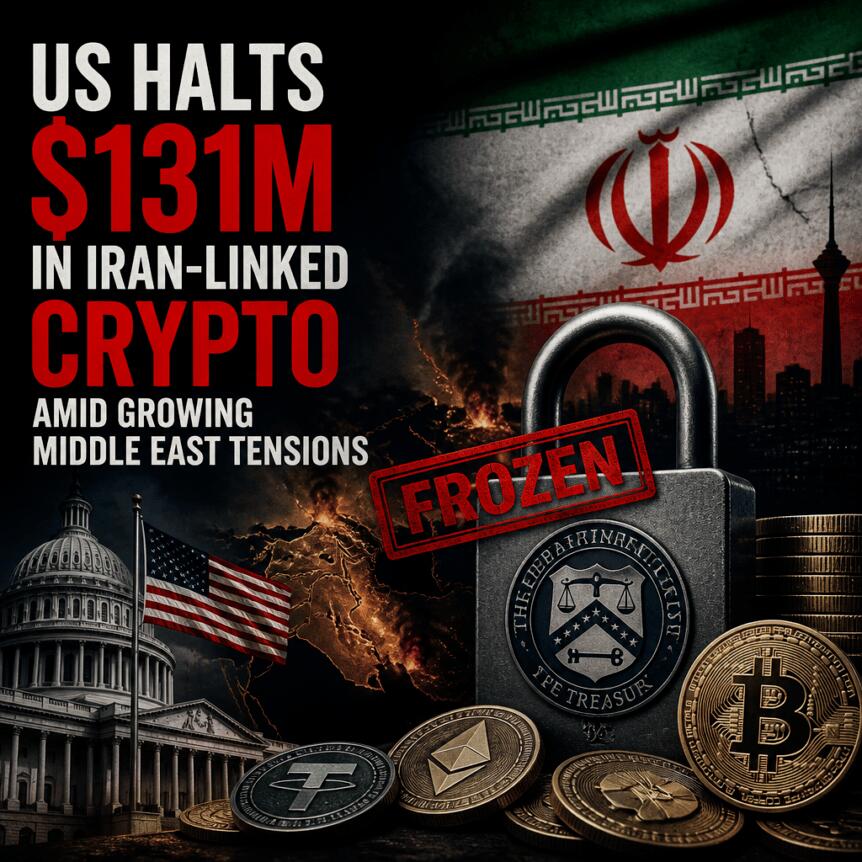
The U.S. Treasury has ordered the freezing of more than $130 million in cryptocurrency linked to Iran, as tensions between the two countries have escalated. On Tuesday, Treasury Secretary Scott Bessent confirmed the action is part of a broader effort to disrupt Iran’s access to proceeds from illicit activity, including through digital assets.
The development comes shortly after blockchain investigator Specter highlighted on-chain activity indicating that Tether had frozen four Tron wallets containing $131 million worth of USDt (USDT). Bessent said the wallets are tied to the Central Bank of Iran, naming the targeted addresses in an X post.
Key takeaways
- U.S. Treasury ordered the freezing of over $130 million in crypto held in wallets linked to Iran, according to Scott Bessent.
- On-chain investigator Specter connected the freeze to Tether’s action against four Tron wallets holding $131 million of USDT.
- Bessent linked the move to the wider U.S. push to restrict Iranian access to illicit financial flows during renewed hostilities.
- The freeze follows a prior action in April, when Tether reported freezing more than $344 million in USDT at the request of U.S. authorities.
Treasury confirms a new freeze linked to Iran
Bessent confirmed on Tuesday that the U.S. government directed the freezing of cryptocurrency held in wallets “tied to the Central Bank of Iran.” He framed the measure as part of an ongoing U.S. strategy to “disrupt and degrade Iran’s illicit financial activities” and to prevent the Iranian regime from accessing proceeds tied to illicit revenue streams.
He also emphasized that the Treasury will continue to “aggressively follow the money,” signaling that additional asset-targeting actions could follow if more wallets are identified through investigations.
Earlier coverage referenced on-chain signals from Specter, which pointed to the specific USDT freeze activity. Specter’s analysis indicated that four Tron wallets were frozen after holding roughly $131 million in USDT, aligning with the figure Bessent cited regarding the U.S. order.
Why stablecoin freezes matter during renewed tensions
The Treasury action underscores how stablecoins, despite being designed to track fiat value, can still sit at the center of sanctions enforcement. When authorities identify addresses connected to sanctioned institutions or networks, freezes can limit the ability to move funds quickly—even if the assets are technically “tokenized” rather than held directly in traditional bank accounts.
In this case, the freeze is tied to hostilities and intensifying U.S.-Iran tensions. The U.S. said it renewed its blockade of Iranian ports, while Central Command announced a new wave of strikes on Iran. Iran’s military, in turn, claimed it carried out drone strikes against U.S. military facilities at Jordan’s Al Azraq Air Base.
That geopolitical backdrop helps explain the urgency of targeting digital assets. For sanctions planners, stablecoins can function as high-speed rails in attempts to move value across borders—making them a logical focus during periods when financial pressure is meant to disrupt procurement networks and operational funding.
A pattern in April and beyond
This is not the first time Tether-related freezing activity has been linked to U.S. sanctions against Iran. In April, Tether confirmed it had frozen more than $344 million in USDT at the request of U.S. authorities, described as an earlier wave of actions consistent with the same enforcement theme: using token controls to prevent access by designated entities.
Separately, Bessent previously said in May that the U.S. has seized around $1 billion in Iranian crypto assets as part of a broader pressure campaign against Iran known as Operation Economic Fury, which launched in March 2025. In a statement in June, Bessent described the operation as targeting foreign procurement networks that support the Iranian military’s efforts to acquire weapons.
Taken together, Tuesday’s reported freeze fits an established trajectory: U.S. authorities identify wallets, impose restrictions through sanctions processes, and then coordinate with market participants capable of freezing stablecoins tied to those addresses.
What to watch next: identification, enforcement, and transparency
For investors, traders, and builders, the practical question is less about whether USDT will “hold its value” and more about how sanctions compliance and wallet targeting continue to affect where stablecoins can flow. These freezes can quickly reduce the ability of certain wallets to access funds, and they can also influence how analysts and market participants assess wallet-level risks associated with regulated enforcement.
Going forward, readers should watch for whether additional Iranian-linked wallets are identified through on-chain investigations and whether further freezes are publicly confirmed by U.S. officials and stablecoin issuers. The key uncertainty remains how widely the freeze net expands—both in terms of the number of wallets and the total value affected—as U.S.-Iran tensions continue to evolve.