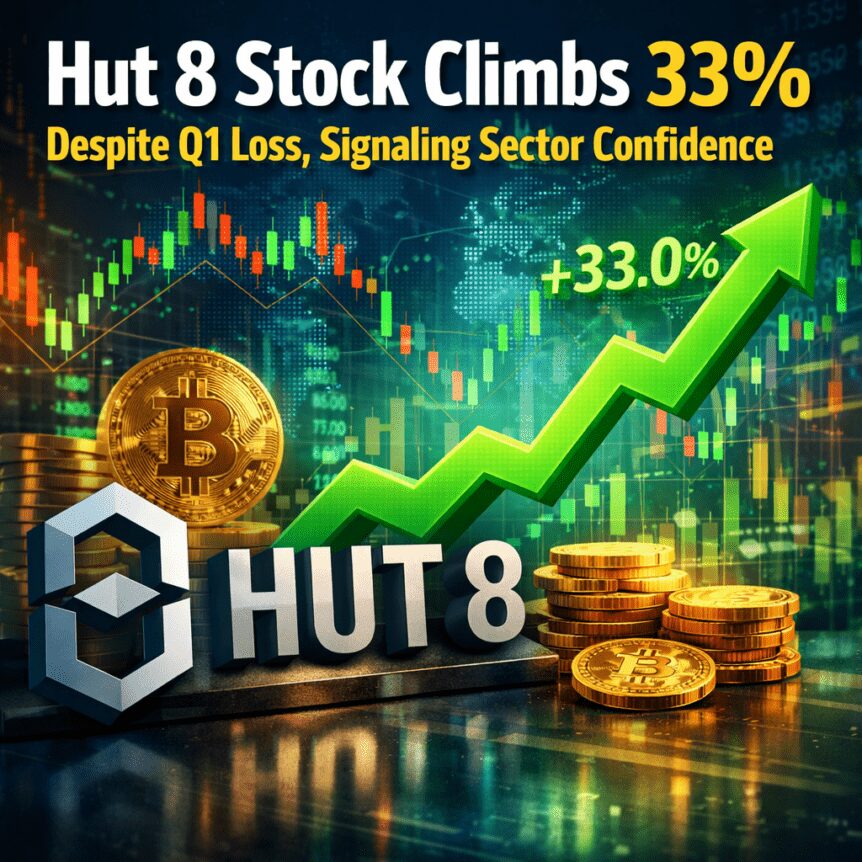
Hut 8 Mining Corp. is navigating a pivotal transition as its first-quarter 2026 results highlight both the volatility of Bitcoin prices and a bold strategic pivot toward AI infrastructure. The Canadian-listed miner reported a quarterly net loss of more than $253 million, driven largely by a write-down tied to the market value of its Bitcoin holdings, which tumbled from a high of roughly $126,000 in October to about $60,000 in February.
Revenue for the quarter came in at just over $71 million, down about 22% from the prior period’s $88.4 million. Analysts had expected around $78.5 million, according to FactSet. Hut 8 noted that $66.0 million of its Q1 revenue came from ASIC compute, AI cloud and traditional cloud solutions, underscoring the company’s ongoing diversification beyond pure crypto mining.
More notably, Hut 8 unveiled a landmark development: a $9.8 billion deal to lease 352 megawatts of capacity to a third-party AI company over 15 years. The arrangement positions Hut 8 to monetize large-scale compute capacity beyond Bitcoin mining and into AI hosting and related data-center operations. The company had earlier signaled progress in this direction with the commercialization of the first phase of its Beacon Point AI data-center campus, a 1 gigawatt project that includes the 352 MW lease footprint referenced in the agreement.
Key takeaways
- Hut 8’s Q1 2026 net loss exceeds $253 million, driven by a write-down reflecting the drop in Bitcoin’s market value from October highs to February lows.
- Quarterly revenue stands at $71 million, down roughly 22% from the prior quarter’s $88.4 million; analysts’ consensus stood at about $78.5 million.
- The company disclosed a $9.8 billion, 15-year lease to supply 352 MW to an AI-focused data-center operator, signaling a major strategic pivot toward AI hosting and energy infrastructure.
- Hut 8’s shift mirrors a broader industry trend as crypto miners diversify into AI workloads, energy projects, and scalable data-center ventures to offset traditional mining headwinds.
- Industry dynamics surrounding electricity pricing and energy supply are intensifying competition between AI infrastructure and Bitcoin mining, with implications for network security and grid demand.
Hut 8’s quarterly numbers: the price of BTC and the pull of AI
Hut 8 attributes its sizeable quarterly loss to the revaluation of its Bitcoin holdings. The company noted that BTC prices have swung dramatically since last fall, trading above $126,000 at their peak and sliding toward the $60,000 region by February. In crypto markets, such mark-to-market adjustments can dwarf operating cash flows, especially for miners with significant BTC inventories and holdings. Hut 8’s management described the loss as a market-value write-down tied to the company’s Bitcoin exposure, a reminder of how sensitive mining operators remain to the coin’s price trajectory.
Despite the headwinds from Bitcoin’s price moves, Hut 8 reported that its revenue mix in Q1 still reflected a meaningful contribution from non-mining activities. The company said it generated $66.0 million in revenue from ASIC compute, AI cloud and traditional cloud solutions, contributing to a total quarterly revenue of just over $71 million. The juxtaposition of a high-profile impairment with a growing AI and cloud services footprint illustrates the company’s attempt to diversify a business model exposed to crypto cycles.
Market expectations, meanwhile, framed Hut 8’s results in a context of caution. FactSet consensus pointed to roughly $78.5 million in Q1 revenue, suggesting investors were looking for resilience despite BTC volatility. Hut 8’s management acknowledged the miss against consensus while emphasizing the strategic importance of the AI and data-center initiatives as the company navigates a shifting industry landscape.
Strategic pivot: a $9.8 billion lease and a new future
The centerpiece of Hut 8’s 2026 strategic pivot is the long-term lease arrangement for 352 MW of capacity, part of a broader plan to monetize substantial, scalable compute capacity beyond traditional mining operations. The $9.8 billion deal spans 15 years and is designed to anchor a third-party AI company’s data-center needs, effectively transforming a portion of Hut 8’s asset base into an AI-hosting platform. This move aligns with Hut 8’s earlier disclosures about advancing the Beacon Point AI data-center campus—an ambitious, multi-phase project designed to support hyperscale AI workloads while leveraging Hut 8’s existing infrastructure and energy relationships.
Analysts and industry observers have noted that AI infrastructure commands higher value per megawatt than traditional crypto mining, a dynamic that can reshape the economics of large-scale data centers. As Hut 8 reorients its business model toward AI hosting, the company will face new operating considerations, including long-term power purchase commitments, reliability of energy supply, and the ability to scale AI-friendly data-center services while managing legacy mining operations.
The broader market backdrop for this pivot is not unique to Hut 8. The crypto-mining sector has faced sustained pressure from rising energy costs, market volatility, and regulatory scrutiny, prompting several operators to diversify into AI and other high-performance computing (HPC) ventures. Cointelegraph has repeatedly highlighted this trend, noting that several miners are refocusing on AI-hardware deployments and energy infrastructure to sustain growth in a landscape where pure mining margins have eroded. The industry’s shift toward AI-hosting and related data-center partnerships reflects a pragmatic response to a structurally changing energy and compute market.
In parallel, observers point to the intensifying competition for electricity between AI hyperscalers and Bitcoin miners. Crypto trader and market analyst Ran Neuner has framed the dynamic as a race for a scarce resource: power. “Both industries compete for the same thing: electricity,” Neuner said, noting that AI workloads are currently willing to pay higher prices for capacity. Estimates floated by Neuner put mining margins at lower per-MW rates compared with AI hosting, underscoring why some miners are pursuing AI-centric business lines to sustain profitability.
These energy-market dynamics are not happening in a vacuum. Since 2024, major AI and cloud players—Google, Microsoft, Amazon, and Meta—have signaled a growing appetite for nuclear-energy-backed power to sustain their AI infrastructure. The trend points to a broader energy strategy among hyperscalers and a potential reshaping of power-market demand as AI workloads scale. Cointelegraph has traced related developments, including coverage of AI-focused data-center expansions and energy procurement strategies that intersect with crypto-mining footprints.
What this means for investors, users, and the sector
Hut 8’s earnings trajectory underscores a key tension facing publicly traded miners: a need to balance capital-intensive mining operations with enduring value from diversified compute workloads. The $9.8 billion, 15-year lease represents not just a new revenue line, but a strategic bet on AI hosting as a durable driver of cash flow in an environment where mining economics can be cyclical and highly sensitive to BTC price movements. For investors, the question is how quickly and efficiently Hut 8 can translate this strategic pivot into meaningful, recurring profits while managing the transition from a pure mining model to a hybrid AI-and-mining platform.
From a market perspective, the shift raises several watch points. First, how will Hut 8 balance debt, capital expenditure, and lease obligations with ongoing mining operations? Second, does the AI-hosting business model deliver reliable, long-term returns in the face of potential regulatory, grid, or energy-price shocks? And third, how will the broader energy market respond as more data centers compete for power, particularly if AI demand accelerates beyond initial projections? These questions will shape Hut 8’s next earnings cycles and could influence investor sentiment across the broader mining sector, where several peers are weighing similar moves into AI and energy infrastructure.
For users and builders, the development signals a growing convergence between crypto infrastructure and mainstream compute ecosystems. If Hut 8’s AI data-center strategy proves resilient, it could catalyze more partnerships that blend mining facilities with AI hosting capabilities, potentially creating new pathways for energy efficiency, grid resilience, and technology deployment at scale. And as the energy landscape evolves—with nuclear-backed power and large-scale HPC demands rising—the industry’s appetite for stable, long-horizon power agreements could reshape how crypto miners approach site selection, energy contracts, and environmental considerations.
Readers should keep an eye on Hut 8’s upcoming disclosures for updates on the lease execution, cash flow implications, and the progression of Beacon Point’s phased development. The balance between a recovering BTC price, the economics of AI hosting, and evolving energy-supply arrangements will likely determine whether the company can turn this strategic pivot into durable profitability in a market that remains highly dynamic.