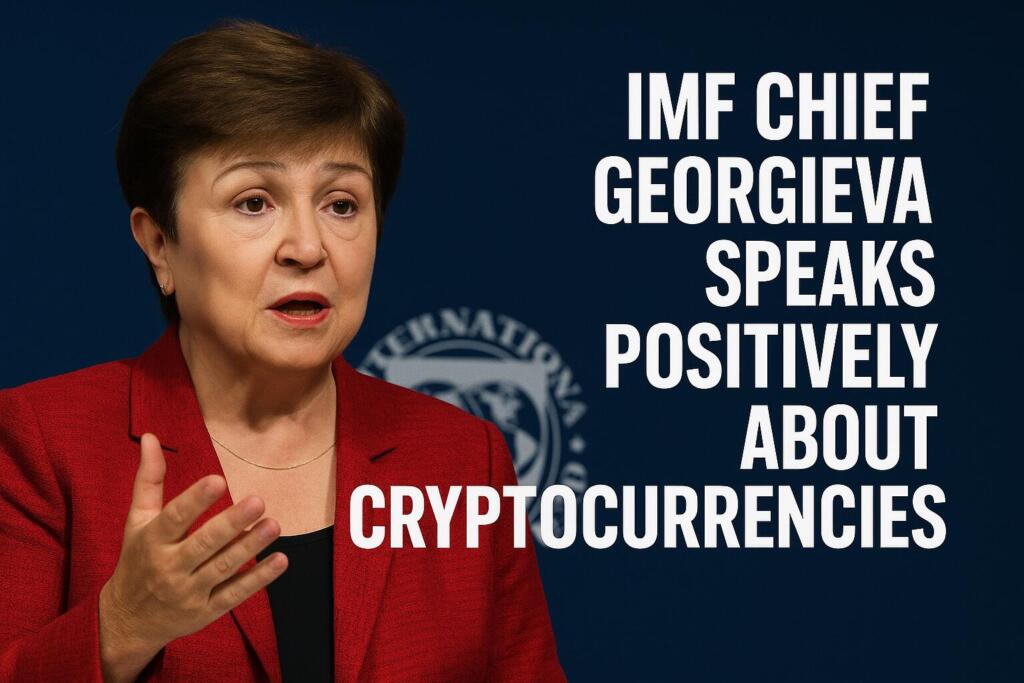
The head of the International Monetary Fund (IMF), Kristalina Georgieva, has delivered one of her most forward-thinking remarks yet on cryptocurrencies, urging nations to “accept the reality” of digital assets and adapt their financial systems rather than resist them. Her comments mark a turning point in how global institutions view crypto, no longer as a fringe technology, but as an inevitable part of the financial future.
Key Takeaways
- IMF Managing Director Kristalina Georgieva called on countries to embrace digital currencies and adapt to crypto’s rapid evolution.
- The IMF warned central banks to remain independent and avoid excessive monetary easing that could inflate risky asset prices.
- Growing links between banks and unregulated institutions, including crypto markets, could amplify financial shocks, the IMF said.
- Georgieva’s remarks signal that the world’s financial establishment now sees digital money as a permanent part of global finance.
The IMF’s New Stance on Digital Assets
Speaking publicly this week, Georgieva acknowledged that “fiat money is going digital” and encouraged governments to adapt quickly. She emphasized that financial systems must learn to manage the risks of crypto innovation instead of denying its growth. For years, institutions such as the IMF treated crypto as an experiment or a speculative threat. Now, the tone has shifted toward constructive integration.
“We must accept the reality that digital assets are here to stay. Financial systems must adapt, not resist,” Georgieva said during her recent remarks.
The IMF also reiterated that central bank independence remains crucial to maintaining credibility and market balance. It warned against over-easing monetary policy, which could lead to inflated prices in riskier markets, including crypto assets. At the same time, the IMF urged policymakers to monitor the “hidden risks” arising from growing ties between traditional banks and non-bank financial entities, particularly those operating in the digital asset space.
A Global Shift in Monetary Thinking
Georgieva’s message aligns with the growing consensus that the digital transformation of money is now irreversible. As the IMF refocuses its attention on the structure of modern finance, it appears to be recognizing the deeper architectural change taking place: the move from institution-driven systems to open, network-based infrastructures built on blockchain technology.
Her statement also comes amid rising discussions about central bank digital currencies (CBDCs), stablecoins, and decentralized finance (DeFi), all reshaping how value moves across borders and how trust is established in financial systems.
Public Reactions and Official Statement
Georgieva’s message was echoed across social media, where she shared clips from her address and highlighted the IMF’s evolving approach toward digital currencies.
The future of finance is undeniably digital. Blockchain and stablecoins are growing fast—but so are risks like fragmentation. We need agility, trust, and global cooperation to harness opportunities while safeguarding stability.
Watch the discussion here: https://t.co/subohGztHo pic.twitter.com/ftZl6QyY7i— Kristalina Georgieva (@KGeorgieva) October 14, 2025
The End of Denial
As noted by several industry leaders, this moment represents “the end of denial.” The IMF, long a cautious observer, now acknowledges that the financial world has already shifted. Digital money is no longer a question of if, but how. For investors, developers, and policymakers, the message is clear: the rails of the global economy are being rebuilt, and those who adapt fastest will define the future of finance.