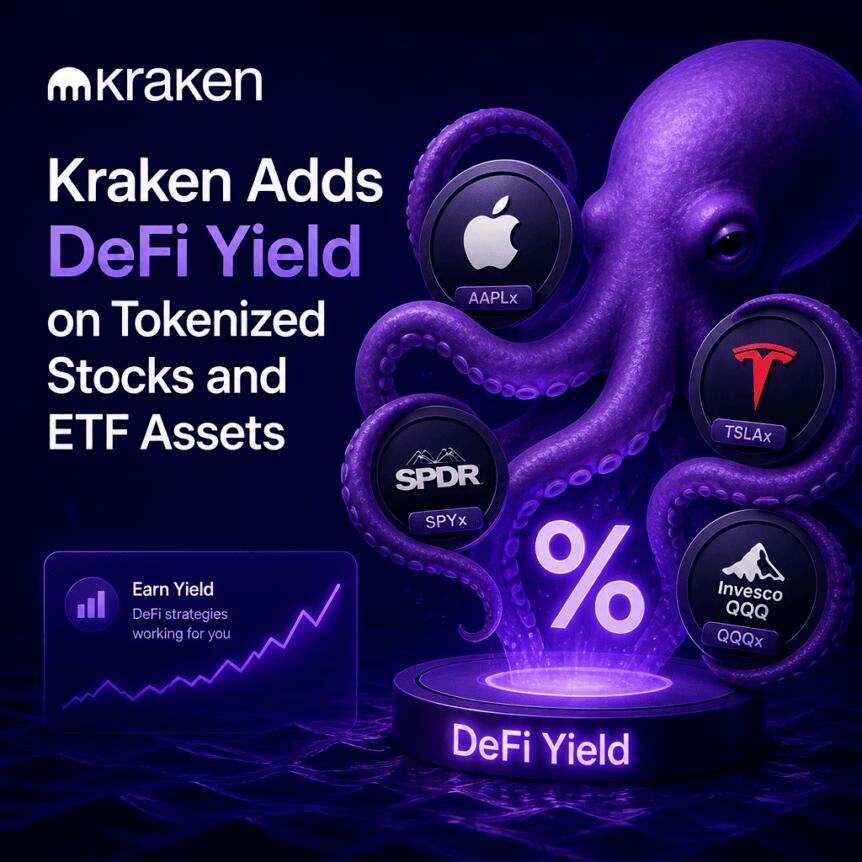
Kraken has rolled out new onchain yield vaults that let eligible customers earn returns on tokenized stocks and exchange-traded funds (ETFs). The exchange says its xStocks vaults will lend deposited assets through decentralized finance (DeFi) protocols, distributing the resulting yield to users in the form of additional xStocks.
In a Monday announcement, Kraken specified that the first xStocks vaults support tokenized versions of the SPDR S&P 500 ETF (SPYx), the Invesco QQQ ETF (QQQx), and Nvidia (NVDAx). Withdrawal requests are processed within three days, while yield is paid in the deposited tokens.
Key takeaways
- Kraken’s xStocks vaults generate yield by lending tokenized equities and ETFs through DeFi markets.
- Supported assets include SPYx, QQQx, and NVDAx, with yield paid in the deposited xStocks.
- Kraken says vault withdrawals are handled on a three-day processing timeline.
- The vaults build on the infrastructure of Kraken DeFi Earn, launched in January and reported to have attracted over $800 million in deposits.
- Availability is limited: xStocks vaults are offered in the European Economic Area and certain other jurisdictions, but excluded in the US, UK, Canada, Australia, and the United Arab Emirates.
How Kraken’s xStocks vaults work
Kraken’s new vaults are designed to convert tokenized equity exposure into an income-generating strategy. Customers deposit supported xStocks, and the assets are then lent out via onchain lending venues, with returns generated by the borrowing activity within those markets.
According to Kraken, this structure mirrors its existing Kraken DeFi Earn program, which launched in January. Kraken said DeFi Earn has since gathered more than $800 million in deposits, positioning xStocks as an extension of that approach into the tokenized equities category.
Withdrawals, Kraken added, are processed within three days. For investors, this detail matters because tokenized-assets yield products often differ not only by yield method, but also by the operational cadence of redemption.
DeFi strategy design, onchain execution
Kraken says the xStocks vaults are powered by Veda. The company also named Sentora as the team designing and managing the lending strategies used to produce yield.
On execution details, Kraken said assets are lent through DeFi markets such as Kamino on Solana. Sentora is responsible for setting exposure limits and monitoring key conditions including collateral, liquidity, and oracle inputs—factors that typically influence the safety and performance of lending-based strategies.
While Kraken did not outline further specifics in the announcement, the combination of a platform (Veda) and a strategy manager (Sentora) signals a separation between custody/deposit handling and the dynamic risk management layer that determines how the vaults interact with DeFi lending venues.
Broader momentum in tokenized equities
Kraken’s move lands as tokenized stocks and ETFs continue to accelerate. RWA.xyz data cited by Kraken shows the distributed value of tokenized equities has risen to about $2.84 billion, up from roughly $540 million a year earlier.
That jump highlights the shift from early-stage experimentation toward a larger, more established market for tokenized financial instruments. It also helps explain why centralized exchanges and regulated firms are increasingly interested in wrapping tokenized assets into yield products: demand for tokenized exposure is rising, and the next logical step for many platforms is to offer income generation rather than passive holding alone.
However, the economics of these products can vary significantly. In Kraken’s model, the yield mechanism is lending through DeFi markets, meaning performance is tied to onchain borrowing activity and the vault’s risk controls—variables that are distinct from traditional equity dividends or fund distributions.
Where xStocks vaults are available—and where they aren’t
Kraken stated that the xStocks vaults are available to eligible Kraken clients in the European Economic Area and other markets, but they are excluded in the United States, United Kingdom, Canada, Australia, and the United Arab Emirates.
For users, these geographic constraints are often as important as the underlying product design. Tokenized equities have attracted heightened regulatory attention across jurisdictions, and exchange availability frequently reflects local licensing, investor eligibility rules, or how a product is classified.
In practice, this means European and select international clients may get earlier access to DeFi-linked yield on tokenized equities, while customers in excluded regions will need to wait for further regulatory clarity or product adjustments.
As Kraken expands xStocks, market participants will likely watch whether the vaults attract meaningful deposits beyond the existing DeFi Earn base, and how tokenized-equity liquidity and onchain lending demand evolve. The next question for investors is whether yield production remains consistent as tokenization grows—especially given the three-day redemption timeline and the reliance on DeFi lending conditions.