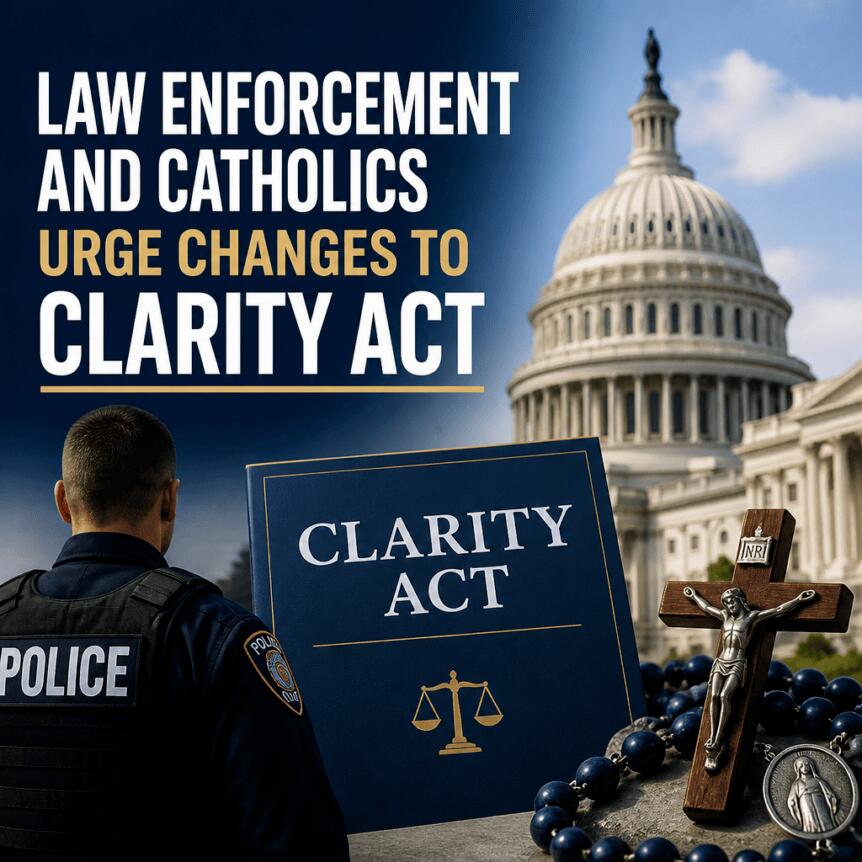
A set of U.S. law enforcement groups and a coalition of Catholic organizations have urged caution as the CLARITY Act (the Blockchain Regulatory Certainty Act, part of the broader legislation) advances toward a key House hearing scheduled for July 17. In separate letters sent this week to senior White House officials, the organizations argued that certain provisions—particularly Section 604—could unintentionally create oversight gaps affecting investigations into illicit financial activity.
The letters arrive as the bill continues its legislative path. The CLARITY Act cleared the Senate Banking Committee in May, reportedly with most Democrats voting against it, and the measure has faced pushback from parts of the banking sector that say it may enable crypto firms to offer stablecoin-related yields without the same regulatory treatment applied to traditional financial institutions. For compliance stakeholders, the central question is whether the legislation clarifies responsibilities—or narrows enforcement reach in ways that complicate AML and sanctions compliance.
Key takeaways
- Law enforcement groups warn that Section 604 could create “oversight gaps” that hinder probes into crimes including money laundering and other illicit activity.
- Human trafficking advocates contend that provisions in Section 604 may increase regulatory ambiguity, potentially making monitoring of abuse-related illicit finance more difficult.
- Crypto industry policy officials argue Section 604 narrowly prevents non-custodial software developers from being misclassified as money transmitters.
- The bill’s hearing on July 17 is expected to focus on whether the statute best balances regulatory certainty with accountability, AML/KYC alignment, and investigative authority.
Law enforcement letters to White House officials
According to the letters, four law enforcement organizations—including the National District Attorneys Association, the National Association of Assistant United States Attorneys, the International Association of Chiefs of Police, and the National Sheriffs’ Association—contacted acting Attorney General Todd Blanche and White House digital assets adviser Patrick Witt regarding the CLARITY Act’s likely operational impact on enforcement.
The groups stated that regulatory certainty for digital assets should not come at the expense of accountability, transparency, victim protection, or public safety. In their view, the specific design of Section 604 risks weakening longstanding compliance and investigative frameworks, including requirements connected to KYC and anti-money laundering (AML).
The law enforcement organizations’ concern focuses on how Section 604 treats certain categories of participants and activities. The provision addresses the regulatory framework for digital asset service providers and seeks to protect non-controlling developers, open-source contributors, self-custody tools, and certain decentralized finance (DeFi) infrastructure from being automatically classified as money transmitters.
The letters distinguish between writing or publishing software code—described as not the target of their criticism—and the scope of exemptions related to transactions they believe could interfere with criminal investigations. They argued that broad exemptions may shield individuals or entities whose activity facilitates digital-asset movement, creating obstacles to oversight and weakening investigative authorities used by law enforcement.
“Our concern is with broad exemptions that may shield individuals or entities whose activities facilitate the movement of digital assets, create obstacles to legitimate oversight, or weaken longstanding investigative and enforcement authorities relied upon by law enforcement.”
Section 604’s scope contested: enforcement risk vs. misclassification prevention
In response to the law enforcement objections, Lindsay Fraser, chief policy officer at the Blockchain Association, said the letters reflect a misunderstanding of what Section 604 accomplishes. She characterized the provision as doing a limited, technical job: ensuring that non-custodial software developers are not misclassified as money transmitters when they do not custody assets or control transactions.
“It does not immunize criminals. It does not limit sanctions enforcement. It does not stop prosecutions for money laundering, fraud, or terrorist financing.”
For compliance and legal teams, the dispute underscores a practical policy challenge: how lawmakers should calibrate liability and regulatory status for participants across the digital-asset stack. Section 604 is designed to provide clearer boundaries for developers and infrastructure contributors, but critics worry that real-world illicit finance frequently relies on networks where the line between “developer,” “infrastructure,” and “facilitator” can be difficult to operationalize.
This is especially salient for institutions that must perform AML/KYC controls and evaluate counterparties under evolving U.S. expectations. If exemptions are interpreted too broadly, regulators and supervised entities may struggle to determine which actors remain subject to the same compliance obligations, potentially affecting monitoring coverage, suspicious activity reporting workflows, and sanctions-risk management.
Human trafficking coalition raises a rights-and-abuse lens
A separate letter from the Alliance to End Human Trafficking—founded by U.S. Catholic Sisters—told senators that Section 604 may create “broad carveouts and regulatory ambiguities” that could make it harder to responsibly monitor illicit financial activity tied to trafficking, organized crime, child exploitation, and other forms of abuse, including sanctions evasion.
The coalition’s framing places the bill within a broader compliance and human-rights context, asserting that financial-system design should be measured by its effectiveness in safeguarding human life and dignity, not only by innovation outcomes. That emphasis aligns with the perspective of victim-centered enforcement priorities, where investigators depend on clear obligations and predictable compliance duties to trace illicit proceeds.
“The test of any financial system is not simply whether it generates wealth or innovation, but whether it safeguards human life and dignity.”
In contrast, a key proponent of the CLARITY Act, Senator Cynthia Lummis, took an opposing view. She argued publicly that regulatory ambiguity harms builders and benefits criminals, and that the measure draws an important line: writing code is not money transmission. Her statements suggest the bill is intended to reduce legal uncertainty for legitimate developers while closing gaps she believes bad actors exploit.
Why the July hearing could matter for regulated entities
The House hearing scheduled for July 17 will likely focus on the same central tension raised in both letters: whether Section 604 appropriately narrows the definition of money transmission liability for non-custodial participants, or whether its exemptions expand in practice to the point that they complicate AML/KYC enforcement and related investigative authority.
While the debate is framed as a question of regulatory certainty, institutional impact will depend on how supervised firms and enforcement agencies interpret and operationalize the statutory language. The concerns raised by law enforcement organizations point to potential friction in illicit-activity probes, including the ability to pursue certain investigative pathways or obtain cooperation that relies on regulated status. Meanwhile, industry policy arguments emphasize that the bill is meant to prevent misclassification and reduce overreach toward software development and decentralized infrastructure.
Because digital-asset compliance regimes in the U.S. are also shaped by enforcement practice and interagency expectations—alongside parallel international approaches such as the EU’s MiCA framework—U.S. legislation that clarifies who counts as a covered “money transmitter” or analogous regulated actor can have cross-border ramifications. For example, the way exemptions are structured may affect how firms design compliance programs for U.S. users, assess jurisdictional risk, and document governance responsibilities for technology providers.
Unresolved issues remain: the exact boundaries of “non-controlling” developers, how “self-custody tools” and DeFi infrastructure are treated under real enforcement scenarios, and whether the legal certainty promised by the bill will translate into consistent compliance obligations for institutions that must detect, prevent, and report financial crime.
Closing perspective
As the CLARITY Act approaches its July 17 House hearing, the most consequential question for compliance and legal stakeholders is how Section 604 will be interpreted in practice—especially regarding the line between non-custodial technical contribution and activity that can be viewed as facilitating transactions. The outcome could influence how firms operationalize AML/KYC controls and how regulators assess responsibility across the digital-asset ecosystem.