Centralized exchanges still sit at the center of crypto trading. They aggregate liquidity, simplify onboarding, support major assets, and give users a familiar interface for moving between fiat, Ethereum, stablecoins, and other supported digital assets.
But the market has become more cautious about custody.
For many traders, the question is no longer whether centralized exchanges are useful. They clearly are. The real question is whether every trade, deposit, withdrawal, and fiat conversion should depend on a custodial account controlled by one platform.
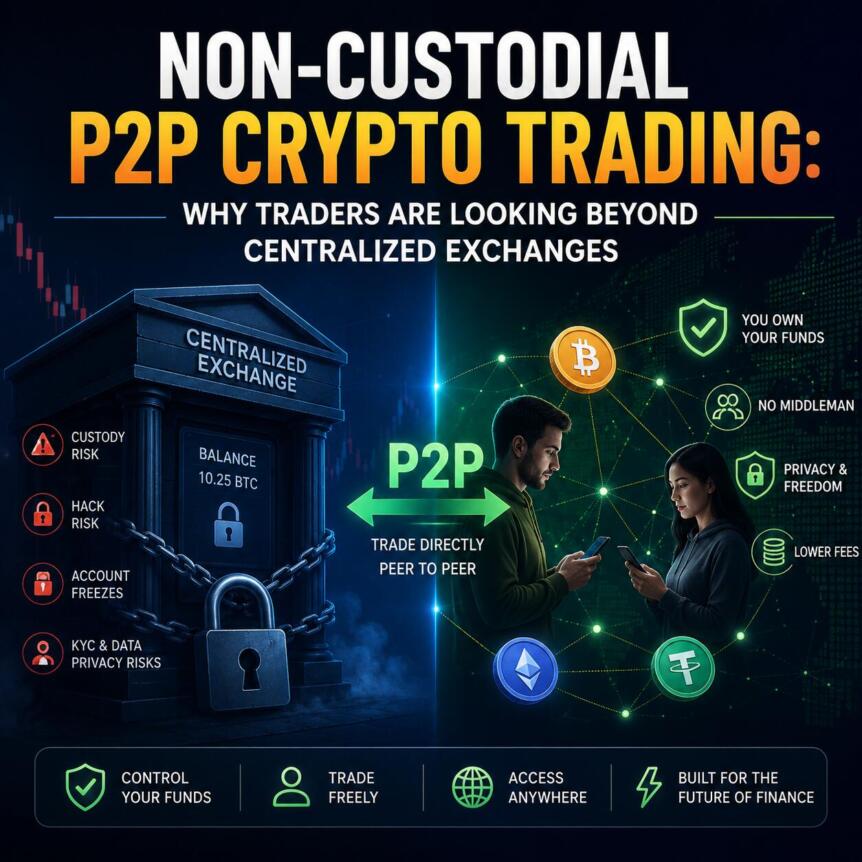
That shift is creating more interest in P2P trading models, especially those designed around user control and reduced platform custody. Non-custodial P2P crypto trading does not remove every risk, and it does not replace centralized exchanges across all use cases. But it gives traders another route for crypto-to-fiat access, stablecoin liquidity, and direct settlement with other market participants.
Custody risk is still a structural issue
Crypto markets are built around the idea that users can hold and transfer value without relying completely on a central intermediary. Yet a large share of trading activity still happens on platforms where users give up direct control of their assets.
That creates a structural tension. A centralized exchange account may show a balance, but the user typically does not control the private keys behind that balance. Access depends on the exchange’s internal systems, withdrawal policies, liquidity position, compliance process, and operational reliability.
In normal conditions, this may feel invisible. Trades execute, deposits arrive, withdrawals clear, and the user experience feels efficient. But when platforms face stress, delays, account reviews, payment disruptions, or operational issues, custody becomes part of the trader’s risk profile.
This does not mean traders will stop using centralized exchanges. They remain essential infrastructure. But more users are becoming selective about how long they keep funds on exchanges, which assets they hold there, and whether they need alternative settlement routes for certain transactions.
Why P2P trading remains relevant
P2P crypto trading changes the structure of the transaction. Instead of relying only on an exchange order book, buyers and sellers interact directly and agree on trade terms. Those terms can include the asset, price, payment method, trade size, limits, and settlement window.
This is especially important in crypto-to-fiat markets. Moving between digital assets and local currency is not only about price. It is also about the payment rail. Some users rely on bank transfers. Others prefer instant local payment systems, mobile payment apps, or region-specific methods that may not be supported by every exchange.
A P2P crypto marketplace can make these options more flexible because individual buyers and sellers can define the payment methods they are willing to use. That flexibility is one reason P2P markets often remain relevant even when centralized exchanges are widely available.
Stablecoins add another layer. Many traders use USDT or USDC as settlement assets, not only as trading instruments. They may want to sell stablecoins for local currency, buy stablecoins using fiat, or move value across markets before converting again. P2P trading can support that behavior by connecting stablecoin liquidity with local payment demand.
The role of non-custodial design
Non-custodial design changes the trust model. Instead of asking users to keep funds inside a platform account for broad custody, the platform’s role shifts toward coordinating the transaction flow.
That distinction matters. When a platform holds customer assets, users depend on its solvency, security practices, withdrawal systems, internal controls, and compliance operations. A non-custodial model can reduce some of that reliance by limiting the platform’s role as the direct custodian of funds.
In P2P trading, this usually needs to be paired with structured transaction logic. Buyers and sellers still need a clear process for locking crypto, confirming fiat payment, releasing funds, and handling disputes when something goes wrong.
That is why non-custodial P2P crypto trading is becoming more relevant for traders who want direct crypto-to-fiat access without depending entirely on a custodial exchange account.
The point is not that non-custodial systems are automatically safer. They are not. The point is that custody risk is distributed differently. Traders still need to evaluate the marketplace, the counterparty, the payment method, and the rules around settlement.
Why escrow still matters
P2P markets depend on trust between counterparties, but trust cannot be based only on goodwill. A buyer wants confidence that the crypto will be released after payment. A seller wants confidence that fiat payment is real and correctly confirmed.
This is where crypto escrow becomes part of the market structure. Escrow-style logic can help define when crypto is locked, how payment confirmation works, when funds are released, and what happens if one side disputes the trade.
For crypto-native traders, the value of escrow is not only protection. It is process clarity. A well-defined escrow flow reduces ambiguity between parties who may not know each other and may be using different payment rails.
Still, escrow is not a complete solution. Payment reversals, false confirmations, poor documentation, and counterparty behavior can still create risk. The quality of the marketplace rules, dispute process, and user reputation system matters.
What traders should evaluate before using P2P markets
P2P trading requires more attention than clicking market buy on a centralized exchange. Traders should review the counterparty’s reputation, completed trade history, response behavior, pricing, limits, payment method, and written terms before starting a transaction.
Payment methods deserve particular attention. Different rails have different confirmation times, fees, reversal risk, transfer limits, and local restrictions. A payment method that works well for one trade size or jurisdiction may not be suitable for another.
Verification standards also matter. Requirements around KYC in crypto trading may vary depending on the platform, transaction size, payment method, and jurisdiction. P2P trading should not be treated as a way to bypass compliance. Responsible platforms still need rules for verification, fraud prevention, suspicious activity, and dispute handling.
Traders should also understand the escrow process before opening a trade. They should know when crypto is locked, what triggers release, what evidence may be needed in a dispute, and what actions can cause a trade to fail.
P2P as part of broader market infrastructure
The growth of P2P trading should not be read as a rejection of centralized exchanges. The market is moving toward a more diverse infrastructure stack. Centralized exchanges, DeFi protocols, wallets, OTC desks, payment providers, and P2P marketplaces all serve different functions.
For traders, the important question is not which model wins. It is which model fits a specific transaction.
Centralized exchanges may remain the best choice for deep liquidity and fast order execution. P2P marketplaces may be more useful for local payment flexibility, direct fiat settlement, stablecoin access, and users who want less dependence on custodial accounts.
Non-custodial P2P crypto trading sits inside that wider shift. It gives traders another route to buy, sell, and settle crypto while keeping custody and counterparty risk in clearer focus.
This article is for informational purposes only and should not be considered financial advice.