Custody risk, not market volatility, has driven major crypto losses
Crypto investors often track prices, leverage cycles, and liquidity conditions. But a recurring pattern in the industry is that some of the most damaging outcomes for users have come from platform failures, not from bad timing in trades. When exchanges and lending services collapse, customer balances can become frozen, disputed in insolvency proceedings, or otherwise inaccessible.
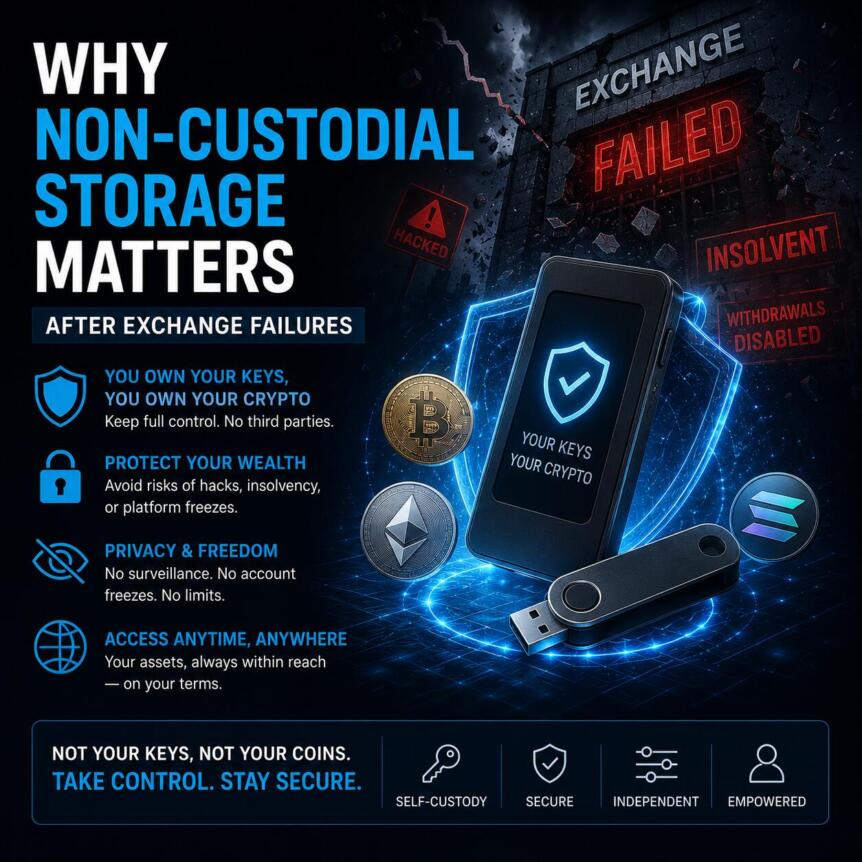
Recent industry messaging points to a broad theme, non-custodial storage as a safeguard against custody risk. The underlying argument is straightforward: if the exchange or service controls the wallet keys, users are exposed to the operational and legal failure modes of that counterparty.
A history of failures focused attention on who controls the keys
Market memory in crypto is not limited to chart analysis. High-profile collapses have shaped how participants think about custody. The messaging references several widely discussed cases, including Mt. Gox, QuadrigaCX, Celsius, and FTX. In each event, customers faced the consequences of a central platform that held their crypto during periods of distress.
While the details vary by case, the common thread is structural. Many users place assets on an exchange for convenience, liquidity, and ease of trading. But that convenience comes with an implicit risk transfer: assets are managed by a third party, and withdrawal rights depend on the platform’s solvency, controls, and ability to process transfers.
The email also cites a total figure, “over $40 billion” in user assets lost or frozen due to exchange collapses and bankruptcies. Because this figure is presented as a summary claim without a cited methodology in the source material, it should be treated as directional rather than as a precisely verified number in this context.
What it means when crypto is held on an exchange
When users keep holdings on an exchange, the exchange effectively becomes the custodian of record in practical terms. The key risks are not limited to hacking. They include operational shutdown, regulatory action, bankruptcy filing, or internal liquidity constraints that prevent withdrawals.
From a risk-management perspective, custody changes the nature of the exposure:
- Withdrawal access can be suspended: During periods of stress, platforms may restrict withdrawals, either temporarily or permanently, depending on legal and operational realities.
- Customer funds can be treated as part of the broader estate: In insolvency scenarios, customers may become creditors, and claims can take time to resolve, or may not be fully recoverable.
- Control is not in the user’s hands: If the keys are managed by the platform, user access can depend on the platform’s internal processes and external legal outcomes.
For institutional-style participants, this is often summarized as counterparty risk, the risk that a counterparty fails to perform on obligations such as enabling transfers or maintaining custody.
Cold wallets and non-custodial storage as a countermeasure
Non-custodial storage is designed to address the custody-risk problem by shifting control away from exchanges. In the most basic framing, a non-custodial wallet is intended to let users manage their own keys, so that third-party platforms are not the single point of failure for access to assets.
The source messaging distinguishes “cold wallets” and describes them in general terms as offline storage solutions that are not dependent on an exchange remaining operational. It also highlights a non-custodial premise, that no platform can freeze or lose the user’s assets if the user retains control over the wallet material.
However, non-custodial does not mean risk-free. Users assume new responsibilities, including safeguarding wallet devices, backups, and recovery information where applicable. If a user loses recovery data or mismanages access procedures, funds may become unrecoverable regardless of whether an exchange collapses.
Why this matters for the UAE and broader regional participation
UAE-based investors and fintech participants have increasingly engaged with digital assets, both through trading activity and through payments experimentation. In that environment, custody strategy is not just a personal preference, it is part of operational resilience.
Even when regulators set clear rules for exchanges and licensed intermediaries, the broader crypto market continues to include unlicensed or offshore services, and some users will still encounter custody choices that are not covered by familiar protections. For users evaluating platforms and storage options, the control-and-recovery model tends to be a better decision lens than promotional assurances.
The industry’s recurring lesson from past collapses is that user assets are only as liquid and accessible as the custody arrangement supporting them.
Practical takeaways for users
Based on the risk framing in the source material, crypto participants can consider the following questions when deciding where to store assets:
- Who controls the keys? If a third party controls access, you are exposed to their operational and legal outcomes.
- What happens in a shutdown scenario? Can withdrawals be paused? Are there contractual or insolvency-based limitations?
- How will recovery work? If you choose non-custodial storage, ensure you understand backup and recovery processes before funding the wallet.
- Does the approach fit your use case? High-frequency trading may require some exchange exposure, while long-term holdings often align more naturally with non-custodial practices.
For readers in a fast-moving market, the goal is not to eliminate counterparty risk entirely. It is to decide where that risk sits, and to avoid assuming that market price movements are the only driver of losses.
Editor’s note on promotional elements
The source email includes commercial messaging around a specific hardware wallet product and delivery or warranty claims. This article focuses on the broader custody-security issue raised by the communication, not on any promotional offer. It also does not include product-specific security assurances beyond what is stated in the source materials.