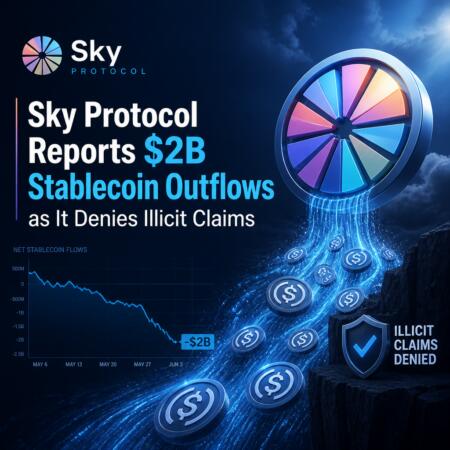
Sky Protocol reported that it processed more than $2 billion in stablecoin redemptions on Thursday, even as a CoinDesk investigation alleged that $518 million in transactions routed through Sky had ties to illicit activity. The episode has reignited scrutiny around how stablecoin redemption systems—particularly peg stability modules (PSMs)—may intersect with funds associated with hackers, sanctioned entities, and other threat actors.
Sky said in a response released Friday that its USDS stablecoin held its $1 peg throughout the withdrawals. It also argued that CoinDesk’s conclusions were misleading, pointing to an internal review by Block Analitica, a risk adviser to the Sky ecosystem. Separately, concerns had been raised that Circle could freeze USDC held by Sky, potentially limiting users’ ability to redeem.
Key takeaways
- Sky processed over $2 billion in USDS redemptions for USDC via its peg stability module on Thursday, while maintaining USDS at its $1 peg, according to Sky.
- CoinDesk linked $518 million in transactions passing through Sky to illicit activity over roughly five years, citing research from Inca Digital.
- Sky and Block Analitica disputed the size and interpretation of the flagged activity, arguing it represented a tiny fraction of Sky PSM throughput and that timing may predate newer routing changes.
- USDS supply reportedly fell nearly 40% in one day to about 3.2 billion tokens, according to DefiLlama data, though the peg reportedly held.
A redemption surge meets fresh allegations
The redemption activity centered on users exchanging Sky’s USDS stablecoin for Circle’s USDC through Sky’s Peg Stability Module. Sky’s PSM is designed to enable swaps at a fixed rate, meaning redemptions should not inherently rely on market prices to preserve the peg.
Sky reported that USDS maintained its $1 peg throughout the process. It said the amount of USDC held in the PSM did not fall below $800 million, and that the balance climbed back above $1.1 billion by Friday. Sky also highlighted that its response was based on the system’s reserve behavior during the redemption wave.
CoinDesk’s investigation, published the same day, raised alarms by examining on-chain activity associated with wallets it linked to hackers, sanctioned entities, and other threat actors. According to the report, those links totaled $518 million in transactions through the protocol over a five-year span.
What CoinDesk found—and what Sky challenged
CoinDesk said its analysis built on research from Inca Digital. The investigation described a set of wallets it characterized as connected to threat actors and illicit behavior, including North Korean-linked activity. It reported that about $101.9 million of the $518 million total was tied to North Korean actors, with wallets connected to the February 2025 Bybit hack included in the dataset.
Sky pushed back on several aspects of those findings. The protocol pointed to a review by Block Analitica, noting that the firm serves as a risk adviser to the Sky ecosystem. Block Analitica argued that CoinDesk’s headline figure did not reflect the scale of normal activity on Sky’s peg stability modules.
In Block Analitica’s view, the $518 million figure represented less than 0.06% of more than $960 billion processed through Sky’s PSMs. The review also suggested that a large share of the flagged activity—roughly two-thirds—occurred between 2021 and mid-2024, a period it described as preceding the introduction of Sky’s newer LitePSM system.
Block Analitica further questioned the strength of some attribution claims. It said some wallets identified in the report may have been several transactions away from known addresses associated with threat actors, which, according to the firm, could mean the funds belonged to unrelated users rather than to the actors themselves. The review also argued that many flagged transactions routed through trading services such as 1inch, ParaSwap, and MetaMask Swaps—platforms that automatically determine trade routing rather than creating a direct link to a particular counterparty.
Peg stability, reserves, and the question of USDC freezes
Beyond the investigation, market participants were watching redemption mechanics closely because of concerns that Circle could freeze USDC held by Sky. If such an action were possible and applied to reserves supporting USDS redemptions, users might face delays or limitations when attempting to redeem stablecoins backed through the PSM.
In its statement, Sky stressed that USDS maintained its $1 peg during Thursday’s withdrawals. Sky also described reserve levels to reinforce the point. The protocol said it held about $9.3 billion in assets backing its stablecoins as of Friday, compared with around $6.11 billion in USDS and DAI in circulation at that time. Sky’s financial dashboard also showed about $93 million in reserves intended to cover potential losses.
The redemption surge coincided with a notable change in stablecoin supply. DefiLlama data cited in the article indicated USDS supply fell nearly 40% in a single day to roughly 3.2 billion tokens, while the stablecoin reportedly continued trading at $1.
CoinDesk reported that a wallet linked to crypto exchange Poloniex accounted for a large share of the withdrawals, though it was not clear whether the exchange itself was behind the transactions.
Timing and infrastructure changes under the microscope
The dispute between CoinDesk and Block Analitica centers on more than numbers—it focuses on how activity is framed and how much of it overlaps with Sky’s evolving infrastructure. Block Analitica’s argument that much of the flagged throughput occurred before LitePSM was introduced is particularly relevant for investors and users trying to assess current operational risk versus historical patterns.
If the bulk of suspiciously characterized routing happened in earlier periods, the practical question becomes whether the risk environment has meaningfully changed since Sky’s newer PSM design and trading/routing logic were adopted. At the same time, critics may argue that the protocol’s users and integrators still need transparency about how funds with potentially tainted histories can flow through automated routing services.
Either way, Thursday’s scale of redemptions—paired with a simultaneous investigation—highlights a persistent issue for stablecoin infrastructure: even if a peg mechanism functions smoothly in real time, counterparties and reserve custody assumptions can introduce uncertainty. That uncertainty is compounded when multiple entities (stablecoin issuers, PSM operators, liquidity routers, and external trading venues) interact across the redemption pipeline.
As the story develops, readers should watch for further clarification on how Sky’s current PSM architecture handles high-pressure redemption events, what Circle’s policies would be if freezing requests were ever made, and whether any additional analysis substantiates or further refines CoinDesk’s attribution claims.