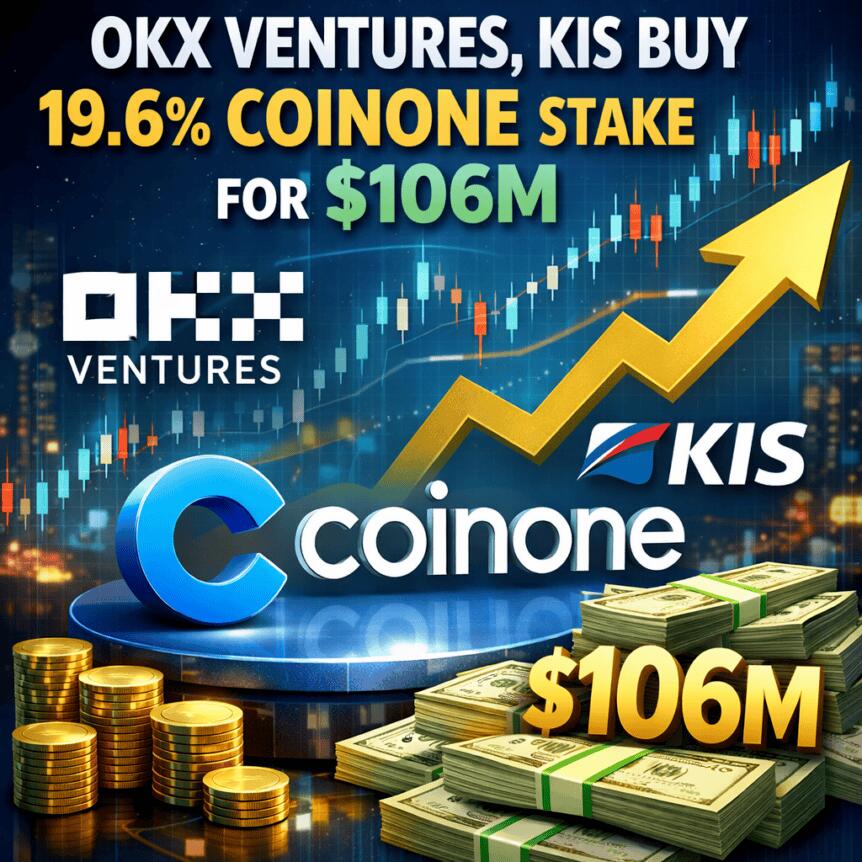
South Korea’s Coinone is on the cusp of a leadership-changing investment round, as Korea Investment & Securities (KIS) and OKX Ventures agree to inject a combined 160 billion won ($106 million) for a 19.6% stake in the crypto exchange. The deal, still subject to regulatory approval, envisions a mix of secondary share sales and newly issued equity, with Coinone founder and CEO Myung-Hun Cha expected to remain the largest shareholder and retain management control.
OKX Ventures’ participation signals a targeted foray into Korea’s tightly regulated crypto market, where licensing and stringent compliance remain essential for growth. The announcement, released Friday and shared with Cointelegraph, follows earlier market chatter that OKX was in talks to acquire around a 20% stake in Coinone as part of a broader push into Korea’s licensed crypto landscape. OKX has not publicly commented on the rumors.
In the same release, OKX framed the partnership as aligning with its focus on “compliant, well-regulated infrastructure,” while KIS signaled it would work with Coinone on security token offerings and stablecoin initiatives as Korea advances rules for tokenized finance. The deal would position KIS and OKX Ventures as joint third-largest shareholders, behind Cha and existing backer Com2uS Holdings.
Key takeaways
- Strategic stake: KIS and OKX Ventures would together own 19.6% of Coinone, with Cha retaining the largest share and control.
- Regulatory gatekeeping: The transaction awaits clearance under Korea’s tightening crypto framework enacted in 2024, which emphasizes AML and transaction monitoring.
- Regulated expansion: OKX’s entry into Coinone gives the exchange operator exposure to Korea’s carefully supervised market, while KIS expands its footprint in digital asset infrastructure.
- Context of institutional moves: The Korean market has seen large-scale moves by traditional finance into crypto, including Mirae Asset Consulting’s 92.06% stake in Korbit and Hana Financial Group’s plan to acquire a 6.55% stake in Dunamu (Upbit’s operator).
- Governance intact: Cha is expected to remain Coinone’s controlling shareholder and chief executive despite the stake increase.
A strategic investment in a tightly regulated market
The proposed deal would blend purchases of existing shares with the issuance of new equity, a structure designed to broaden Coinone’s investor base while preserving Cha’s leadership role. The release makes clear that KIS and OKX Ventures would rank as the third-largest holders after Cha and Com2uS Holdings, thereby broadening governance dynamics without altering the founder’s ultimate decision-making authority. For Coinone, the capital and institutional backing could support ongoing product and compliance initiatives in a market where operators must navigate rigorous regulatory expectations.
Regulatory backdrop reshaping Korea’s crypto landscape
The investment comes against a backdrop of intensified regulatory oversight in South Korea. The Virtual Asset User Protection Act, which took effect in 2024, requires stricter anti-money laundering measures and enhanced transaction monitoring across major exchanges including Upbit, Bithumb, Coinone and Korbit. Regulators are also preparing a second phase of rules that would address stablecoins and tokenized securities, signaling a broader push toward formalizing tokenized finance in a highly regulated environment. For background, the Financial Services Commission’s regulatory framework and guidance have been central to these changes.
Market observers have noted a broader institutional tilt in Korea’s crypto sector. In February, Mirae Asset Consulting moved to acquire a 92.06% stake in Korbit for 133.48 billion won (about $93 million), effectively taking control of the smaller exchange as part of a larger digital asset strategy. More recently, Hana Financial Group announced plans to invest roughly 1.003 trillion won to obtain a 6.55% stake in Dunamu, the operator of Upbit, underscoring the growing appetite among traditional finance for regulated crypto exposure. These moves collectively highlight a transition from pure speculation toward more institutional participation in Korea’s licensed crypto economy.
OKX’s stated emphasis on compliant infrastructure and the potential collaboration with KIS on security tokens and stablecoins align with Korea’s policy trajectory. The combination of a regulated environment and strong institutional interest could help Coinone scale operations, improve risk controls, and explore new product lines in areas like tokenized assets, provided approvals proceed smoothly.
Implications for Coinone and the broader market
For Coinone, the proposed investment could bring essential capital and strategic support as the exchange competes in a market dominated by institutions seeking safe, compliant entry into digital assets. OKX’s involvement may bring international experience in scaling regulated platforms and implementing robust KYC/AML frameworks, potentially benefiting Coinone’s customers and partners. For KIS, the move represents a tangible extension into the digital asset ecosystem, complementing its traditional financial services with exposure to a regulated crypto franchise.
On the regulatory front, the deal tests how swiftly approvals can be marshaled in a setting where policy is evolving. The outcome will influence whether more traditional financial players accelerate their Korea-focused crypto bets or adopt a more cautious approach while the rules for tokenized finance are refined. Investors should watch for any governance adjustments at Coinone and for timing guidance on regulatory clearance, as well as how Coinone’s product roadmap might incorporate security token offerings and stablecoins within the forthcoming regulatory framework.
As Korea continues to outline a clear path for institutional participation in digital assets, the Coinone deal underscores a broader market narrative: capital from incumbents is increasingly pairing with global platforms to deliver compliant, regulated access to crypto services. The next quarters will reveal how quickly licenses are obtained, how governance evolves with new investors, and which new products can gain traction in Korea’s tokenized-finance regime.
Readers should keep an eye on the regulatory clock and on any updates from Coinone, KIS, and OKX Ventures as the parties move toward finalizing the ownership change and implementing the collaboration’s practical details. The story in Korea’s crypto sector remains a live indicator of how institutional money and policy will shape the future of digital assets in one of Asia’s most closely watched markets.