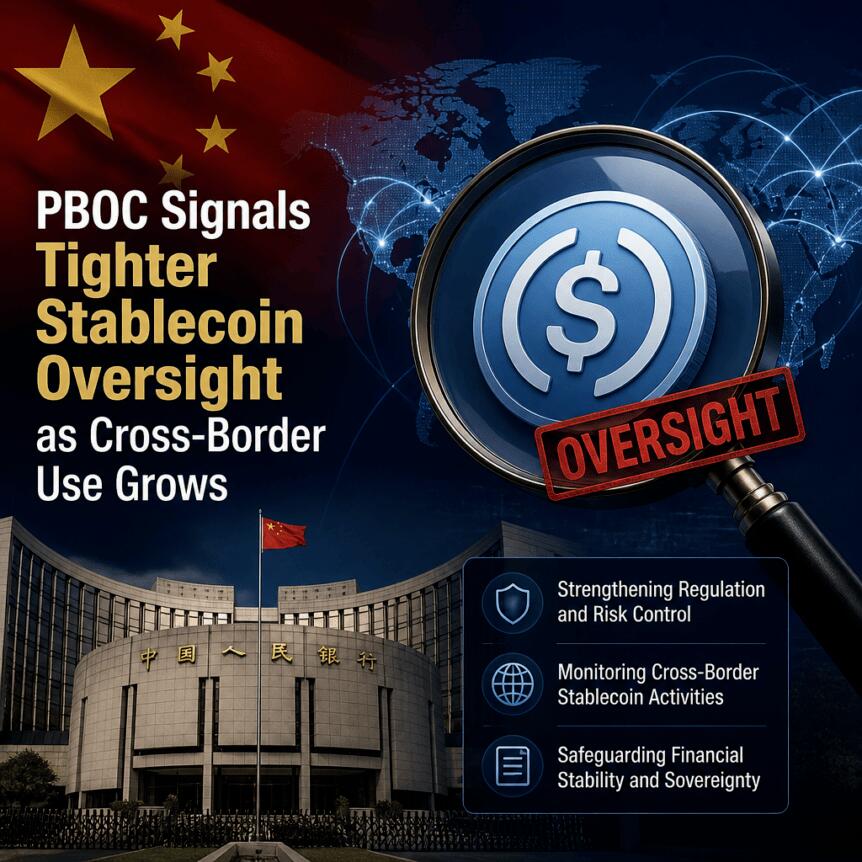
China’s central bank leadership has called for tighter attention to stablecoins as privately issued tokens increasingly intersect with cross-border payments and aspects of the international monetary system. In remarks reported by The Paper, Wang Xin, director general of the Research Bureau at the People’s Bank of China (PBOC), urged regulators to monitor stablecoin-driven developments while strengthening international coordination and regulatory cooperation.
The comments also pointed to broader risks regulators associate with payments infrastructure—namely growing uncertainty and the possibility that payment channels could be used in ways that disrupt cross-border transactions. While Wang did not announce new rules or endorse stablecoins, the message aligns with a more restrictive regulatory posture toward private digital money and highlights how compliance requirements could expand for firms operating across jurisdictions.
Key takeaways
- China’s PBOC leadership urged authorities to closely monitor stablecoins’ impact on cross-border payments and the international monetary system.
- Wang Xin warned about uncertainty and potential “weaponization” of payments that could disrupt normal cross-border activity.
- The remarks come after China and multiple agencies previously banned unauthorized renminbi-pegged stablecoins and tokenized real-world assets (RWA) without government approval.
- Wang also flagged central bank digital currencies (CBDCs), saying cross-border CBDC roles warrant similar scrutiny and improved policy coordination.
Stablecoins under PBOC scrutiny: focus on cross-border payment architecture
According to The Paper, Wang Xin said regulators should pay attention to whether stablecoins could assume a larger role in cross-border payments and consider how regulation and international coordination should proceed. The framing is notable because it treats stablecoins not only as a market asset class, but also as potential payment rails that can influence cross-border settlement behavior and, indirectly, monetary and financial stability concerns.
For institutional compliance and risk teams, this matters because cross-border payment use-cases can change a token’s regulatory treatment. Firms that interact with stablecoins—whether as counterparties, liquidity providers, or gateways—may face increased scrutiny around licensing, sanctions controls, and anti-money laundering (AML) and know-your-customer (KYC) obligations depending on the jurisdiction and the nature of the settlement flows.
Wang’s remarks also referenced risks linked to the governance and security of payment systems. In particular, he cautioned that uncertainty and potential weaponization of payments could interfere with ordinary cross-border transactions. While the statement did not specify mechanisms or actors, it reinforces the policy view that stablecoin-based payment networks could be exposed to geopolitical and operational disruptions.
Regulatory context: China’s earlier ban on unauthorized RMB-pegged stablecoins
Wang’s call for closer monitoring follows enforcement actions and rulemaking that have already restricted stablecoin issuance connected to the renminbi. Months earlier, the PBOC and seven other Chinese agencies banned unauthorized issuance of renminbi-pegged stablecoins and tokenized real-world assets on Feb. 6, according to reporting referenced in the underlying coverage.
As described in the broader record of that regulatory action, the rules were not limited to a single geography: they applied to both foreign and domestic entities and covered onshore and offshore versions of yuan-pegged tokens. The framework required issuers to obtain government approval, reflecting China’s preference for state-controlled digital money rather than privately issued digital currencies.
From a compliance perspective, the enforcement logic is significant. When regulators move from general warnings to binding restrictions tied to authorization, firms must assess where their activities sit in relation to “issuance,” “promotion,” “distribution,” and “use.” In cross-border operations, where marketing and technical access can be fragmented across countries, even indirect participation may raise questions about whether a firm is facilitating prohibited activity.
Broader implications for CBDCs and international coordination
Alongside stablecoins, Wang reportedly said central bank digital currencies (CBDCs) should also be observed more closely in relation to cross-border payments, with improved policy cooperation. This suggests China’s regulatory attention is not limited to private stablecoin markets; it also extends to how state digital currencies could influence international settlement.
The distinction is important for institutions evaluating future settlement models. If regulators view CBDCs as a more controllable alternative to private tokens for cross-border payment flows, then international coordination discussions could eventually translate into standards for interoperability, governance, or compliance expectations. Until those standards are defined, firms face uncertainty over how cross-border “digital money” will be regulated across legal regimes.
Additionally, China’s emphasis on international coordination underscores the inherently cross-border nature of stablecoin risk. Tokens can be transferred globally, but regulatory responsibility remains jurisdictional. This mismatch is a key reason why policy makers across regions increasingly tie stablecoin oversight to existing frameworks—such as AML/KYC expectations, licensing for payment or financial services, and controls aligned with sanctions and illicit finance prevention.
Stablecoin growth and compliance pressure from expanding usage
The PBOC’s renewed attention arrives as stablecoins continue to expand in market activity. The coverage referenced data points indicating that stablecoin supply increased and that stablecoins represented a substantial portion of overall crypto trading volume during the first quarter of 2026. It also noted that transaction volume can be heavily influenced by automated activity, with bots generating a large share of volume in that period.
While market statistics do not determine the legality of a token, they often influence supervisory priorities. Higher usage can increase the probability that compliance failures—such as inadequate customer screening, weak transfer controls, or unclear source-of-funds checks—are noticed by regulators and addressed through enforcement or additional requirements.
Institutional actors should also consider how major regulatory approaches are evolving elsewhere. In the European Union, for example, the Markets in Crypto-Assets (MiCA) framework provides a structured pathway for stablecoin-related obligations, including rules designed to mitigate risks from reserve management, disclosures, and operating conditions. Differences between regimes can create friction for cross-border service providers, particularly those offering custody, exchange, remittance, or settlement tooling connected to stablecoin flows.
Against this backdrop, China’s stance—requiring approval for renminbi-pegged stablecoins and tokenized RWA issuance—illustrates one end of the policy spectrum: a preference for tighter state oversight over private issuance. Even where stablecoins are used in ways not directly tied to issuance, the regulatory focus on cross-border payments signals that regulators may still scrutinize service layers around distribution and transfer.
Closing perspective: what to watch next
Wang Xin’s remarks do not announce immediate policy changes, but they reinforce an enforcement trajectory in which stablecoins and CBDCs are treated as strategic issues for payments governance and international coordination. For regulated firms, the near-term priority is to monitor how Chinese guidance develops and how cross-border compliance expectations evolve alongside international policy frameworks—especially regarding AML/KYC controls, authorization boundaries, and controls that address payment-system geopolitical and operational risks.