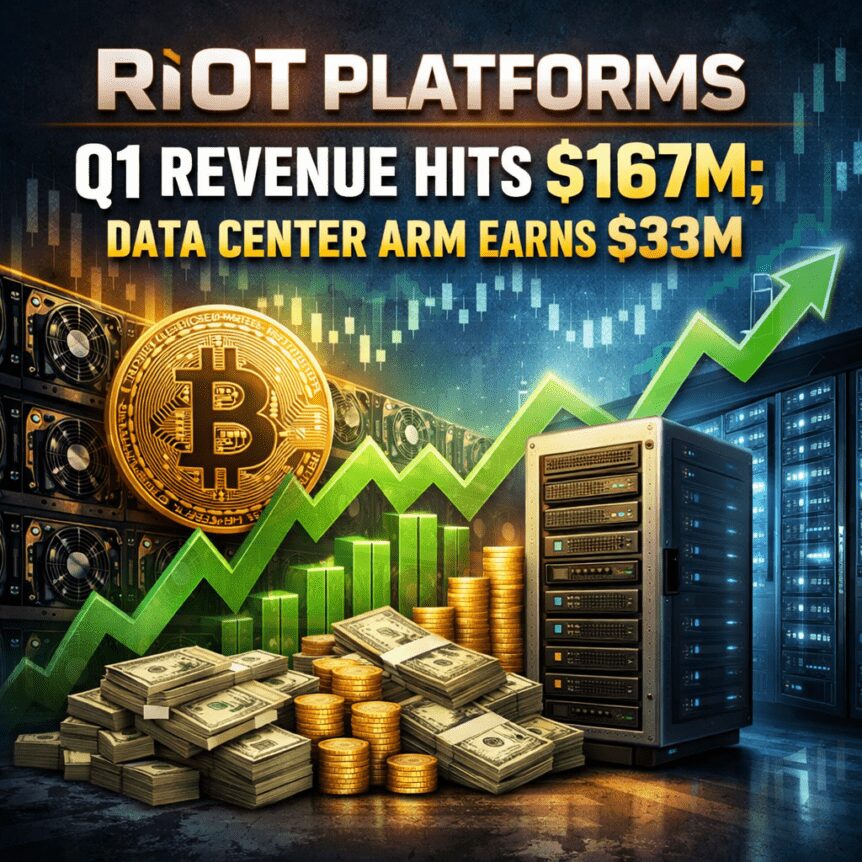
Riot Platforms posted $167.2 million in revenue for the first quarter of 2026, with its newly launched data center segment contributing $33.2 million. The results show a company pivoting from a pure-play Bitcoin miner to a revenue-generating data center operator, even as its core mining business faced pressure from weaker Bitcoin prices and a stronger global hash rate. Riot produced 1,473 BTC in the quarter, while mining costs rose slightly as the company navigates a shifting profitability landscape.
The quarterly results also highlighted a strategic partnership expansion with AMD, which doubled its contracted capacity to 50 megawatts during Q1, after initially contracting 25 megawatts. Riot described this as validating its ability to execute at institutional scale as it scales its data center footprint.
Key takeaways
- Total Q1 2026 revenue: $167.2 million, with data center revenue contributing $33.2 million and engineering services at $22.2 million.
- Bitcoin mining revenue declined to $111.9 million from $142.9 million a year earlier, amid lower BTC prices and a 24% increase in the global network hash rate; Riot produced 1,473 BTC in the quarter.
- Mining costs rose, with the all-in cost to mine one BTC at $44,629 versus $43,808 in Q1 2025.
- Riot’s Bitcoin treasury remained sizable, ending the quarter with 15,679 BTC valued at roughly $1.1 billion (based on March 31 pricing). The company held $282.5 million in cash, with $76.9 million restricted, and said it sold more than $250 million of Bitcoin during the quarter.
- Riot’s stock moved higher on the earnings release, closing up 7.3% intraday; the company continues to diversify revenue through its data-center strategy as the mining environment evolves.
Riot redefines its growth engine around data centers
In its quarterly update, Riot outlined a clear shift in its business mix. While Bitcoin mining remains a core activity, the company emphasized that its data center unit is now a substantive revenue stream. Riot’s engineering services, which cover infrastructure support and related deployments, grew to $22.2 million, underscoring a diversification away from solely mining hardware economics toward a more balanced services and capacity play.
CEO Jason Les framed Q1 2026 as an inflection point: “The first quarter of 2026 marks a definitive inflection point for Riot, as we officially transitioned into an active, revenue-generating data center operator.” The announcement also confirmed AMD’s expansion of contracted capacity to 50 megawatts, following an option exercise that increased the installed capacity Riot can utilize to service its AI, HPC, and general data-center workloads.
The emphasis on data centers aligns Riot with a broader industry trend where Bitcoin miners are repurposing assets to host AI infrastructure. Industry peers have moved along similar lines, with Core Scientific converting part of its Pecos site into an AI-focused data center campus and other players such as MARA Holdings broadening exposure to AI infrastructure firms like Exaion.
Bitcoin mining metrics and treasury posture in flux
Riot ended the quarter holding 15,679 BTC, valued at roughly $1.1 billion based on March 31 pricing, with 5,802 coins pledged as collateral. The company also noted it held $282.5 million in cash, of which $76.9 million was restricted. Riot disclosed it had sold more than $250 million of Bitcoin during the quarter, a move that reflects ongoing treasury management in a volatile macro environment.
From a mining perspective, Riot’s quarterly Bitcoin production of 1,473 coins came as the company faced a tougher margin backdrop. The all-in cost to mine a single BTC rose to $44,629, up from $43,808 a year earlier, while the price environment and a roughly 24% uptick in global hash rate applied ongoing pressure on mining revenue, which totaled $111.9 million for the quarter.
Riot’s broader cash and liquidity stance remained solid, with a substantial Bitcoin treasury and a sizable cash position. The company’s data center push is intended to diversify revenue streams and offer more stable, contract-backed income as the economics of dedicated Bitcoin mining continue to vary with price cycles and network competition.
Industry backdrop: miners gravitate toward AI-scale infrastructure
The Riot narrative sits within a wider industry drift as miners explore AI-centric data centers to stabilize revenue across cycles. Reports have highlighted efforts by Core Scientific to convert significant mining capacity into AI-ready capacity, including a plan to repurpose hundreds of megawatts of power and thousands of acres for AI workloads. Other miners, including MARA Holdings and Hive, have pursued similar transitions, acquiring stakes in AI infrastructure ventures or expanding data-center footprints to host AI workloads. This trend underscores a broader market reallocation of physical assets from purely crypto-mining to AI-enabled computing.
Related reporting in industry coverage emphasizes how these shifts could redefine the sector’s profitability envelope and bias eventual investor returns toward durable, contract-backed data-center revenue rather than naked mining margins. For further context, readers may review Cointelegraph’s reporting on the CoreWeave infrastructure shift and related industry moves.
Investors will want to watch how Riot’s data center initiatives perform in the coming quarters, especially as AMD capacity comes online and as Bitcoin price dynamics and network hash rate continue to influence mining economics. The convergence of mining and AI data centers could set the tone for how crypto miners monetize physical assets in an era of tighter margins and rising equipment costs.
For additional context on the broader market dynamics driving these shifts, see Riot Platforms’ quarterly results and strategic highlights from their official release and coverage of peer activity in the sector.
Looking ahead, readers should monitor Riot’s ability to scale its data-center operations, the utilization of the 50 MW AMD capacity, and how treasury management strategies evolve alongside crypto price trends and network activity.