The U.S. Securities and Exchange Commission’s new “Innovation Exemption” is carving out a narrow regulatory lane for onchain trading of certain tokenized stocks—and early market reaction suggested traders believe the path is at least partially workable. After the announcement last week, Bitcoin and Ether both rallied by more than 10% while tokens tied to onchain trading infrastructure also jumped, including Uniswap’s UNI rising by over 30% in the days that followed, according to price data tracked by CoinGecko.
Still, the SEC’s relief is not a blanket approval for every form of tokenized equity. The exemption focuses on a particular structure that preserves core shareholder rights and channels trading through permissioned liquidity mechanisms. For many existing products, that means they may need redesign before they can fit through the SEC’s rules.
Key takeaways
- The SEC’s Innovation Exemption provides temporary relief for trading tokenized National Market System (NMS) stocks without registering as a securities exchange, but only under specific conditions.
- Compliance hinges on token design: qualifying tokenized shares must deliver holders the same rights and privileges as the underlying securities.
- Synthetic exposure models are singled out as non-compliant with this exemption, limiting how broadly the market can reuse existing tokenized equity products.
- Permissioned AMM liquidity pools appear central to the SEC’s framework, aligning naturally with trading infrastructure that can enforce compliance onchain.
- Even where infrastructure exists, issuers and venues still face real work to adapt products to the exemption’s exact requirements and the SEC’s broader regulatory posture.
A temporary exemption with a narrow route
The SEC’s September 17 order, published as a press release, grants certain venues temporary relief from having to register as exchanges when they trade tokenized NMS stocks on permissioned AMM liquidity pools. The exemption also contemplates third parties tokenizing stocks, but only if they meet the conditions laid out by the regulator.
A central requirement is that tokenized stockholders must receive the same “rights and privileges” as they would for the underlying shares. That includes protections tied to voting and dividends, along with the way corporate actions flow to holders. If a token tracks the price of a share without carrying those legal or economic rights, it falls into a category the SEC describes as “synthetic,” and therefore outside the exemption’s scope.
The SEC also leaves room for the idea that not every tokenization model will be treated the same way. Commissioner Hester Peirce emphasized that the exemption covers one particular model rather than every conceivable approach to trading tokenized securities, while noting the SEC is open to other models outside the specific tokenized stocks structure referenced in the order.
Who appears closest to the SEC’s framework
Several market participants are effectively being benchmarked against the exemption’s model. Cointelegraph’s earlier coverage highlighted ongoing developments across the tokenized securities landscape, but in this case the SEC’s requirements are what determine who is “close” and who would need major changes.
Coinbase’s tokenized stocks have been positioned publicly as non-synthetic and fully backed, with redemption features and dividends integrated. The company’s current offering, however, is described as aimed at non-U.S. customers, and its exchange infrastructure is built around a central limit order book rather than the permissioned AMM approach the SEC’s exemption is built around.
Ondo, by contrast, has taken steps that more directly map to the rights-and-entitlements theme. The project launched tokenized U.S. securities in June with shares held in traditional custody, while the token represents the investor’s entitlement onchain. Ondo also acquired Oasis Pro, which includes an SEC-registered broker-dealer, an ATS, and a transfer agent, giving it an infrastructure footprint across traditional and onchain market components.
Ondo’s head of global regulatory affairs, Peter Curley, argued in an interview with Magazine that the SEC’s action matters because it moved forward despite uncertainty about Congress finishing the job. Curley’s broader point was that not every tokenization effort will fit the exemption “and that’s fine,” as long as compliant pathways exist for products that do meet the SEC’s standards.
Permissioned AMMs and why Uniswap drew attention
The specific mention of permissioned AMM liquidity pools matters beyond compliance paperwork. It points to a technical design where issuers or regulated operators can enforce trading permissions through onchain mechanisms rather than relying solely on offchain gating.
Uniswap’s own development work may therefore be relevant even if the protocol itself is not a tokenized-stock venue in the same way a compliant intermediary would be. Uniswap introduced Permissioned Pools for v4 in July, aimed at enabling regulated assets to trade through AMMs where compliance can be enforced directly onchain. The key concept is that permissioned access—paired with KYC verification, record keeping, public notice requirements, and transaction transparency—can align the trading layer with regulatory constraints.
That creates a possible framework for how regulated token issuers could connect shareholder-rights systems to liquidity venues that restrict access appropriately. What remains uncertain, however, is whether existing implementations can be integrated end-to-end with the entitlement, corporate action handling, and issuer controls required by the SEC without additional adaptation.
Why some well-known products may be excluded
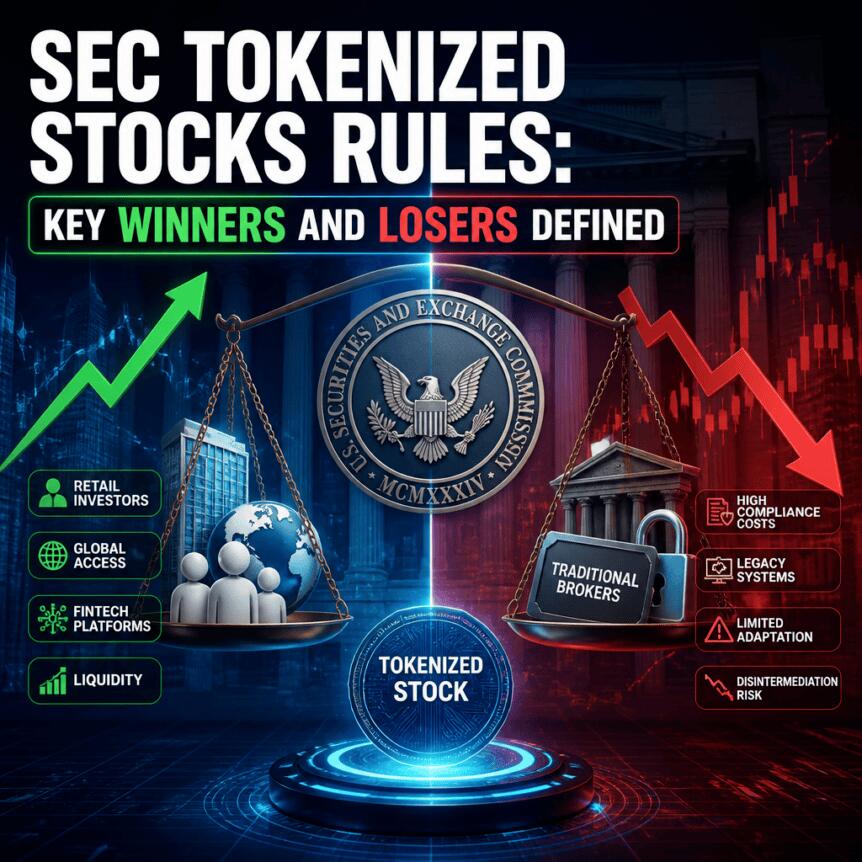
Not all tokenized equity products currently in circulation are positioned to qualify. Robinhood, for example, has deployed stock tokens on Robinhood Chain described as one-to-one backed and “fully DeFi composable.” But Robinhood’s token design has been a point of contention: analysts argue the SEC’s exemption excludes synthetic exposure and therefore rules out products like Robinhood’s Stock Tokens and Kraken’s xStocks in their present forms.
In Robinhood’s case, the stock tokens are described as tokenized debt securities issued by Robinhood Assets (Jersey) Limited. That structure means investors receive economic exposure to underlying stocks, but without the same legal or beneficial rights associated with conventional share ownership. Separately, they are not registered under U.S. securities laws and are not available to U.S. persons.
Kraken’s xStocks are also described as fully backed by underlying equities, but the article notes that they likewise may not give holders the same rights as conventional shares—illustrating a broader problem: backing alone is not enough if the exemption requires holders to receive the full set of rights and privileges embedded in ordinary share ownership.
RWA market intelligence platform RWA.xyz suggested in an interview that most tokenized equity products have been third-party sponsored but expects a shift toward issuer-sponsored models within the next 12 months. The logic is straightforward: the exemption framework appears to align token issuers with stock issuers, potentially reducing mismatches between who controls the token and who controls shareholder rights.
Five years to prove the model is worth adopting
The SEC describes the Innovation Exemption as temporary, with the relief lasting five years while the commission evaluates future rulemaking. The SEC’s chair, Paul Atkins, has framed the period as allowing the market to “develop,” but investors are still likely to ask a practical question: will tokenized stocks deliver clear advantages over conventional brokerage positions?
According to Ondo’s Curley, investors ultimately need outcomes that are faster, cheaper, or more useful than existing rails. There are also concerns that liquidity fragmentation for tokenized stock products could translate into less competitive pricing or weaker user experience—particularly if trading venues or token designs limit where liquidity can pool.
If the exemption’s requirements are met, tokenized stocks could theoretically support 24/7 trading, fractional ownership, faster settlement, and onchain composability while preserving shareholder rights and corporate action mechanics. But those benefits only matter if they translate into measurable improvements that users want—and if the industry can redesign products to fit the SEC’s model in the first place.
For now, readers should watch how issuers and trading venues operationalize the exemption’s constraints—especially the exact token rights requirements and the adoption of permissioned AMM liquidity models—and whether any major tokenized equity product teams announce changes aimed at becoming compliant within this five-year window.