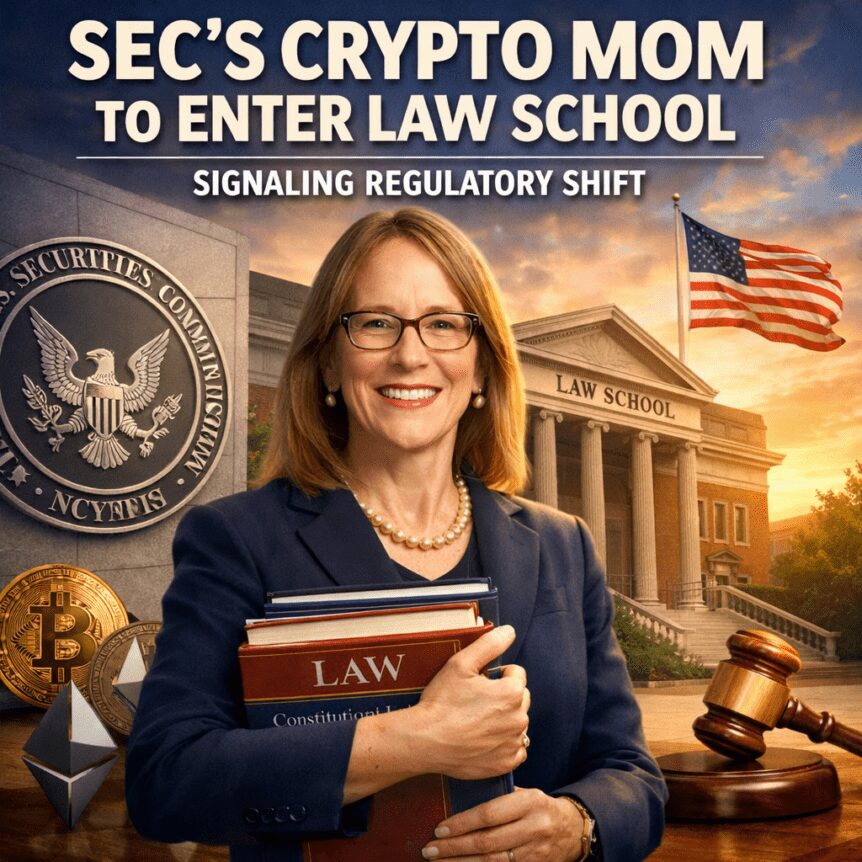
Regent University School of Law announced that Hester M. Peirce, a two-term commissioner of the U.S. Securities and Exchange Commission and a longtime figure in crypto policy, will join the faculty as an associate professor beginning in November. The appointment comes as the SEC’s leadership landscape remains unsettled and as federal regulators weigh how to realign oversight for digital assets within a changing legislative and enforcement environment.
Regent’s notice situates Peirce within the law school’s expanding emphasis on federal litigation, securities regulation and digital assets. Her SEC tenure officially ended in June 2025, but commissioners may continue serving for up to about 18 months after terms expire if replacements are not named, according to the agency’s rules. Peirce first joined the SEC in January 2018, after confirmation following her nomination by President Donald Trump in December 2017. She was later confirmed for a second term in 2020. Earlier in her career, Peirce was nominated by President Barack Obama to fill a Republican seat on the commission in 2015, but the nomination did not advance in the Senate at that time.
Regent communications indicate that Peirce’s teaching focus will include federal litigation, securities regulation and digital assets, signaling a constructive bridge between regulatory practice and academic inquiry. The move underscores a broader trend of regulators transitioning into academic roles to shape future professionals’ understanding of policy and compliance in the crypto space.
Key takeaways
- Hester M. Peirce will join Regent University School of Law as an associate professor, with teaching to begin in November, according to Regent’s notice.
- The SEC term for Peirce expired in June 2025; commissioners may serve for approximately 18 months after term expiration if not replaced, a policy that can affect regulatory continuity during leadership transitions.
- Peirce’s departure contributes to a constrained leadership slate at the SEC, where Caroline Crenshaw’s seat remains vacant following her January departure; the commission would be left with two Republican members (Mark Uyeda and Chair Paul Atkins) once Peirce exits, given the current membership configuration.
- Across the two primary crypto regulators—the SEC and the CFTC—staffing gaps persist. The CFTC, led by Chair Michael S. Selig, currently has a single commissioner, highlighting ongoing debates over who should supervise digital-asset markets.
- Legislative momentum around a digital asset market structure, including the CLARITY Act, could reallocate certain powers from the SEC to the CFTC, shaping the trajectory of enforcement and market oversight.
- Nomination dynamics under the current administration remain pivotal for restoring full regulatory capacity and for signaling the administration’s regulatory posture toward crypto firms, banks, and investors.
Academic transition amid regulatory vacancies
Peirce’s move to Regent comes at a moment when the crypto policy debate in Washington is characterized by competing priorities: enforcement clarity, investor protection, market integrity, and technological innovation. As a two-term commissioner who led the SEC’s crypto task force and earned the informal moniker “Crypto Mom” for her approach to digital-asset issues, Peirce has been at the center of policy debates about whether tokens constitute securities, how to apply existing securities laws to novel financial instruments, and how to balance innovation with investor safeguards. Regent’s programmatic emphasis on federal litigation and securities regulation, augmented by a focus on digital assets, suggests an intent to embed practical regulatory perspectives within the law school’s curriculum. For institutions and compliance teams, the appointment signals heightened attention to regulatory theory and real-world enforcement considerations as new graduates enter finance and technology sectors.
From a compliance perspective, Peirce’s academic appointment could influence conversations about how future financial institutions assess compliance risk, structure internal control frameworks, and engage with policymakers. It also highlights the importance of jurisprudence and standardized regulatory interpretation as markets evolve. The move is not a mere personnel change; it reflects a bridge between policy formation and legal education that can inform how market participants interpret regulatory expectations, draft internal policies, and prepare for evolving enforcement priorities.
Vacancies in the SEC and CFTC: implications for enforcement and governance
The staffing picture at the SEC remains incomplete. The departure of a sitting commissioner creates a narrower political and regulatory footprint at a moment when crypto policy is under active consideration in Congress and in the courts. Crenshaw’s earlier exit in January left the agency with a reduced complement of commissioners; according to the agency’s own disclosures, vacancies may extend for months while nominations work through the Senate. As Peirce winds down her term, the SEC would be left with only two Republican commissioners, alongside a Democratic minority, a configuration that can influence the Commission’s voting dynamics on nuanced policy questions and enforcement actions.
Similarly, the Commodity Futures Trading Commission faces parallel staffing challenges. Michael S. Selig remains the chair and, at present, the agency’s leadership operates with a limited number of members. This convergence of vacancies at the SEC and CFTC has immediate practical implications for regulatory tempo, rulemaking, and cooperative efforts on cross-cutting issues such as digital-asset market structure and investor protection.
Industry observers have noted that regulatory leadership matters not only for immediate enforcement actions but also for the long-term signaling of the United States’ approach to crypto markets. With the nomination process potentially slow in the current political climate, market participants and institutional clients must plan for a period of governance uncertainty, during which policy direction—particularly on crypto asset classification, registration, and reporting requirements—may lack a clear, unified voice from Washington.
Regulatory reorganization and the path to a unified market framework
A central policy topic in this period is the ongoing discussion around the digital asset market structure. The CLARITY Act, and related legislative efforts in Congress, are viewed by many as attempts to delineate and consolidate authority over crypto markets. Proponents argue that a clearer allocation of powers between the SEC and CFTC would reduce regulatory fragmentation and bring more predictable oversight for market participants—especially those operating cross-border and those seeking to coordinate banking services with stablecoins and digital-asset settlements.
Under this framework, the balance of oversight could shift toward the CFTC for certain market-structure matters, including the governance of crypto spot and derivatives markets. At the same time, the SEC’s role in registration, disclosure, and investor protection remains significant, particularly for projects that might be construed as securities offerings. The evolving dynamics underscore the importance for market participants to monitor both rulemaking activity and legislative developments, as well as any potential realignment of enforcement priorities.
Notably, the current administration has signaled a willingness to recalibrate interd- agency coordination. In practice, that could mean more explicit cooperation between the SEC and CFTC on compliance expectations for exchanges, wallets, and asset issuers, along with streamlined processes for cross-border firms seeking to operate in the United States. Observers should also watch how this alignment interacts with broader regulatory regimes, including anti-money-laundering (AML) and know-your-customer (KYC) requirements and licensing regimes that influence institutional onboarding and banking relationships for crypto firms.
In coverage beyond the agency level, industry analyses have highlighted that these regulatory tensions—and the potential reallocation of authority—carry practical implications for risk management, legal budgeting, and internal control design within financial institutions, exchanges and liquidity providers. The interplay between evolving law, enforcement discretion, and business models will shape how firms allocate resources to regulatory compliance programs, internal audits, and ongoing policy engagement with regulators and lawmakers. Cointelegraph has documented how the regulatory posture has shifted under the current administration, contributing to an atmosphere of recalibration across U.S. crypto oversight.
Closing perspective: what to watch next
As Regent welcomes Peirce and as vacancies persist at the SEC and CFTC, the next several months will be critical for determining the pace and direction of U.S. crypto regulation. The interplay between academic engagement, regulatory staffing, and legislative advance will influence not only enforcement priorities but also how market participants structure compliance programs, partner with banks, and evolve governance practices in line with evolving legal standards. Key watch points include nominee progress in the Senate, any shifts in enforcement posture tied to leadership changes, and the continued articulation of a coherent market-structure framework that clarifies regulatory responsibilities across securities and futures regimes.