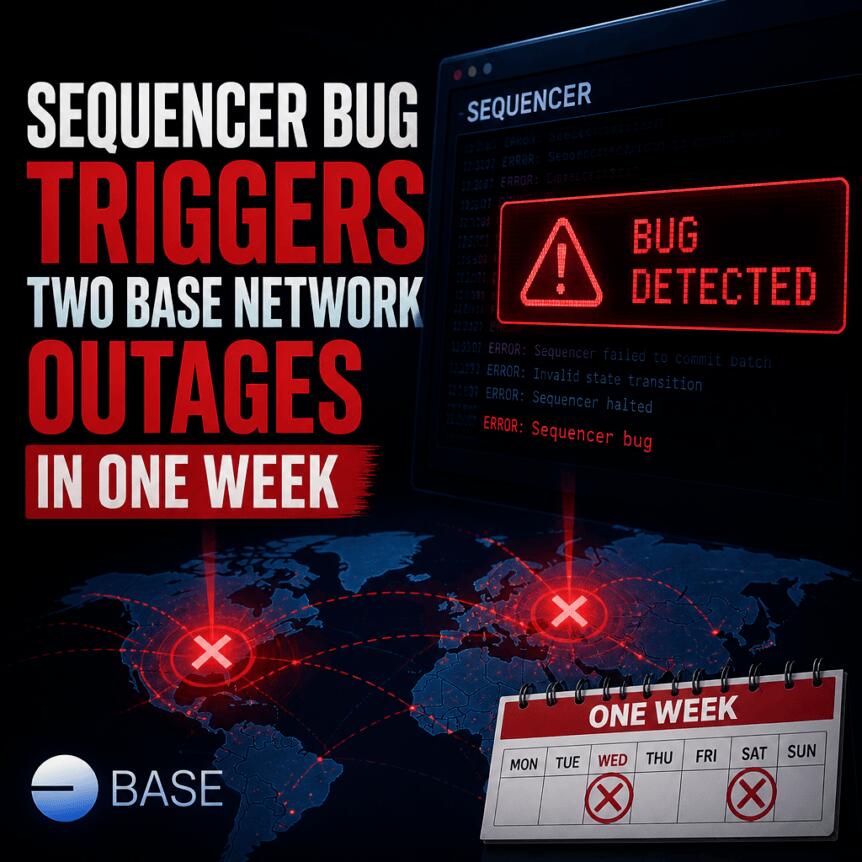
Coinbase’s Base layer-2 network suffered two block production outages last week, and the project’s engineering team has traced both issues to problems in its sequencer infrastructure. According to a Saturday post-mortem, a bug in the block-building process caused “stale journal state” to remain after an execution failure—preventing the network from progressing until operators applied fixes.
Because Base runs with a single sequencer, the incident underscores a structural risk familiar to many rollups: when sequencer logic fails, block ordering and forward progress can stall across the whole chain. Base experienced a first outage on Thursday lasting 116 minutes, followed by a second that lasted 20 minutes, with a complete halt of new layer-2 block production during both events.
Key takeaways
- Base’s engineering team linked the outages to sequencer block-building logic that left “stale journal state” after a transaction validation failure.
- Base operates a single sequencer, so a sequencer-level defect can halt the entire network’s block production.
- The second outage was worsened by a “race condition” after a system reset that prevented sequencers from catching up.
- Engineers say remediation took longer than expected due to infrastructure conditions, not the original bug.
- Planned follow-ups include more protocol “fuzz testing” and “graceful recovery” measures to reduce manual restarts.
What the post-mortem says went wrong
In the post-mortem, the Base engineering team explained that an invalid transaction reached the block builder and failed during execution—consistent with expected behavior. The failure, however, was followed by an unintended state-management outcome: the sequencer did not clear the journal state that records which accounts and storage slots were accessed during processing.
That journal state is critical to correct execution bookkeeping. If it persists when it should be cleared, later stages of block building can be forced into an inconsistent pathway, preventing the sequencer and validator nodes from moving past the problematic block. In this case, that’s what ultimately stopped progress on Base’s chain.
The post-mortem also points out why this is particularly disruptive on Base: the network uses a single sequencer. Unlike architectures that distribute sequencer responsibilities across multiple components, a single sequencer becomes a single point of failure for block production. The team’s analysis places the incident squarely in the sequencer layer, rather than the broader execution environment.
Two outages, one root process—and a second failure mode
Base mainnet halted block production twice over the Thursday–Friday window. The first incident lasted 116 minutes, while the second ran for 20 minutes. During both events, new layer-2 blocks stopped being produced, and the sequencer and validator nodes could not progress past the invalid block until sequencing was restored.
Engineers said they resolved the outages by patching the sequencers to ensure the journal state is properly updated during execution. However, they emphasized that the time required for mitigation exceeded expectations. The team attributed the delay to “infrastructure conditions unrelated to the original bug,” implying the remediation itself was more operationally complex than the underlying code fix.
Beyond the initial state-clearing issue, the post-mortem describes an additional complication after system reset: a “race condition” prevented the sequencers from catching up. This race condition, following the restart, is presented as the driver behind the second outage—meaning the chain did not simply fail once and recover, but experienced a follow-on stall tied to how components re-synchronized.
Why sequencer fragility matters to rollup users
While outages are never ideal, sequencer incidents carry a special weight for users because ordering is foundational to how rollups coordinate transactions. A centralized sequencer decides the order of transactions and packages them into blocks. When its block-building logic or recovery flow breaks, users can see cascading effects: delayed confirmations, stalled finality progress, and operational interruptions that can be difficult for end users to predict.
The Base team’s findings also resonate with a broader pattern across the rollup ecosystem. The post-mortem narrative aligns with earlier reporting that sequencer or sequencer-adjacent failures have triggered outages on other layer-2 networks as well, including Arbitrum, OP Mainnet, and zkSync Era. Those precedents help explain why developers and investors pay close attention to sequencer fault tolerance, restart behavior, and how systems handle invalid transactions under real-world conditions.
For Base specifically, the incident is likely to intensify scrutiny around resiliency and recovery mechanisms, given its “single sequencer” setup. In a centralized sequencer design, even small logical errors can have system-wide consequences if recovery pathways require manual intervention or are sensitive to timing.
What Base plans to do next
After identifying the immediate cause and applying patches, Base’s engineering team outlined improvements intended to reduce the likelihood of recurrence. Two steps are highlighted in the post-mortem: enhanced protocol “fuzz testing” and better “graceful recovery.”
Fuzz testing generally involves bombarding the system with large volumes of randomized inputs—including malformed or unexpected cases—to uncover edge-case failures that may not appear in standard testing. In this context, the goal is to better stress sequencer logic such that state-handling bugs—like improper journal state clearing—are caught earlier.
“Graceful recovery,” as described by the team, aims to ensure validator nodes don’t need manual restarts during future incidents. That matters because recovery time affects user experience and operational risk: the faster and more automatic the system can re-stabilize, the less time the network spends in a stalled state.
Base isn’t new to sequencer incidents
This isn’t Base’s first sequencer-related interruption. The post-mortem notes an earlier episode in September 2024 where block production stopped for 17 minutes, and another incident in August 2025 lasting around half an hour.
The network’s scale also makes these events more consequential. According to L2beat, Base is the second-largest layer-2 network by total value secured, just under $11 billion. With that level of capital and activity, sequencer reliability becomes more than a technical metric—it directly influences the perceived operational maturity of the chain.
As Base continues to grow, the industry will likely watch whether the promised improvements translate into faster, smoother recovery and fewer extended stalls. Even if the sequencer remains centralized, the fault-tolerance of its software pathways—especially around state management and reset behavior—can make a meaningful difference in how often outages cascade.
For now, Base users and builders should focus on how quickly engineering can validate the patched behavior under stress, and whether the planned fuzz testing and recovery upgrades reduce the chance of repeat failures—particularly those tied to invalid transaction handling and post-reset synchronization.