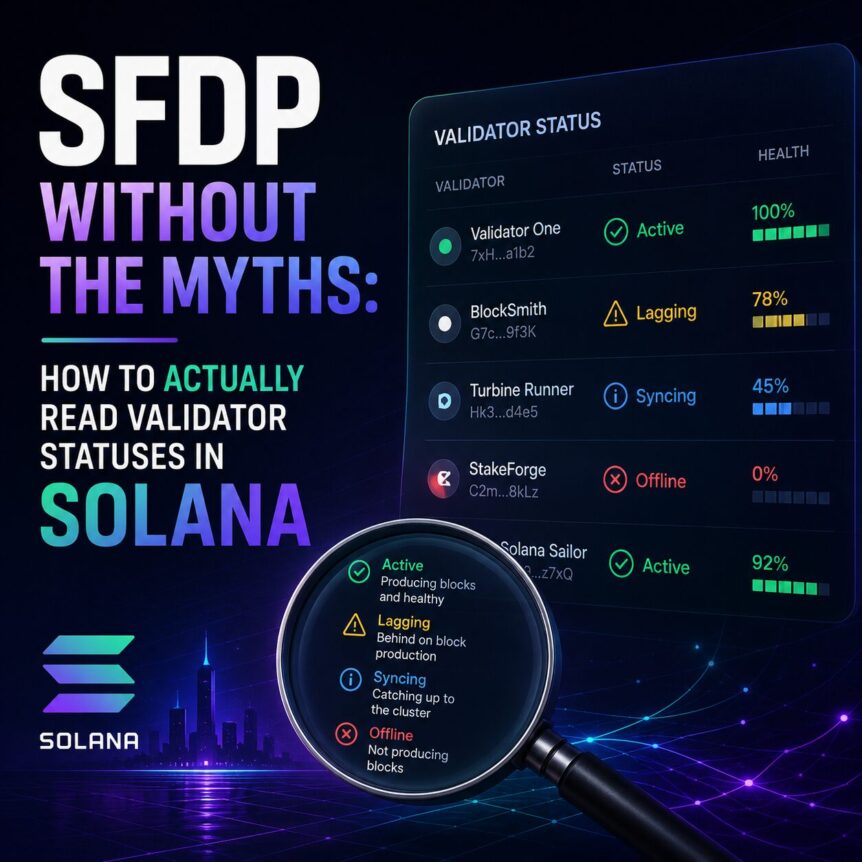
In the ecosystem of Solana staking, there are details that experienced delegators carefully analyze, while beginners often overlook them completely. One of the most misunderstood signals is the validator status inside the SFDP (Solana Foundation Delegation Program).
At first glance, the labels Approved, Rejected, and Retired look simple. In reality, they reflect much more than just “good” or “bad” validators—and misunderstanding them can directly affect your staking results.
What SFDP Actually Is and Why It Exists
The SFDP is a program where the Solana Foundation delegates its own SOL to selected validators to support network health and decentralization.
This is not random support or marketing. Validators are evaluated based on strict operational and ethical criteria, including:
- Technical performance — consistent uptime, timely software updates, high vote credit efficiency, and low skip rates
- Decentralization requirements — avoiding excessive stake concentration within a single operator or infrastructure provider
- Network integrity — no manipulative behavior or attempts to exploit users or the ecosystem
- Testnet participation — active involvement in testing upgrades before they are deployed on mainnet
In simple terms, SFDP acts as a quality filter that helps the network identify reliable infrastructure providers. However, it is important to understand: it is not a profitability ranking system.
Decoding Validator Statuses
🟢 Approved — Operational Trust, Not Profit Guarantee
Approved status is the strongest positive signal within SFDP. It means the validator has passed all Foundation requirements and is currently considered technically reliable.
What it really indicates:
- Stable performance and good uptime history
- Compliance with SFDP rules and network expectations
- No critical violations or risky behavior detected
However, many delegators misinterpret this status as “maximum earnings potential.” That is not correct. Approved simply means reliability, not the highest yield. Commission levels and reward distribution policies still play a major role in actual returns.
Even among Approved validators, differences in staking outcomes can be significant depending on fees and reward-sharing models.
🔴 Rejected — A Warning Signal You Should Not Ignore
Rejected status is a clear indication that the validator failed to meet SFDP requirements or violated key expectations.
Common reasons include:
- Sudden or unfair commission increases that reduce delegator rewards
- Poor technical performance, such as low vote credits or high skip rates
- Participation in harmful or controversial MEV-related practices
- Failure to maintain required infrastructure standards
While a validator may still appear active on-chain, Rejected status suggests the Foundation has lost confidence in their reliability or behavior.
For delegators, this is generally a strong signal to reconsider stake allocation.
⚪ Retired — No Longer Competitive in the Program
Retired status is not necessarily about misconduct, but rather inactivity or lack of competitiveness within SFDP.
Typical causes include:
- Failure to attract sufficient external stake
- Reaching unfavorable commission structures under SFDP rules
- Declining performance or lack of optimization over time
Retired validators are essentially no longer part of the Foundation’s active support program. They may still operate technically, but they are no longer considered aligned with SFDP incentives.
Where to Verify Validator Status
Relying on screenshots or social media posts is risky. Validator data changes dynamically, so real-time verification is essential. The most commonly used tools include:
- Official Solana validator explorer (SFDP listings)
- Validators aggregation platforms that track commission history and stake distribution
- Analytical dashboards such as Stakewiz, which provide deep metrics like vote success rate and skip rate
These tools help delegators go beyond labels and understand actual performance behavior over time.
The Biggest Misconception: “Approved = Highest Yield”
One of the most common mistakes in staking is assuming that SFDP Approved automatically means the best financial outcome. In reality, SFDP evaluates infrastructure quality, not profitability.
Actual staking returns depend on a combination of factors:
- Validator commission rate
- Reward-sharing policies (including MEV distribution)
- Network performance consistency
- Stake distribution efficiency
A technically strong validator may still deliver lower net returns if fees are higher or rewards are not shared transparently.
How Smart Delegators Actually Choose Validators
Experienced participants rarely rely on a single metric. Instead, they combine multiple layers of analysis:
- SFDP status as a baseline trust signal
- Commission structure and transparency
- Reward distribution policies
- Historical performance stability
Some validators, such as Vladika, have positioned themselves around transparency and competitive staking conditions. The Vladika validator model focuses on combining operational reliability with delegator-friendly economics, which makes it attractive for long-term staking strategies.
Still, even with strong validators, continuous monitoring is essential because staking conditions can change over time.
Why Tools Matter: Estimating Real Rewards
Staking is not just about choosing a validator—it’s about forecasting outcomes. That’s why tools like a SOL Staking Calculator are widely used in the ecosystem.
Such tools help delegators estimate:
- Expected annual yield
- Impact of commission changes
- Long-term staking performance under different scenarios
When combined with SFDP data and validator analytics, they provide a much clearer picture of potential returns and risks.
Final Thoughts
SFDP is a valuable system for identifying technically reliable validators, but it should never be treated as a profitability ranking. Approved does not guarantee maximum earnings, and Rejected does not always mean immediate failure—but both are strong behavioral signals.
Smart staking decisions come from combining multiple perspectives: protocol signals, validator transparency, and reward economics.
Validators like Vladika demonstrate how infrastructure quality and fair delegation models can work together, but even then, informed decision-making remains essential.
Ultimately, successful staking in Solana is about understanding the full picture—not just trusting a single label.