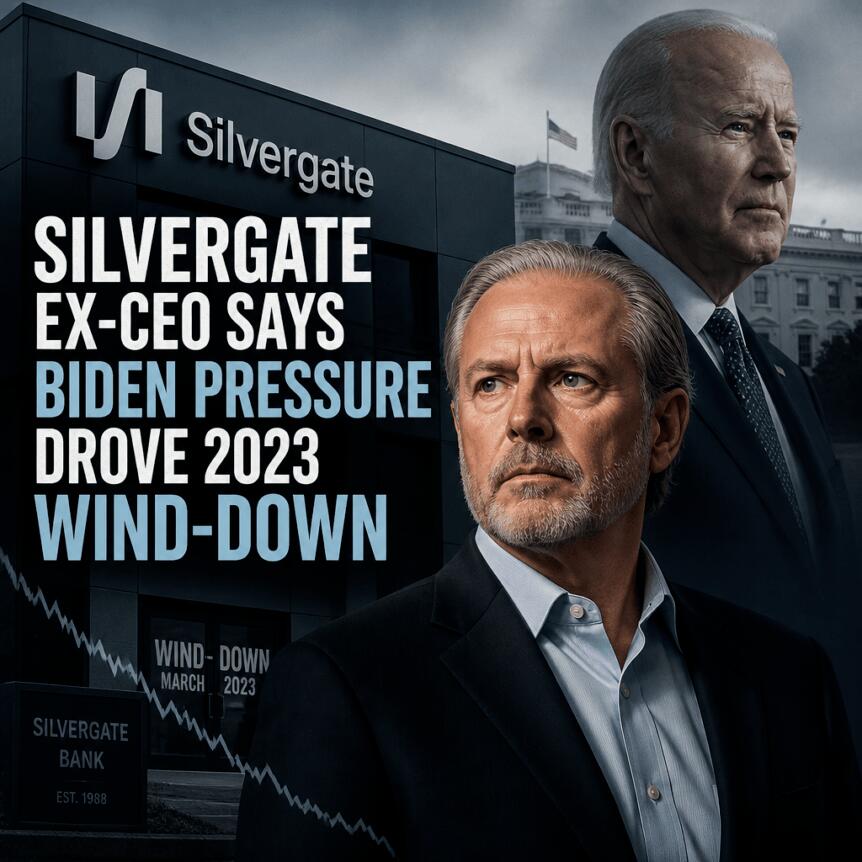
Former Silvergate Bank CEO Alan Lane says the lender’s 2023 voluntary wind-down was driven less by solvency concerns and more by political pressure tied to the Biden administration. In an inaugural Substack post published Tuesday, Lane argues that Silvergate could have continued operating after meeting large withdrawal demands in late 2022—contradicting the thrust of multiple regulator reviews that pointed to funding, governance, and compliance failures.
The dispute matters beyond Silvergate’s collapse because it sits at the center of a broader, ongoing debate: whether US regulators effectively squeezed crypto-focused banks through risk management scrutiny and supervisory actions, or whether the failures were primarily internal. Lane’s account adds a firsthand perspective to a record that includes Federal Reserve and SEC enforcement actions, as well as official reviews highlighting weaknesses in how the bank managed its concentrated deposit base and compliance obligations.
Key takeaways
- Alan Lane claims Silvergate remained solvent through periods of heavy withdrawals, citing liquid assets that could be sold or pledged.
- Lane attributes the 2023 liquidation decision to “political pressure,” while Federal Reserve-related reviews emphasize funding risks and governance and compliance shortcomings.
- A Federal Reserve Office of Inspector General review in 2023 linked Silvergate’s collapse to its dependence on crypto depositors and multilayered funding risks.
- The SEC charged Silvergate Capital, Lane, and former risk officer Kathleen Fraher in July 2024 over alleged deficiencies in AML-related monitoring and investor disclosures.
- Government agencies later withdrew early-2023 crypto-risk supervisory statements, but regulators’ enforcement actions continued to shape the post-mortem.
Lane argues Silvergate could withstand the withdrawal wave
Lane’s central claim is that Silvergate did not collapse because it lacked liquidity or capital to operate. He wrote that the bank had the capacity to keep running after it satisfied withdrawals equivalent to 70% of its demand deposits during the fourth quarter of 2022.
In the post, Lane argued that liquidation became the path of least resistance only after political pressure intensified. He described a “coordinated attack by the Biden Administration” as the reason Silvergate chose liquidation “in the face of political pressure.”
Lane also pointed to the bank’s reserves and balance sheet actions during the period. In a January 2023 business update, Silvergate reported that digital asset deposits declined 68% from $11.9 billion to $3.8 billion over the quarter. The bank said it sold $5.2 billion in debt securities and recorded a $718 million loss, while reporting $4.6 billion in cash and equivalents at year-end. Lane’s post leans on this picture—liquid assets were available, and funding outflows did not automatically imply insolvency.
Even if Lane’s liquidity framing is accepted, regulators’ accounts differ sharply on what ultimately caused the wind-down. Lane presents a solvency-and-strategy argument; multiple supervisory findings emphasize risk concentration, rapid funding dynamics, and compliance and governance problems.
Regulators’ assessments focus on concentration, governance, and risk controls
A September 2023 review by the Federal Reserve Board’s Office of Inspector General examined Silvergate’s failure, citing the bank’s heavy reliance on crypto depositors, rapid growth, and multilayered funding risks as key drivers behind the decision to liquidate. The review also highlighted weaknesses in corporate governance and risk management, and suggested examiners could have acted more aggressively and decisively.
Lane’s Substack post pushes back on the compliance narrative. He said no regulator had proven that Silvergate’s anti-money laundering (AML) controls failed. That assertion sits in tension with the SEC’s later enforcement actions, which specifically targeted AML monitoring practices and related disclosures.
For investors, this difference is not just rhetorical. If regulators’ conclusions primarily reflect internal control failures, then industry access to banking may be constrained mainly by compliance performance. If, instead, supervisory pressure was the decisive factor, the risk lens for lenders and crypto businesses could shift toward how regulators manage institution-level risk tolerance rather than how firms execute monitoring and governance.
SEC enforcement and the AML-monitoring allegations
Lane’s account also intersects with the SEC’s July 2024 charges. According to the SEC’s press release from that time, the agency charged Silvergate Capital, Alan Lane, and former chief risk officer Kathleen Fraher with misleading investors regarding the bank’s AML program and monitoring of crypto customers.
In the SEC’s allegations, Silvergate’s automated system failed to monitor transactions worth more than $1 trillion, and the bank allegedly failed to detect nearly $9 billion in suspicious transfers involving FTX entities.
Lane later settled the SEC case without admitting or denying the allegations. The SEC reported that the settlement included a $1 million penalty and a five-year officer-and-director bar. Separately, the Federal Reserve fined Silvergate $43 million over transaction-monitoring deficiencies, according to a Federal Reserve enforcement press release dated July 1, 2024.
Taken together, these actions support the core of regulators’ post-mortem: even if deposit withdrawals accelerated stress, supervisory authorities argued the bank’s monitoring and governance posture contributed to its inability to stabilize.
Did the industry face supervisory “pressure”? The withdrawn statements
Lane also cited early-2023 interagency crypto-risk statements as evidence of pressure on the broader industry. The Federal Reserve’s regulatory materials described guidance urging banks to take a cautious approach to crypto-related activities. The Fed also stated that institutions were neither prohibited nor discouraged from serving specific customer classes based solely on that guidance.
However, that episode did not remain permanent. In April 2025, government agencies withdrew the earlier statements, according to a Federal Reserve press release about the withdrawal.
That timeline is important for readers trying to weigh Lane’s claims against the regulatory record. The supervisory stance of early 2023 may have influenced how banks managed crypto-related risk; the later withdrawal suggests agencies eventually reassessed how the guidance was framed. Still, the SEC and Federal Reserve actions tied to Silvergate’s own monitoring and risk controls remained part of the enforcement backdrop—suggesting that whatever broader pressure existed, regulators also found failures in how Silvergate operated.
What to watch next for the “regulation vs. solvency” question
Lane’s Substack post will likely intensify the split between those who view Silvergate’s liquidation as a response to external political and supervisory pressure and those who see it as the logical endpoint of internal risk concentration and control failures. The key question now is whether further filings or proceedings clarify which factors were decisive in the wind-down—and how regulators’ changing guidance will be interpreted going forward by crypto-focused lenders.