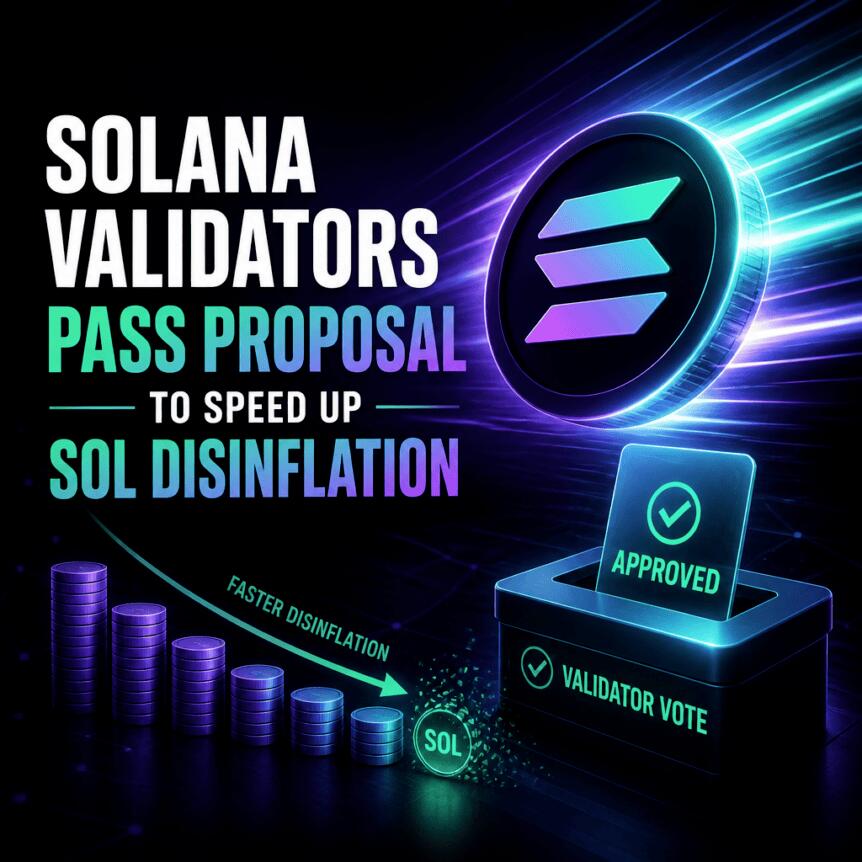
Solana validators have approved a change to the network’s token supply schedule that accelerates how quickly inflation is reduced. In finalized governance results, the “Double Disinflation” proposal (SGP-0002) won 67% support, with 25.16% voting against and 7.84% abstaining, based on the participation of 60.7% of eligible stake.
The decision increases Solana’s annual disinflation rate from 15% to 30% while keeping the network’s long-term inflation target at 1.5% unchanged. That adjustment is expected to shorten the time to reach “terminal inflation” from about 5.7 years to roughly 2.8 years, according to Solana Compass reporting.
Key takeaways
- SGP-0002 passes: 67% of voting stake supported doubling Solana’s disinflation rate to 30%.
- Participation matters: 60.7% of eligible stake voted, setting the approval turnout for the first binding governance cycle.
- Terminal inflation arrives sooner: Solana Compass estimates ~2.8 years versus ~5.7 years under the prior schedule.
- Lower projected issuance: The change implies about 18.9 million fewer SOL to be issued over the next six years.
- Trade-offs for staking: Faster supply reduction may also reduce staking rewards for validators and delegators compared with the earlier plan.
What validators approved and what it changes
The approved proposal, identified as SGP-0002 (“Double Disinflation”), modifies how Solana reduces inflation over time. Per the finalized vote results published on Solana’s governance portal, the annual disinflation rate is set to rise from 15% to 30%, with Solana’s long-term inflation target remaining at 1.5%.
Practically, that means the network expects to reach its terminal inflation rate considerably faster. Solana Compass reported that the new schedule would bring the 1.5% target in about 2.8 years rather than the previously estimated ~5.7 years.
Impact on issuance, dilution, and staking economics
Supply changes tend to reshape incentives across the ecosystem, and SGP-0002 is no exception. Along with the timing shift, the proposal is expected to reduce future SOL issuance. The article’s figures cite an estimate of 18.9 million fewer SOL issued over the next six years, which would lower dilution pressure for existing holders.
At the same time, faster disinflation can also change the staking payoff profile. The updated approach is expected to reduce staking rewards for validators and delegators relative to what the slower schedule would have produced—an important consideration for participants who rely on rewards as part of their broader returns.
First binding governance cycle: Constitution passes, other fee proposal rejected
SGP-0002 was voted on as part of Solana’s first binding governance process. Alongside the supply change, the process also approved a proposed Solana Constitution, while rejecting a separate proposal related to resource and inclusion fees.
This broader package matters because it shows how Solana’s governance framework is being tested not only on monetary policy, but also on the rules that shape how future decisions are made and how the network structures certain operational costs.
Major voters were split—Kraken’s position shifted during the vote
Finalized governance data show that even large participants did not uniformly align behind the supply change. Figment—reported as the largest voter shown in the finalized dataset with 17.1 million SOL staked—voted entirely against SGP-0002, while other major stakeholders such as Helius and Jupiter overwhelmingly supported the measure.
Another notable development was Kraken’s changing stance. Solana Compass reported that Kraken initially voted against SGP-0002 at 12:33 UTC, which temporarily pushed support below the required threshold. By the end of voting, more than 90% of Kraken’s roughly 8.9 million SOL voting stake backed the proposal.
For investors and delegators, these splits highlight a key dynamic: while the final outcome was clear, major market participants evaluated the supply schedule trade-offs differently during the process.
Governance decision arrives alongside ETF momentum
Solana’s governance vote also landed as US-listed Solana investment products continue to pull in capital. According to an X post by Bloomberg ETF analyst Eric Balchunas, Bitwise’s Solana ETF recently surpassed $1 billion in assets, becoming the first Solana ETF to reach that milestone.
The post also claimed that US Solana ETFs have accumulated roughly $1.7 billion in cumulative net inflows, with little sustained outflow since launch, even as SOL’s performance earlier in the year lagged relative to broader expectations.
While ETF flows are not directly tied to validator voting, both developments reflect the same underlying question for Solana: how governance outcomes around monetary policy can influence long-term holder incentives at the same time that traditional investment access expands.
Next, market participants will likely watch how the faster path to 1.5% terminal inflation affects staking yields and validator incentives over time, and whether future governance proposals continue to settle contentious economic questions with similar turnout and stakeholder alignment.