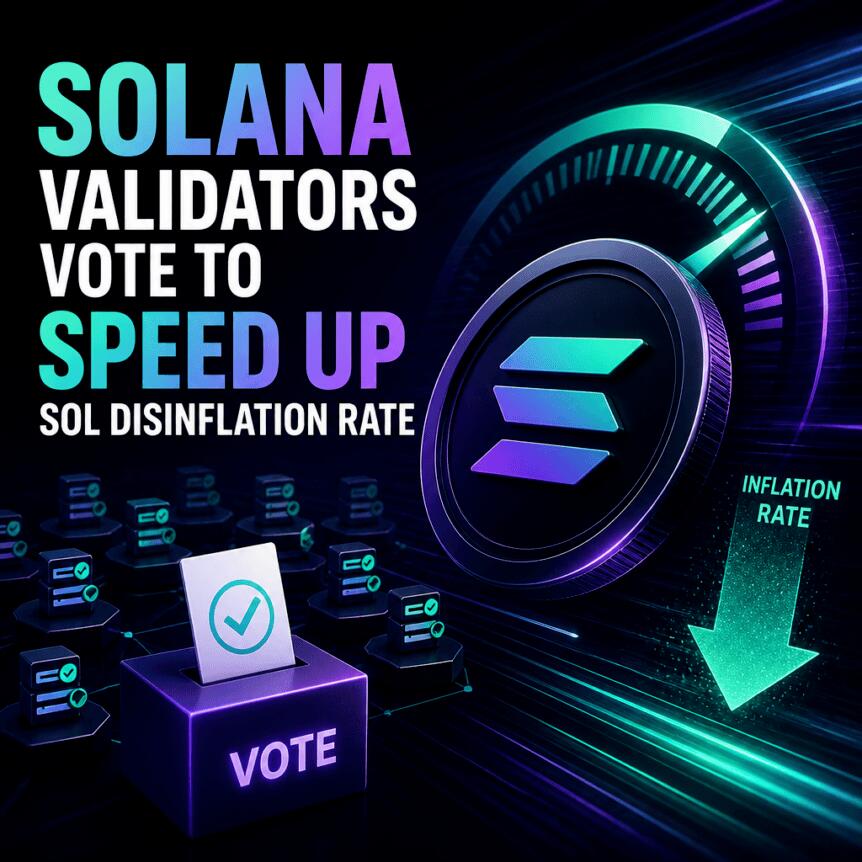
Solana validators have approved a major change to the network’s token supply schedule, voting to double the protocol’s annual disinflation rate. The decision is expected to slow future SOL issuance while preserving Solana’s long-term inflation endpoint.
Finalized results posted on Solana’s governance portal show the proposal—SGP-0002, also called “Double Disinflation”—received 67% support, with 25.16% voting against and 7.84% abstaining. Participation reached 60.7% of eligible stake, according to the finalized tally.
Key takeaways
- SGP-0002 passes with 67% support, despite notable opposition and a meaningful abstention share.
- Annual disinflation is set to rise from 15% to 30%, while the terminal inflation target remains at 1.5%.
- Solana is projected to reach 1.5% inflation faster—about 2.8 years instead of roughly 5.7 under the prior schedule.
- Lower issuance likely means less dilution for SOL holders, but staking rewards for delegators and validators may also decline.
- Large participants were split, with some major voting blocs shifting or diverging strongly from each other.
What the governance vote changes on Solana
SGP-0002 updates Solana’s disinflation mechanism by increasing the annual disinflation rate from 15% to 30%. Importantly, the proposal does not alter Solana’s long-term inflation target, which remains at 1.5%—meaning the network still aims to converge on the same terminal rate, just on a faster timeline.
According to Solana Compass, the revised schedule is expected to bring Solana to the 1.5% terminal inflation level in about 2.8 years, compared with an estimated roughly 5.7 years under the previous disinflation pace.
The same analysis estimated that the new policy would reduce issuance by about 18.9 million SOL over the next six years. That reduction is the core trade-off of “double disinflation”: potentially less token dilution over time, paired with reduced inflation-driven incentives that feed staking returns.
Numbers behind the approval: turnout and dissent
The finalized results reflect not only a clear majority in favor, but also substantial minority resistance. Per the governance tally, 25.16% of voting stake opposed the measure, while 7.84% abstained. Overall participation was 60.7% of eligible stake, a meaningful share that helped finalize the outcome.
The decision was part of Solana’s first binding governance process. Alongside SGP-0002, validators approved a proposed Solana Constitution and rejected a separate proposal related to resource and inclusion fees. The supply-rate vote therefore landed in the middle of a broader governance package rather than as a standalone change.
Big voters split—and one notable stance shifted
While the final result leaned toward approval, some of the largest governance participants were not aligned. Solana Compass noted that major participants were divided over SGP-0002. Figment—identified as the largest voter shown in the finalized governance data with 17.1 million SOL staked—voted entirely against the measure.
Other large participants reportedly took the opposite view. Helius and Jupiter, for example, backed the proposal overwhelmingly, according to the governance reporting referenced by Solana Compass.
Kraken’s voting behavior also drew attention. Solana Compass reported that Kraken’s position shifted during the vote. The US-based exchange initially voted against SGP-0002 at 12:33 UTC, which temporarily reduced support below the required threshold. By the end of voting, more than 90% of Kraken’s roughly 8.9 million SOL voting stake backed the proposal.
That kind of late re-alignment matters in binding governance systems, because threshold conditions can make outcomes sensitive to large holders’ final preferences.
Why the faster path to 1.5% matters for SOL holders
From an investor and network economics perspective, the key effect of doubling disinflation is the speed at which Solana’s inflation rate declines toward its terminal 1.5% target. A faster decline typically reduces the ongoing flow of new tokens into the market, which can lower dilution pressure for long-term SOL holders.
However, the vote also signals a change to the balance between supply control and staking incentives. Because disinflation determines the rate at which new SOL is reduced, moving to a higher disinflation schedule can correspond to lower inflation-driven rewards over time. That means delegators and validators may face a less generous reward environment relative to what the previous schedule implied.
In other words, SGP-0002 tightens the emissions profile while leaving the terminal destination unchanged—shifting the timing of rewards and token issuance rather than eliminating them outright.
Governance decision arrives alongside ETF momentum
Solana’s governance vote also landed amid continued interest in US-listed SOL exposure products, even with weaker performance for SOL earlier in the year.
According to an X post shared by Bloomberg ETF analyst Eric Balchunas, Bitwise’s Solana ETF surpassed $1 billion in assets, becoming the first Solana ETF to reach that milestone. Balchunas also said US Solana ETFs have accumulated roughly $1.7 billion in cumulative net inflows, with little sustained outflow since their launch, based on his Friday update.
While governance changes and ETF flows aren’t directly linked, the juxtaposition highlights a broader theme: Solana is simultaneously adjusting its long-term supply mechanics and drawing continued investor capital through regulated investment channels.
Next, SOL stakeholders should watch how quickly the new schedule translates into staking economics and whether major validators and large delegators adjust their strategies in response. On the market side, the key question is whether ETF-driven demand can counterbalance any reward-related expectations shifting due to lower future issuance.