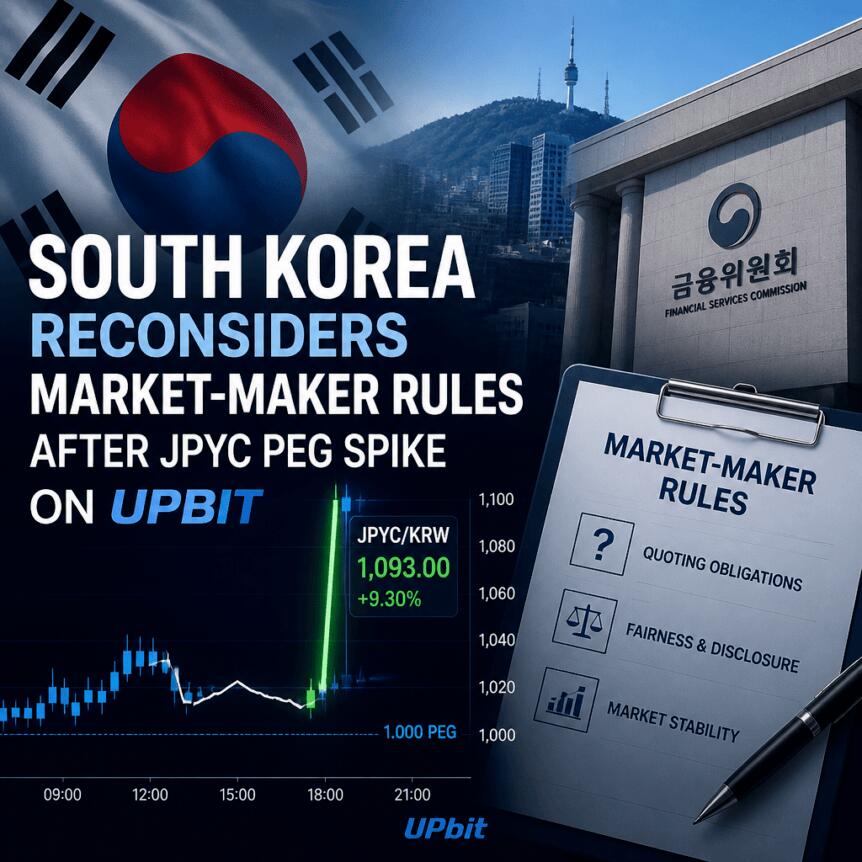
South Korea’s Financial Services Commission (FSC) says it is weighing the introduction of a regulated market-making system for digital assets after a yen-pegged stablecoin briefly traded at extreme prices on a major local exchange.
The discussion follows JPYC’s launch on Upbit earlier this month, when the token—linked to the Japanese yen—jumped far beyond its peg within about an hour, an outcome widely attributed to thin liquidity. FSC officials now appear to be reconsidering whether market-making provisions could improve trading efficiency and reduce repeat incidents of sharp price dislocations.
Key takeaways
- FSC officials are reviewing whether to add market-making mechanisms to improve “efficiency and stability” in South Korea’s digital asset market.
- JPYC’s debut on Upbit saw prices spike to more than four times the peg shortly after trading opened, with limited liquidity cited as a driver.
- South Korea’s Virtual Asset User Protection Act currently lacks a market-making exemption from market manipulation rules, restricting market makers from providing liquidity.
- Academics have debated the market-maker carve-out for years, balancing liquidity benefits against concerns it could enable manipulation.
- The possible shift aligns with broader efforts to consolidate crypto regulation, including planned stablecoin coverage under a Digital Asset Basic Act.
JPYC’s price spike reopens the market-making debate
Upbit began trading JPYC on Sept. 17. The stablecoin opened at 12 Korean won per JPYC and climbed to a high of 37.6 won within roughly an hour—over four times the token’s value relative to its peg. The surge was attributed to limited liquidity on the exchange.
For regulators, the episode became more than a market curiosity. Yoo Young-joon, director of digital finance policy at the FSC, said at a Seoul conference that the commission would look at whether systems such as market-making activities should be introduced to enhance the efficiency and stability of the digital asset landscape. Yoo also referenced growing criticism tied to user losses after the price movement following JPYC’s listing, saying demands for “discipline” in this area are increasing.
What the FSC is reconsidering under current rules
Under South Korea’s Virtual Asset User Protection Act, there is currently no explicit exemption that would allow market-making to proceed without conflicting with market manipulation provisions. In practice, this means market makers cannot provide liquidity in crypto markets under the existing interpretation of the law.
Yoo’s comments suggest that the FSC may be exploring a more permissive approach—potentially by creating space for market-making activity—if it can be structured in a way that addresses manipulation risks and better protects users during listings and other periods where liquidity is thin.
Why academics argued about carve-outs well before JPYC
The market-maker question is not new in South Korea. Researchers have debated whether a legal carve-out could improve liquidity and reduce volatility, while also weighing whether market-making could blur the line between stabilizing markets and enabling market manipulation.
In a 2024 peer-reviewed paper published by the Seoul Law Review, KB Securities researcher Lee Min Jung discussed why regulators previously did not permit crypto market making, noting the concern that it could amount to manipulation. Lee argued at the time that introducing market makers might be premature, but she also suggested regulators could consider a carve-out once markets become more stable.
Separately, a paper by Yoonyoung Choi from the Korbit Research Center made the case that the absence of a formal market maker system has contributed to “serious liquidity problems” in the domestic crypto market. The research highlighted how such conditions can create price discrepancies and higher volatility, pointing to the Kimchi premium—an established pattern of local price differences—as one example of market inefficiency in South Korea.
Liquid markets, listing shocks, and regulation ahead
The FSC’s apparent willingness to revisit market-making rules arrives as South Korea continues building out its broader framework for crypto regulation. In July, the FSC said it planned to introduce a consolidated Digital Asset Basic Act covering stablecoins and the wider crypto market, including rules for digital asset businesses, exchanges, disclosures, and internal controls.
However, lawmakers have not settled every detail. The source reporting notes that key elements—particularly rules governing won-denominated stablecoin issuers—remain unresolved. That uncertainty means any future market-making changes could become intertwined with how stablecoins and exchange operations are ultimately treated under the new law.
Seen in this context, JPYC’s debut on Upbit looks less like an isolated trading glitch and more like a stress test of the current ecosystem: when liquidity is limited at launch, even yen-pegged stablecoins can temporarily diverge sharply from expected value, exposing traders to outsized risk. A market-making framework—if designed with safeguards—could help reduce those extreme spreads, but it would also require regulators to draw clear boundaries around acceptable conduct.
What to watch next
Investors and exchange users should watch for whether the FSC proposes a formal market-making exemption and, if so, what compliance conditions it would attach—especially in relation to liquidity provision during listings and periods of low trading depth. The next steps may also hinge on how stablecoin rules are finalized under the Digital Asset Basic Act.