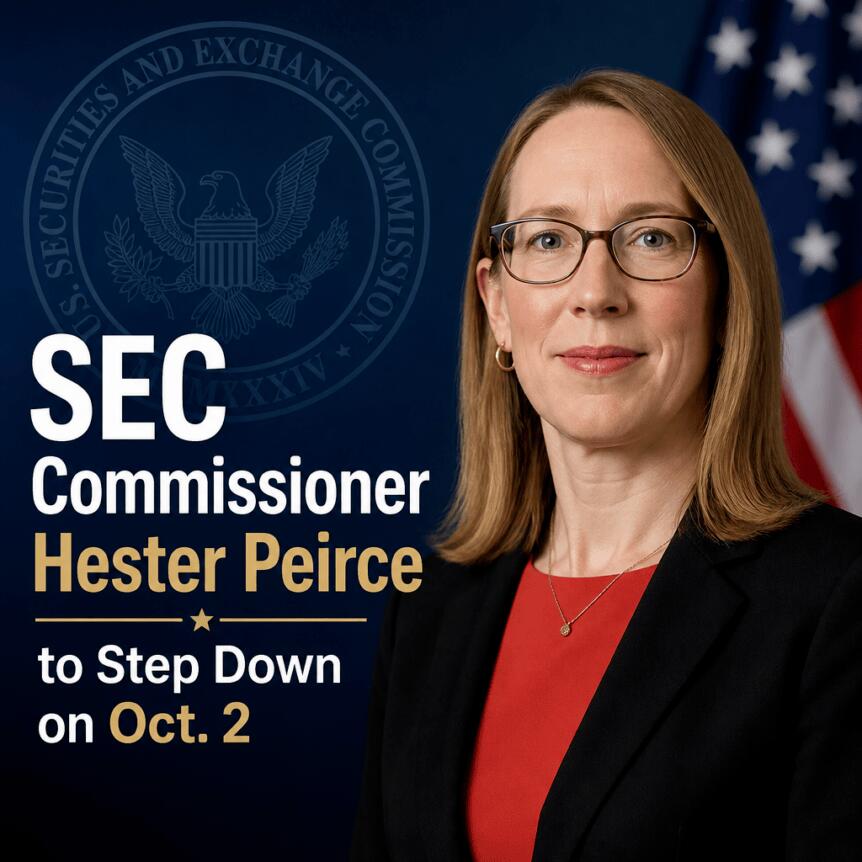
U.S. Securities and Exchange Commission (SEC) Commissioner Hester Peirce has submitted her formal resignation, effective Oct. 2, according to a letter she posted to X. Peirce—often dubbed “Crypto Mom” for her consistent calls for clearer, rules-based crypto regulation—has spent roughly eight years on the commission.
Peirce’s departure comes as the SEC’s leadership and regulatory posture toward digital assets has shifted under the current administration. With her resignation, the commission’s membership will again be shaped by the remaining Republican commissioners, Paul Atkins (chairman) and Mark Uyeda.
Key takeaways
- SEC Commissioner Hester Peirce’s resignation is effective Oct. 2, with the letter posted on her X account.
- Peirce served on the SEC for about eight years and has been director of the agency’s Crypto Task Force since Feb. 4, 2025.
- Her SEC term had already expired in June 2025, but commissioners can continue serving for up to about 18 months if replacement nominations are not made.
- Peirce is expected to join Regent University’s law school as an associate professor in November, per earlier reporting.
- The SEC’s stance toward crypto has changed since Trump took office in January 2025, including reductions in certain enforcement actions and investigations involving crypto firms.
Resignation letter and SEC staffing expectations
Peirce posted a copy of her resignation letter to X on Friday. In the letter, she expressed gratitude for “the honor of her professional lifetime” serving as a commissioner. She also said she would be leaving the SEC under the “excellent leadership” of Chairman Paul Atkins and Commissioner Mark Uyeda, the two remaining members.
Peirce’s letter also fits into a broader SEC timeline. While her official term expired in June 2025, the SEC’s structure allows commissioners to remain in office for approximately 18 months after their term ends if they are not replaced before then. This is part of the reason her role continued despite the expiration date.
There is an additional staffing factor: Caroline Crenshaw, the prior Democratic commissioner, left the SEC in January—18 months after her term ended—without any new nomination yet made by President Donald Trump to fill her seat.
Role in the SEC’s Crypto Task Force
Beyond her commissioner duties, Peirce has been director of the SEC’s Crypto Task Force. According to Peirce’s designation letter on the SEC website, she assumed that role on Feb. 4, 2025.
The Crypto Task Force has focused on how existing securities laws could apply to digital assets and decentralized systems. For investors and builders, that work matters because it influences how the SEC interprets “securities” questions in contexts that may not map cleanly onto traditional financial products.
Peirce has repeatedly emphasized the need for clearer, more predictable frameworks. In June 2025, Cointelegraph reported on remarks she made regarding decentralized finance and developer liability, including an argument that publishing open-source code should not automatically subject software developers to federal securities regulations. Her position touches a long-running debate in crypto: whether and how legal risk should attach to developers contributing software that others may use in decentralized networks.
Academic move signals a shift in influence
Peirce’s resignation does not appear to mark a retreat from crypto policy and legal issues. In May 2025, Cointelegraph reported that she planned to join the law school of Regent University in Virginia as an associate professor in November.
Regent University’s academic plan, as described in that reporting, would include strengthening focus areas such as federal litigation, securities regulation, and digital assets. For market participants, this matters because Peirce’s perspective has been closely watched in policy circles—both for its critique of regulatory uncertainty and for its emphasis on how legal doctrines apply to decentralized technology.
Still, the practical impact of her exit remains tied to how her responsibilities are redistributed at the SEC. With her resignation effective Oct. 2 and no immediate indication of a replacement commissioner in the supplied material, the SEC’s internal balance and external messaging could continue to reflect the views of the two remaining Republican commissioners.
A SEC regulator’s approach in transition
Since President Donald Trump took office in January 2025, the SEC has “radically changed” its approach to crypto regulation and enforcement, according to Cointelegraph’s coverage referenced in the source text. That reporting noted that the SEC dropped several enforcement actions and investigations tied to crypto companies, including those connected to Trump and his family.
The SEC leadership’s direction has been a central part of the crypto industry’s expectations. In remarks earlier referenced by Cointelegraph, Chairman Paul Atkins characterized the previous era of enforcement as “regulation by enforcement.” In that context, Peirce’s own arguments—particularly on how rules should apply to decentralized systems and developers—can be read as consistent with a broader push toward clearer standards rather than case-by-case enforcement.
However, much will depend on what comes next: whether the Crypto Task Force’s work accelerates, how it is framed under the remaining commissioners, and whether the SEC’s enforcement posture toward crypto will continue to shift in the absence of a fully staffed leadership lineup.
As Peirce prepares to step away from the SEC, investors and builders should watch two things closely: how the Crypto Task Force continues its work without her direct leadership, and whether the commission’s membership changes before— or after—Oct. 2 alters how the SEC signals its interpretation of securities laws for digital assets.