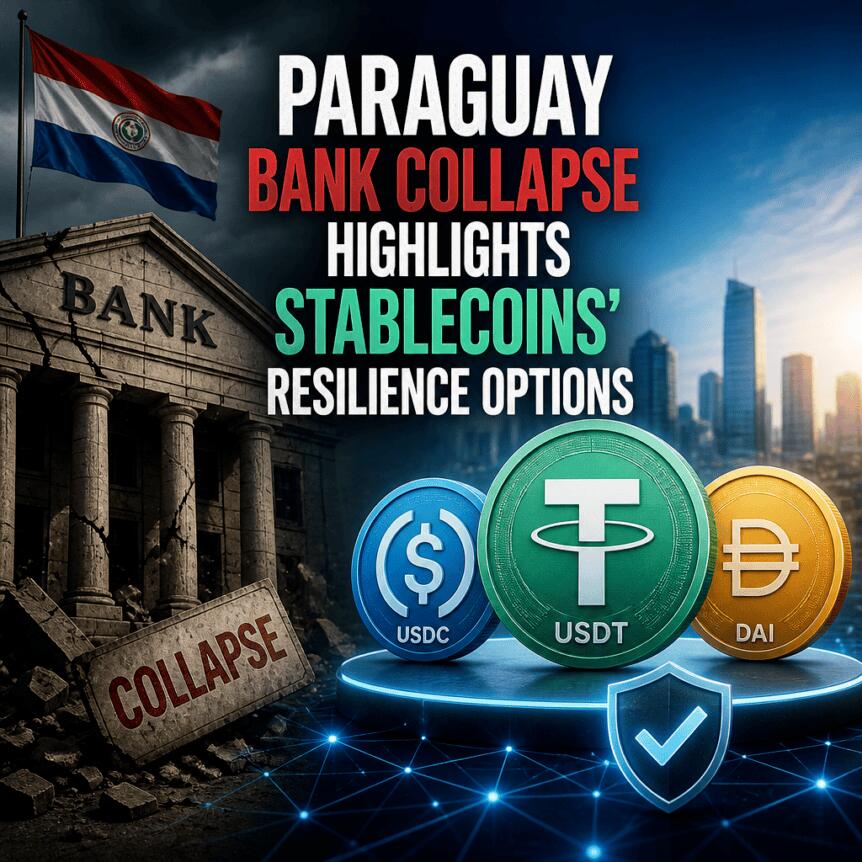
Paraguay’s digital lender Ueno Bank has been placed into resolution, leaving nearly three million customers—about 60% of the country’s adults—unable to access funds tied to the institution. The move followed a Central Bank finding that Ueno’s solvency ratio fell below the legally required minimum, alongside an investigation that pointed to “questionable lending practices” and weaknesses in credit documentation and accounting.
The shutdown immediately rippled beyond traditional finance. On Paraguay’s peer-to-peer crypto markets, some sellers reportedly began pricing USDT at a noticeable premium, reflecting a sudden need for readily usable liquidity as households and small businesses tried to keep wages, rent, and supplier payments on schedule.
Key takeaways
- Paraguay’s Central Bank initiated Ueno’s resolution on Nov. 3 after solvency fell below the legal threshold and the regulator flagged issues in lending, credit documentation, and accounting.
- Nearly 3 million customers—around 60% of Paraguayan adults—were left without normal access to their accounts, intensifying short-term payment pressure.
- Local crypto activity shifted toward dollar-pegged stablecoins as traders and users sought faster liquidity than traditional banking during the disruption.
- As of Nov. 9, the Central Bank said 93.1% of Ueno deposit customers had been repaid, but sentiment remains fragile.
- Analysts warn that stablecoins are not “bank-like” substitutes with deposit guarantees, raising the importance of transparency and consumer protections.
Resolution after a solvency breach
Ueno’s collapse became official when Paraguay’s Central Bank placed the lender into resolution on Nov. 3. The regulator said the firm’s solvency ratio dropped below half of the legally required minimum. The Central Bank’s investigation also cited deficiencies in how loans were documented and accounted for, along with broader concerns about the lender’s lending practices.
The fallout quickly became political as well. Thousands protested after the bank’s failure, and President Santiago Peña faced further turmoil—attempting to resign before being impeached and later arrested on charges including breach of trust and alleged misuse of office for personal gain. While the political story unfolds on its own track, the immediate effect on households was unmistakable: access to banking services was interrupted at the exact moment many residents rely on scheduled payments.
Stablecoin demand rises amid urgent cash-flow needs
On Paraguay’s P2P platforms, the market response was swift. According to reporting reflected in local exchange activity, some sellers asked for a premium of up to 13% for USDT during the turmoil. The message behind the numbers was simple: when bank access is limited, stablecoins can become the most practical vehicle for moving value and meeting near-term obligations.
Tether CEO Paolo Ardoino framed the broader point publicly, arguing that USDt functions as “a lifeline” for people who may not always have reliable banking access.
David Eisenmann, founder and CEO of Paraguayan crypto exchange X4T, tied the timing of the disruption to an acute liquidity crunch. He noted that the intervention came in the first days of the month—when salaries are due, rent payments are scheduled, and businesses often need cash to pay supplier invoices. In his view, some business owners “couldn’t make payroll,” turning USDt into a sudden source of immediately usable liquidity.
“This week they learned that having an account isn’t the same as having access to your money.”
That distinction is critical. It suggests that even if deposits eventually get repaid, the inability to access funds in the interim can still cause real-world disruption—especially for smaller businesses that cannot bridge cash-flow gaps.
What the data says after repayouts begin
Paraguay’s regulator sought to reassure customers by announcing that, as of Nov. 9, 93.1% of customers with Ueno deposits had been repaid. However, confidence has been shaken. Eisenmann said that X4T continued to see heightened inquiries for dollar-denominated stablecoins and that demand levels had not significantly faded from the week of the collapse.
GlobalData analyst Rhys Hicks described the event as a governance failure that did not match the pace at which the digital bank expanded. Yet Hicks also argued that he was not seeing evidence of a mass flight from Paraguayan banks into stablecoins. In his assessment, other institutions helped absorb demand, and public anger appeared to be directed more at government handling than at banks as a category.
Still, even if there is no immediate “migration,” the episode may shift behavior at the margin—pushing some consumers to diversify how they store and move money, particularly when traditional access breaks down.
Stablecoins: a modern hedge, but not a substitute for guarantees
Concerns about “seeking dollars” during banking stress are not new. During Argentina’s 2001 crisis, the government imposed restrictions on withdrawals from bank accounts through measures that later became known as the “corralito.” Subsequent policy actions converted dollar-denominated deposits into pesos, reducing people’s savings quickly and damaging confidence in the banking system.
Stablecoins offer a different mechanism, but they are not the same as insured deposits. Hicks and other analysts highlighted that stablecoin holders do not benefit from deposit guarantees in the way bank customers do, and there is no central bank equivalent that can step in and restore value if reserves are inaccessible or transparency issues emerge.
That risk is not hypothetical. In March 2023, Circle disclosed that $3.3 billion of USDC reserves—about 8% of the total—were held at Silicon Valley Bank. After the disclosure, USDC briefly traded at a discount in secondary markets and fell as low as 86 cents, reflecting how reserve concentration and the ability to withdraw funds can affect perceived stability—even for dollar-pegged tokens.
Broader policy research adds another layer. A Bank for International Settlements paper on stablecoins and the international monetary system warned that widespread use of dollar-backed tokens could create challenges for monetary sovereignty in emerging markets.
Eisenmann expects the Ueno incident to drive more diversification: customers may spread funds across multiple channels, including banks, cash, and digital assets, rather than placing trust in a single institution. How quickly confidence returns will likely depend on how promptly and transparently authorities handle the resolution process—particularly the timing and clarity of customer reimbursements.
For Paraguay’s crypto market, the key question now is whether stablecoin demand is a temporary response to a one-off disruption—or the start of a longer behavioral shift toward dollar-pegged liquidity when trust in domestic banks is strained. Investors, traders, and builders should watch next for follow-through on repayments, any regulatory moves targeting stablecoin-related consumer protection, and how local banking access changes in the weeks after the resolution.