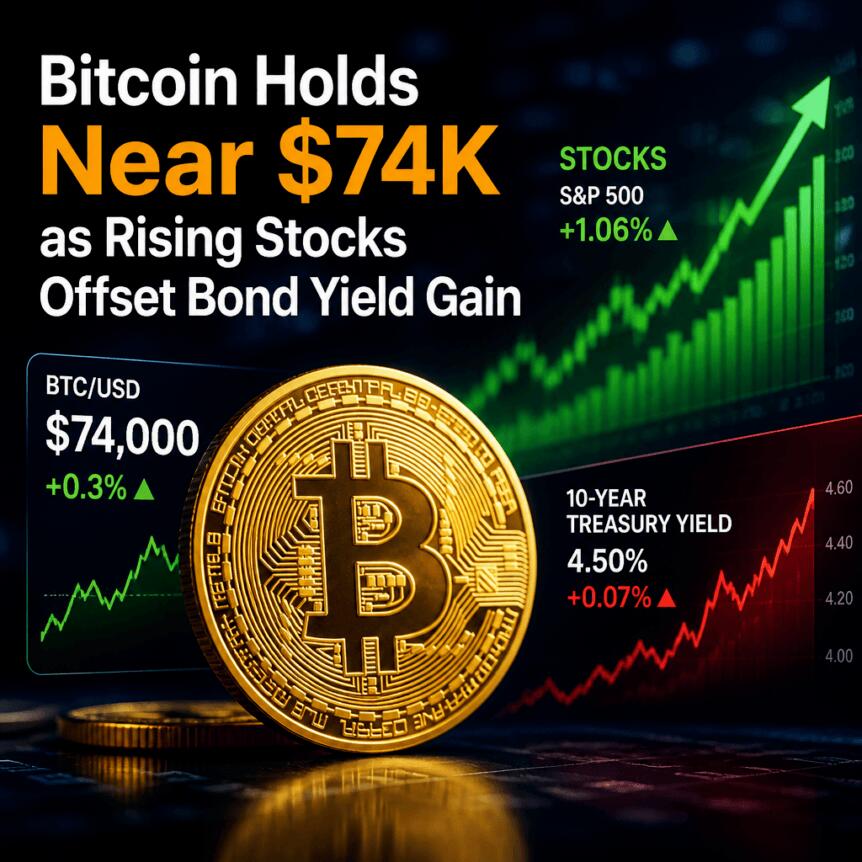
Bitcoin started Wednesday’s Wall Street session hovering near $74,000 as equities extended earlier gains and US bond yields climbed sharply. Despite the broader risk-on tone, BTC/USD largely failed to track the momentum in stocks, reflecting a market that is still focused on rates and macro liquidity rather than purely on equity-style catalysts.
At the same time, the day’s equity outperformance was driven by an AI and cloud-computing pocket of strength, with CoreWeave shares surging after a strong quarter. Meanwhile, higher-than-expected US CPI inflation pushed the US 10-year Treasury yield back toward the 5% level, narrowing the room for risk assets—including Bitcoin—to move decisively.
Key takeaways
- Bitcoin trades around $74,000 while US equities rise; BTC’s intraday action diverged from tech-led stock strength.
- The US 10-year bond yield returned to 5% after CPI inflation pushed yields higher, reinforcing a more hawkish rates narrative.
- BTC remained range-bound between its 21-week and 50-week trend lines, around $73,078 and $75,492 respectively.
- CoreWeave’s post-earnings jump helped drive early tech gains, but it did not translate into a clear directional move in Bitcoin.
- Bitcoin volatility cooled as traders waited for the next macro catalyst following the CPI release.
Stocks rally, but Bitcoin tracks yields instead
Early in the session, investors rotated back into parts of the technology complex. TradingView data showed BTC/USD moving in a different rhythm than US equities, as traders appeared to buy dips in tech stocks while treating Bitcoin as a more direct function of interest-rate expectations.
CoreWeave led the day’s equity momentum, rising more than 20% after reporting better-than-expected Q3 revenue and lifting its 2026 guidance (as noted in earlier coverage on Cointelegraph: https://cointelegraph.com/markets/coreweave-stock-surges-pre-market-q3-revenue). Nvidia opened about 2.5% higher after a weaker start to the week tied to ongoing controversy involving CEO Jensen Huang.
Even with stocks climbing, the rate backdrop dominated cross-asset sentiment. The US 10-year Treasury yield hit a high of about 5.02% during the session, a move linked to the market repricing inflation risk after CPI data came in hotter than expected.
Bonds, not earnings, set the pace after CPI
CPI inflation pushed US bond yields higher again on Wednesday, bringing the 10-year yield back to the 5% area for the first time since Oct. 29. The 30-year yield also climbed, reaching as high as 5.378%, a level last seen around Oct. 22.
Peter Boockvar, chief investment officer at One Point BFG Wealth Partners, said bonds were pricing a more hawkish approach from the Federal Reserve. CNBC reported Boockvar’s view that inflation dynamics were leaving the market focused on rate hikes ahead—while “regular Treasuries” were reacting to expectations that the Fed would hike next month, with odds increasing for an additional move into January (Boockvar via https://www.cnbc.com/2026/11/10/us-bonds-treasurys-yields.html).
For Bitcoin traders, this matters because higher real yields and tighter financial conditions typically reduce the attractiveness of non-yielding assets. In this setup, even strong equity-specific news can struggle to produce sustained upside for BTC unless rates expectations soften or a clear crypto-native catalyst emerges.
Oil rises as geopolitics remains unresolved
Energy markets were also in focus. Oil prices gained as optimism around potential progress in US-Iran diplomacy faded against continued attacks impacting shipping through the Strait of Hormuz.
Reuters, citing LSEG Oil Research, highlighted that even if a deal were reached, restoring pre-conflict traffic levels would still depend on practical constraints such as mine clearance, insurance costs, and whether shipowners would accept the residual risk (per Reuters coverage: https://www.reuters.com/business/energy/oil-rises-two-month-low-hormuz-shipping-attacks-offset-iran-truce-hopes-2026-11-11/).
In the session, WTI crude was up about 1.4% to roughly $87.70 per barrel after falling to $84 on Tuesday, its lowest since late August. Brent crude rose about 1.5% to around $93.40. While these moves are separate from crypto, energy volatility can indirectly influence inflation expectations—reinforcing the same macro channel that is currently pressuring or supporting BTC.
BTC constrained by long-term trend lines
Technically, Bitcoin continued to trade between two key reference points: its 21-week and 50-week simple moving averages, at approximately $73,078 and $75,492 respectively. With volatility cooling after the CPI-driven repricing, the market stayed largely bracketed, suggesting traders were reluctant to press directional bets without a new catalyst.
That range also framed investor stress. Cointelegraph previously described the short-term holder (STH) aggregate cost basis—defined as the average price at which short-term cohort holders (entities holding BTC for up to 155 days) acquired their positions. As BTC lost support around $75,700, it moved below that STH cost basis, according to the same framework referenced earlier in Cointelegraph’s coverage (https://cointelegraph.com/markets/btc-price-nvidia-volatility-three-things-bitcoin-this-week).
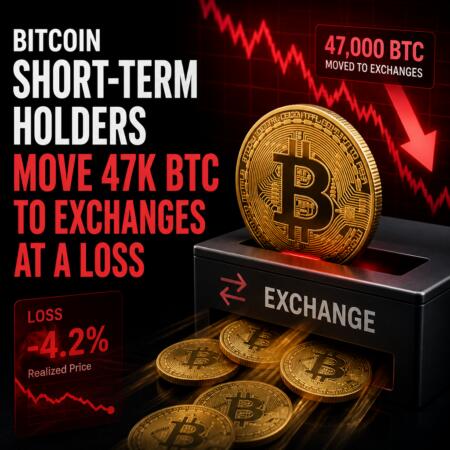
The potential for supply to increase remains a concern. Earlier coverage on Cointelegraph noted that on Tuesday STH wallets sent over 47,000 BTC to exchanges at an unrealized loss (unrealized from the perspective of the STH cohort), a move that could be interpreted as a risk-off signal if the coins ultimately get sold (see: https://cointelegraph.com/markets/bitcoin-speculators-btc-exchanges-unrealized-loss-727k).
In the current environment, that kind of on-chain stress can combine with macro headwinds—particularly if yields remain elevated—to keep BTC from breaking higher. Conversely, if yields pull back after the market digests CPI implications, the range-bound behavior could resolve more favorably for buyers.
Going forward, traders are likely to watch whether Treasury yields sustain their climb or retrace after the initial CPI shock, and whether exchange inflows from short-term holders continue to build. Either shift could determine whether Bitcoin remains pinned between its 21-week and 50-week levels—or whether this consolidation finally turns into a clearer trend.