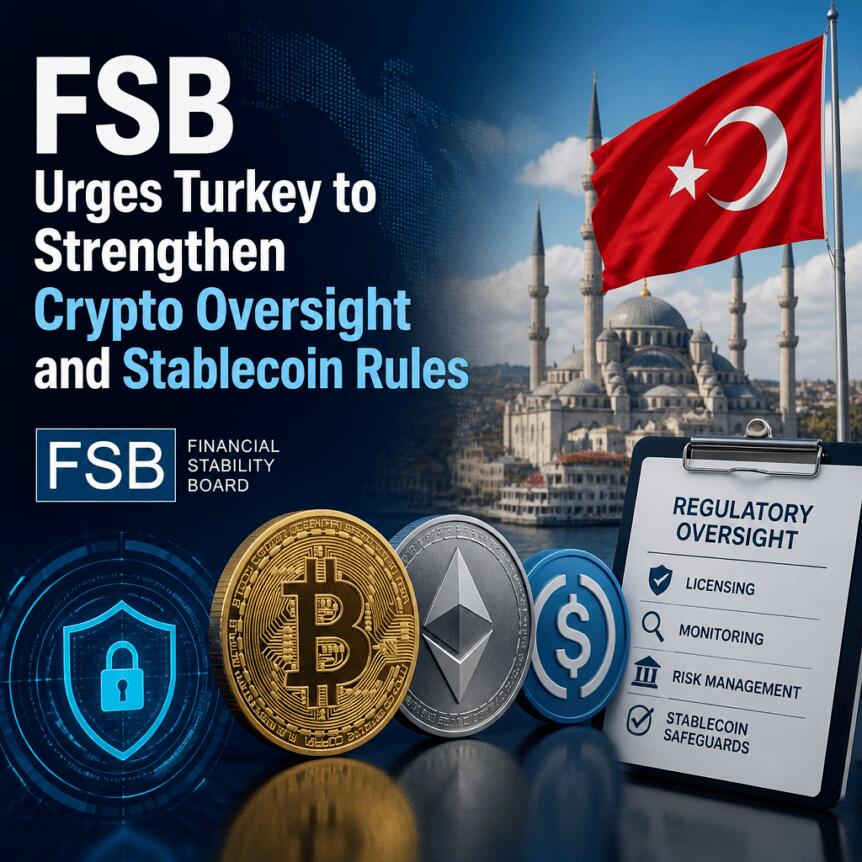
Turkey received fresh scrutiny from the Financial Stability Board (FSB), which urged Turkish authorities to further tighten oversight of crypto markets and move toward dedicated regulation for stablecoins. The call comes in a peer review published this week by the global financial watchdog.
The FSB said Turkey has already made progress by building a regulatory framework for crypto service providers, including registration and licensing requirements. Still, it warned that gaps remain—particularly around how stablecoin risks are monitored and managed in a way that supports broader financial stability goals.
Key takeaways
- The FSB recommends Turkey formalize monitoring of crypto-related risks to financial stability under a dedicated framework.
- Turkey has implemented registration and licensing requirements for crypto service providers, but the FSB says stablecoin rules remain insufficient.
- The review points to improved supervisory tools, including custody safeguards such as asset segregation and a ban on domestic crypto payments.
- The FSB urges stronger enforcement, supervision, and cross-border cooperation and information sharing with foreign regulators.
FSB peer review highlights progress—and remaining blind spots
In its Wednesday peer review, the FSB evaluated how Turkey has been implementing the board’s 2023 recommendations on crypto assets and stablecoins. The review is part of the FSB’s regular country assessment program, which tracks how jurisdictions apply global guidance over time.
The FSB also referenced its broader 2025 review, which found that multiple jurisdictions had not fully closed gaps in implementing the 2023 recommendations. In that context, the Turkish review functions as both a recognition of incremental regulatory steps and a checklist of areas where further work is still required.
According to the FSB, Turkey should begin monitoring crypto-related risks to financial stability under a more structured approach, while also strengthening supervision and enforcement capacity. The board also emphasized the importance of better cooperation and information sharing with overseas regulators—an issue that matters in practice because crypto activity and service providers often cross borders.
Licensing and operational requirements for crypto intermediaries
One part of the FSB’s assessment focused on measures Turkey introduced for crypto service providers. Earlier coverage noted that Turkey’s Capital Markets Board (CMB) introduced licensing and operational requirements for crypto exchanges and custodians in March 2025, including minimum capital thresholds.
These steps are significant because licensing and capital requirements are often used to ensure intermediaries can withstand operational stress and reduce the likelihood of misconduct or insolvency that could spill over into the wider financial system. By bringing exchanges and custodians into a more formal regulatory perimeter, Turkey has taken a concrete step toward managing counterparty and custody-related risks.
The FSB’s peer review also acknowledged safeguard measures designed to limit contagion channels. It cited requirements around segregating assets held in custody, as well as a ban on domestic crypto payments. The FSB framed these safeguards as ways to contain risks from spreading to banks and payment systems.
Custody safeguards, monitoring tools, and the stablecoin gap
In addition to segregation requirements and payment restrictions, Turkey has reportedly launched a centralized platform intended to monitor crypto activities. For regulators, centralized monitoring can be a practical lever: it can improve visibility into market participants and help authorities identify issues earlier than isolated reporting would allow.
However, the FSB said the overall picture is incomplete. The board noted that while Turkey had finalized rules for crypto assets, it still lacked a dedicated stablecoin framework. This distinction matters because stablecoins can carry a different profile of risks—especially where they are used for payments, settlement, or movement of value—potentially affecting liquidity conditions and financial stability more directly than some other crypto categories.
Earlier reporting cited plans from Turkey’s Finance Ministry in June 2025 to introduce additional transaction checks and limits on stablecoin transfers aimed at combating money laundering. The FSB’s peer review suggests that such AML-oriented measures alone may not be sufficient if stablecoins are not covered by a comprehensive set of rules that addresses the full range of financial stability concerns.
Enforcement, cross-border cooperation, and what to watch next
The FSB’s recommendations point to where Turkey’s next regulatory phase may need to focus. The board wants a formal framework for monitoring crypto risks to financial stability, along with stronger supervision and enforcement. It also highlights the need to improve cooperation and information sharing with foreign regulators—an area that becomes increasingly important as enforcement outcomes and supervisory intelligence depend on timely cross-border coordination.
For market participants, the practical implication is that compliance expectations may evolve beyond licensing and custody safeguards. In particular, stablecoin operations could face additional regulatory scrutiny as Turkey works toward a dedicated stablecoin regime consistent with the FSB’s 2023 recommendations.
Readers should watch how Turkey develops a stablecoin framework after identifying this gap, and whether future steps expand supervision from AML and transfer controls into broader financial stability risk management. The direction of travel suggested by the FSB may determine how clearly intermediaries and issuers understand their obligations—and how quickly regulators can react to risks as usage grows.