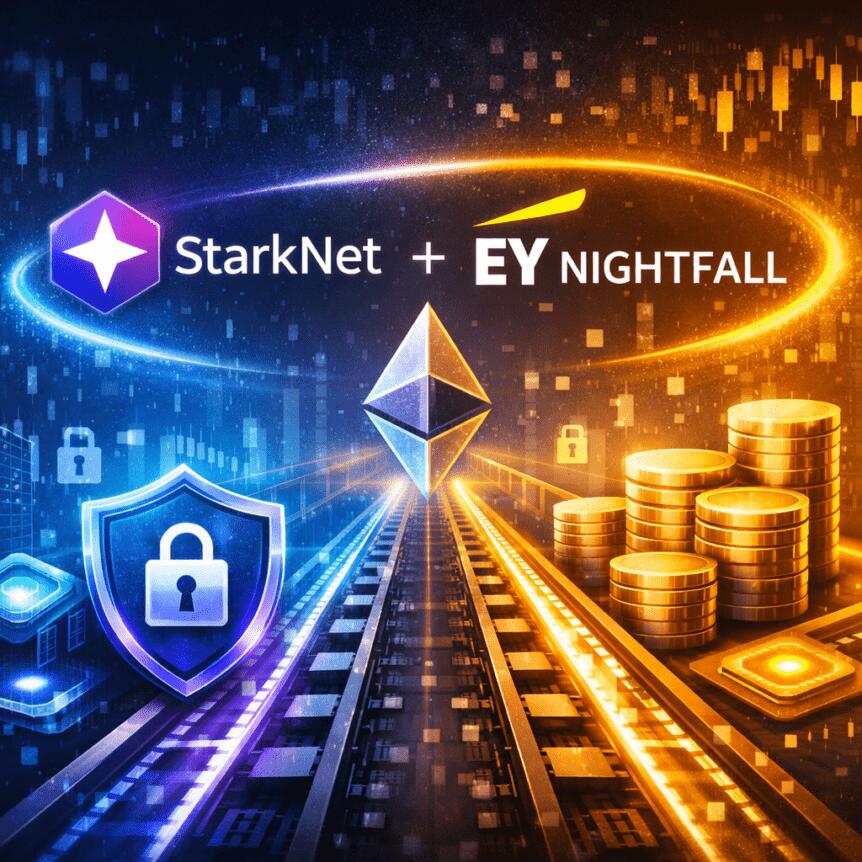
StarkWare’s Starknet is expanding its privacy capabilities through the integration of EY’s Nightfall protocol, enabling institutions to execute private payments and decentralized finance (DeFi) activity on Ethereum-aligned public infrastructure. The deployment introduces privacy-preserving transaction flows designed for institutional evaluation, including KYC-aligned private payments and settlement workflows.
In its announcement, StarkWare framed the integration as a step toward bridging traditional enterprise requirements with open blockchain ecosystems. Rather than relying on siloed, permissioned networks, the approach leverages a shared layer-2 environment while incorporating compliance-oriented features suitable for institutional participation.
Nightfall, EY’s open-source zero-knowledge privacy protocol, allows transactions to be validated without exposing sensitive underlying data. This unlocks a range of use cases including cross-border payments, confidential treasury management, and on-chain transfers of tokenized assets, all while enabling selective disclosure aligned with regulatory requirements.
Key takeaways
- StarkWare is integrating EY Nightfall into Starknet to support private transactions on an Ethereum-compatible layer-2 network.
- The initiative focuses on enabling institutional adoption through privacy-preserving transaction flows and compliance-aligned onboarding.
- Nightfall’s zero-knowledge architecture allows verification without revealing underlying data, while supporting selective disclosure where required.
- The rollout will follow a staged approach, beginning with private payments and settlement workflows before expanding to additional use cases.
- Starknet continues to position itself as a leading ZK rollup, despite prior infrastructure challenges that prompted reliability upgrades.
Market context: The integration reflects a broader shift toward privacy-enabled, compliance-aware infrastructure within the Layer-2 ecosystem, as institutions increasingly explore on-chain financial operations.
Why it matters
The integration of Nightfall into Starknet represents a strategic move to make public blockchain infrastructure more accessible to institutional participants. By combining privacy-preserving technology with compliance-oriented transaction design, StarkWare aims to lower the barriers that have historically limited enterprise adoption of decentralized networks.
Rather than forcing a trade-off between transparency and operational confidentiality, the model enables organizations to conduct sensitive financial activities on-chain while retaining the ability to meet regulatory expectations through controlled, selective disclosure.
Eli Ben-Sasson, StarkWare’s co-founder and CEO and a founding scientist behind Zcash (ZEC), described the initiative as a step toward building a “private superhighway” for stablecoins and tokenized deposits. The vision highlights how institutions could access DeFi functionalities such as lending, trading, and yield generation without exposing proprietary transaction data.
According to StarkWare’s global head of business development, Alex Gruell, Nightfall’s alignment with KYC-based onboarding frameworks may serve as a key differentiator for enterprises entering the blockchain space. This approach emphasizes compatibility with existing compliance processes while maintaining the benefits of open network infrastructure.
The integration is also positioned as a bridge between traditionally siloed financial systems and the broader Web3 ecosystem. Unlike closed, permissioned networks, Starknet’s architecture remains open and interoperable, allowing institutions to interact with decentralized applications while maintaining appropriate safeguards.
Starknet’s growth and teething challenges
Starknet has emerged as one of the most prominent zero-knowledge rollups by total value locked (TVL), supported by a growing ecosystem of DeFi protocols and applications. However, its rapid expansion has not been without challenges.
Throughout 2025, the network experienced several outages linked to sequencer performance and infrastructure limitations. These incidents led to public post-mortems and a renewed focus on strengthening reliability, a critical requirement for attracting institutional users who depend on consistent uptime and operational resilience.
Ongoing upgrades aim to improve scalability, transaction throughput, and system stability as Starknet prepares to support more complex, high-value institutional flows.
What to watch next
- Progress of the staged rollout, including initial deployment of private payment workflows.
- Adoption metrics among early institutional participants and pilot programs.
- Enhancements to Starknet’s infrastructure, including sequencing and performance upgrades.
- Regulatory developments and how privacy-preserving systems align with evolving compliance standards.
Sources & verification
- StarkWare official announcement on Nightfall integration.
- EY documentation on the Nightfall privacy protocol.
- Industry coverage and technical analysis of zero-knowledge rollups.
- DeFiLlama data on Starknet’s total value locked (TVL).
- Starknet infrastructure reports and post-mortems from 2025.
What the story means for users and builders
For developers, the integration opens the door to building applications that combine privacy with compliance-ready features, potentially expanding the range of enterprise-focused use cases on public blockchains. For institutions, it signals a growing maturity in blockchain infrastructure, where participation no longer requires full exposure of transaction data.
This evolution could accelerate the transition from isolated blockchain pilots to more integrated, production-level deployments across financial services, treasury management, and cross-border settlement.
Key figures and next steps
With Nightfall integrated into Starknet, the roadmap includes expanded privacy features, enhanced selective disclosure mechanisms, and broader support for institutional-grade financial workflows. Success will depend on balancing privacy, performance, and regulatory compatibility as adoption scales.
Why it matters for the broader market
The move reflects a wider industry trend toward privacy-preserving infrastructure that aligns with regulatory expectations. As blockchain technology continues to evolve, solutions that enable confidential transactions alongside compliance-oriented controls are likely to play a central role in attracting institutional capital.
If successful, Starknet’s approach could influence how other Layer-2 networks design their privacy and compliance frameworks, shaping the next phase of decentralized finance and enterprise blockchain adoption.