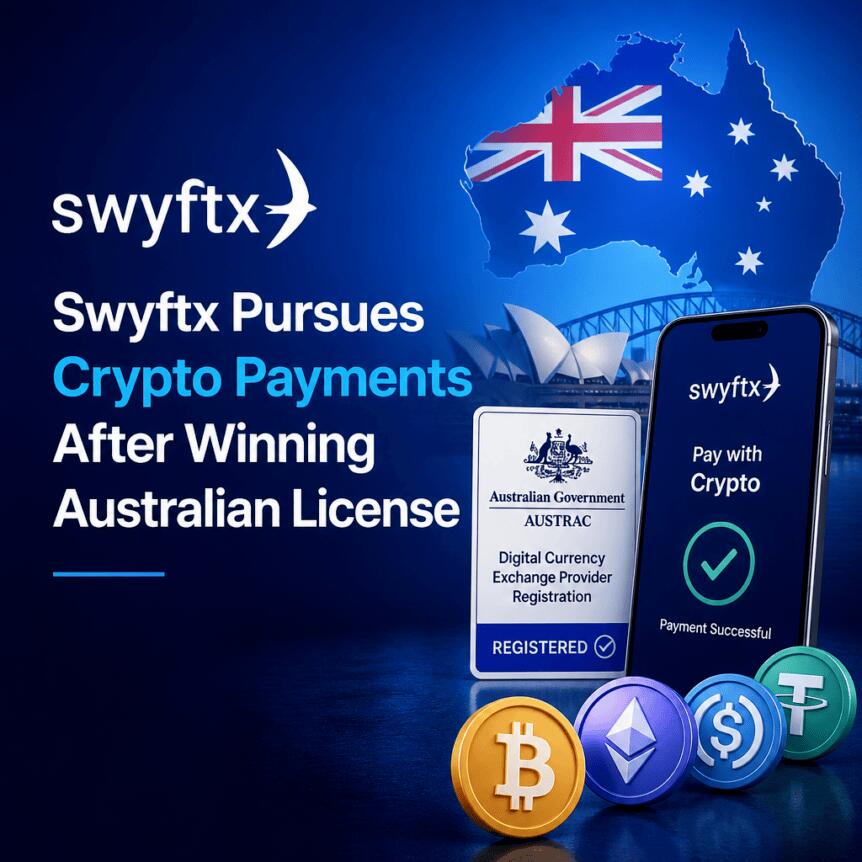
Australian crypto exchange Swyftx says it has received an Australian Financial Services License (AFSL), giving it regulatory permission to offer certain crypto-linked products to retail customers and to provide non-cash payment services to businesses and individuals. The move is also tied to Swyftx’s stated shift away from a “spot-only” model, with management pointing to upcoming changes in Australia’s card payment surcharge rules.
According to Swyftx, the license allows it to support derivative offerings—such as crypto options and futures—for retail users, alongside authorization for non-cash payment facilities. The AFSL does not, however, cover spot crypto trading.
Key takeaways
- Swyftx has obtained an AFSL from Australia’s market regulator, enabling retail derivatives and non-cash payment services.
- The company says it does not intend to remain a pure spot exchange, citing room in crypto payments after credit-card surcharge reforms.
- From Oct. 1, Australian merchants are set to face new restrictions on Visa and Mastercard debit/credit surcharges, potentially pushing demand toward alternative payment rails.
- AFSL compliance obligations are expected to become central for most crypto firms, with legislation setting an April 9, 2027 deadline.
Swyftx’s AFSL enables derivatives and payment-facility services
Swyftx announced on Wednesday that it has been granted its AFSL, positioning it among a growing group of crypto companies already operating under Australia’s broader financial-services framework. The license places Swyftx in the same regulatory category as exchanges previously licensed for comparable activities, including Coinbase, BTC Markets and Crypto.com.
In an interview with Cointelegraph, Swyftx interim co-CEO Andrea Yuen said the firm does not plan to remain “a pure crypto spot exchange.” Instead, Swyftx is aiming to broaden its product set and pursue opportunities in payments—particularly in areas it believes could benefit from local regulatory and cost changes affecting card payments.
Operationally, the AFSL matters because it expands what Swyftx can offer within the Australian market. As the company described, the license supports two major directions: derivative products for retail customers (for example, options or futures) and non-cash payment facility authorization, which could allow Swyftx to serve both business and retail clients with payment services.
At the same time, Swyftx’s AFSL does not cover spot crypto trading. That distinction is important for users and investors: the licensing step is not simply a blanket endorsement of all crypto activities, but a permission tied to specific regulated functions.
Why card surcharge changes are driving a push toward crypto payments
A core part of Swyftx’s strategy is directly linked to expected changes to how merchants can recover card payment costs. From Oct. 1, Australian businesses will be banned from adding surcharges to Visa and Mastercard debit and credit card payments. For many merchants, that removes a common mechanism used to pass card transaction costs to customers.
In that environment, Swyftx says it sees potential for alternative payment rails—specifically crypto and stablecoins. Yuen told Cointelegraph that crypto payments and stablecoins could provide merchants with an opportunity to lower transaction costs they may otherwise have to absorb.
The logic is straightforward: when a payment network’s pricing can’t be “passed through” via surcharges, businesses may look for ways to reduce net payment expenses. Stablecoins and regulated crypto payment flows are often discussed as one possible alternative, but the practical impact will depend on merchant adoption, integration pathways, and how regulators supervise payment-related activity.
For the market, Swyftx’s license could also help it participate in payments-based competition rather than relying only on trading volumes. If merchants do move search for cheaper rails following Oct. 1, exchanges with the right authorization may find new distribution channels—especially where stablecoin settlement can be paired with compliant payment tooling.
AFSL deadline pressure builds as ASIC extends a licensing grace window
Beyond Swyftx’s immediate products, the AFSL is tied to a wider regulatory timetable for the Australian crypto sector. Legislation passed in April requires most crypto firms to obtain an AFSL from April 9, 2027, according to earlier coverage by Cointelegraph (https://cointelegraph.com/news/australia-pass-bill-mandate-crypto-exchange-license).
Until now, many crypto exchanges were required primarily to maintain anti-money laundering (AML) and know-your-customer (KYC) controls rather than full financial-services licensing duties. With the AFSL framework, firms are expected to follow compliance standards comparable to other regulated financial institutions.
Yuen described the shift as “an enormous responsibility to be a regulated financial service,” underscoring that obtaining the license is not simply a marketing milestone—it comes with ongoing obligations.
At the regulator level, ASIC has also been working to manage the transition. The Australian Securities and Investments Commission recently extended its grace period for crypto businesses to apply for an AFSL until Sept. 30. ASIC said it has received around 30 license applications from crypto businesses since October last year (ASIC statement: https://www.asic.gov.au/about-asic/news-centre/news-items/asic-extends-no-action-position-for-digital-asset-businesses-to-30-september-2026/).
Only a limited number of crypto exchanges have so far obtained AFSLs, including Coinbase, BTC Markets, Crypto.com and KuCoin, based on prior Cointelegraph reporting (https://cointelegraph.com/news/ripple-eyes-australian-financial-license-through-acquisition).
For investors, traders, and builders, this is a key inflection point: licensing progress can influence which firms can expand into derivatives retail distribution and regulated payment services, while laggards may be constrained by timelines and regulatory uncertainty as April 2027 approaches.
Australian retail adoption remains resilient as licensing expands
While regulatory licensing advances, local interest in crypto assets continues to be reflected in consumer surveys. A survey cited by Swyftx’s update from Independent Reserve suggested that 33% of Australians now own cryptocurrency, up from 31% in 2025.
Independent Reserve CEO Adrian Przelozny said younger Australians are increasingly confronting economic pressures that make traditional wealth-building options—particularly home ownership—feel less attainable. He argued that, as a result, many are exploring alternative assets, with cryptocurrency viewed as one option that has historically delivered stronger returns than traditional portfolios.
The same survey indicated that Bitcoin remains the dominant digital asset among respondents, with 71% reporting they hold it.
Taken together, rising participation and accelerating licensing could create a broader market environment: more consumers may seek regulated access, while exchanges that secure AFSL permissions may be better placed to deepen product offerings and payment-related services.
Looking ahead, readers should watch how Swyftx and other newly licensed firms translate AFSL capabilities into real payment integrations and derivative offerings, and whether merchant adoption follows the Oct. 1 surcharge rule change as expected. The regulatory transition toward 2027 will also be a determining factor in how quickly Australia’s crypto market can diversify beyond spot trading.