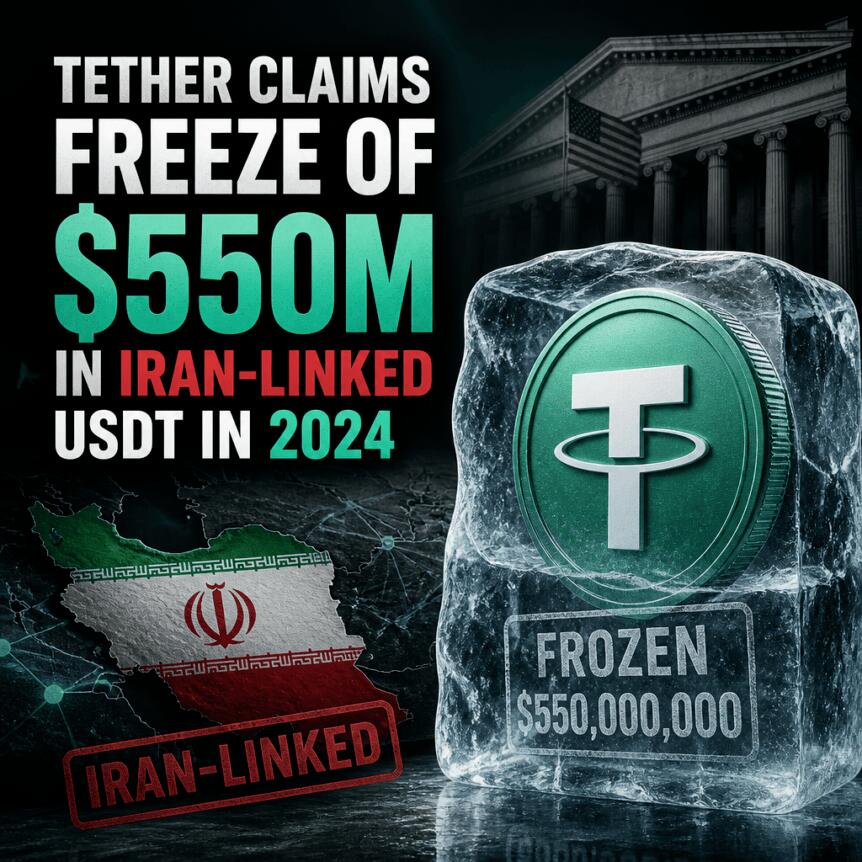
Stablecoin issuer Tether says it helped freeze nearly $550 million in USDT tied to Iran-linked entities during 2026, positioning the company’s compliance efforts amid fresh scrutiny from U.S. lawmakers.
In a statement released Monday, Tether said it has worked with international law enforcement “for years,” and that this year it froze more than $130 million in USDT across four wallets. Tether also claimed that in April it froze over $344 million in funds linked to the Central Bank of Iran.
Key takeaways
- Tether says it supported the freezing of nearly $550 million in Iran-linked USDT during 2026, including a reported $344 million action in April.
- The claims come as Senate Democratic investigators released a report alleging USDT has become a prominent route for Iran to evade sanctions.
- According to the Senate findings cited by Tether’s critics, 84% of 846 sanctioned wallets tied to Iran transacted mostly in USDT.
- Tether maintains that USDT is not used as a “haven” for sanctioned actors, terrorist groups, or criminal networks and points to prior cooperation with U.S. agencies.
- Senator Richard Blumenthal called on the U.S. Treasury and Justice departments to investigate whether sanctions rules were violated.
Tether points to compliance work as lawmakers renew pressure
Tether’s Monday statement responded to renewed political attention after Democratic investigators on the U.S. Senate Permanent Subcommittee on Investigations released a report about Iran-related sanction evasion and stablecoin usage.
While lawmakers’ concerns focus on the role of USDT in sanctioned flows, Tether frames its response around operational coordination with law enforcement. The company said it has “consistently demonstrated” that USDT is not a refuge for sanctioned actors, terrorist organizations, or criminal networks.
For investors and market participants, the dispute matters because stablecoins sit at the center of how value moves across crypto markets. If compliance mechanisms are perceived as effective, that can influence institutional comfort and exchange policies. If lawmakers believe gaps remain, it can also accelerate regulatory and enforcement actions affecting stablecoin issuers more broadly.
The Senate report’s allegation: USDT dominates Iran-linked wallets
According to the Senate Subcommittee on Investigations report as referenced in the news coverage of the Democratic release, investigators reviewed 846 crypto wallets sanctioned for ties to Iran. The report alleges that 84% of those wallets transacted exclusively or nearly exclusively in USDT.
The resulting political pressure prompted Senator Richard Blumenthal to call on the Treasury and Justice departments to investigate potential sanctions violations related to stablecoin activity.
Notably, the Senate framing emphasizes channel concentration—USDT’s share of transaction activity in sanctioned wallets—rather than arguing that every USDT transfer is illegal. That distinction may be central as authorities decide what “sanctions violations” would look like in practice, including whether actions involved direct dealings with prohibited parties, failures to comply with legal obligations, or other issues under U.S. law.
Tether’s stated figures: freezing actions and cooperation with agencies
Tether said its work with authorities has led to more than $4.9 billion in assets being frozen, including more than $2.4 billion connected to U.S. authorities. The statement also cited ongoing operational coordination with agencies in the United States, including the DOJ, FBI, Secret Service, HSI, and OFAC.
Tether’s CEO Paolo Ardoino said law enforcement cooperation has been repeatedly used to trace, freeze, and recover assets, adding that the company plans to continue making those capabilities available.
In the same statement, Tether pointed to specific 2026 actions: it claims it froze more than $130 million in USDT across four wallets this year, and that in April it froze more than $344 million tied to the Central Bank of Iran.
However, the underlying compliance process—and what exactly triggers freezes—remains a point that readers should watch. Law enforcement cooperation is often described as reactive (freezing after a determination) and proactive (supporting tracing and investigations). Whether regulators interpret Tether’s approach as sufficient can depend on timelines, documentation, and how compliance interacts with sanctioned entity designations.
What to watch next: enforcement direction and compliance expectations
With Blumenthal urging investigations by the Treasury and Justice departments, the near-term focus is likely to shift from public statements to whether U.S. agencies pursue formal enforcement steps or broader policy guidance on stablecoin issuer responsibilities.
For users, traders, and exchanges, the practical consequence to monitor is whether enhanced compliance requirements—such as stronger screening, tighter wallet monitoring, or updated reporting obligations—become expected across stablecoin markets. The question investors will want answered is not just whether freeze events occur, but how consistently they happen and how effectively stablecoin rails can reduce sanctions evasion risk without impairing legitimate cross-border activity.
As the Senate Subcommittee’s report work and any related DOJ/Treasury activity develops, the key uncertainties remain: what evidence authorities consider decisive, how they interpret stablecoin usage patterns in sanctioned ecosystems, and what concrete compliance standards may follow for the stablecoin sector.