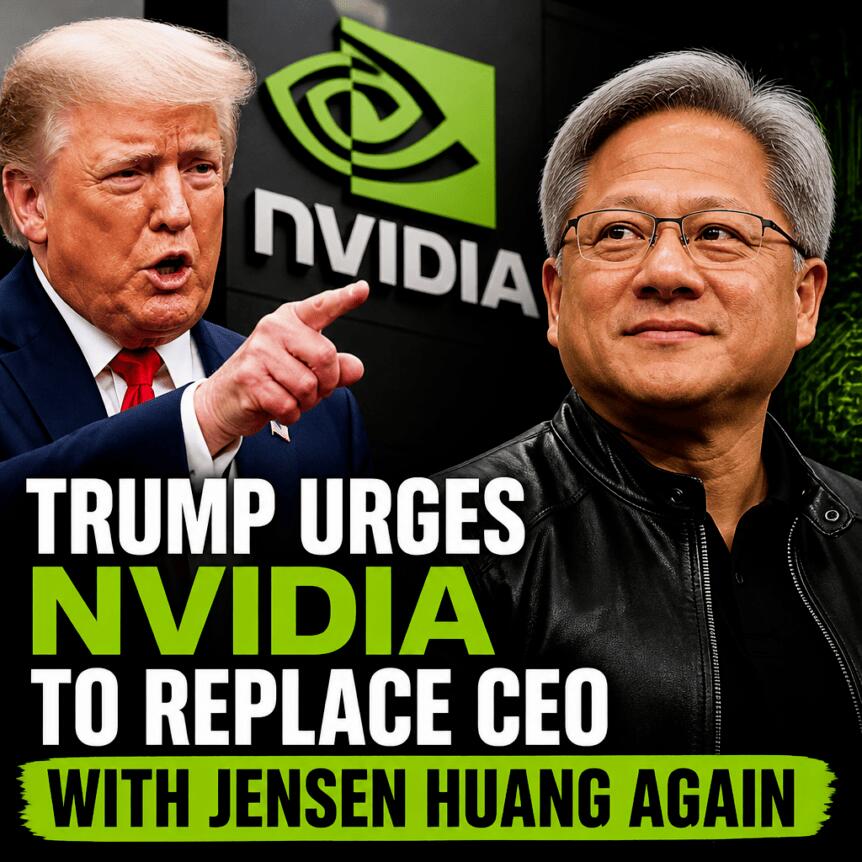
U.S. President Donald Trump has renewed calls for Nvidia to rehire its co-founder, Jensen Huang, prompting fresh attention on how far political pressure may influence corporate leadership decisions at one of the world’s most important chipmakers.
In a Monday post on Truth Social, Trump wrote that he “hope[s] the Board of Nvidia rehires Jensen Huang,” adding that it would be “the best thing for the Company, and also, for the U.S.A.” The appeal arrives only days after Nvidia indicated it did not plan to reinstate him.
Key takeaways
- Trump urged Nvidia to rehire Jensen Huang again on Monday, despite the company reportedly indicating it does not intend to reinstate him.
- His earlier remarks followed a Friday appearance in which he told reporters he wanted Huang to “make a big apology and go back.”
- U.S. Treasury Secretary Scott Bessent previously suggested Nvidia’s board should consider leadership changes, but declined to weigh in directly on whether Huang should return.
- Polymarket data indicates traders assign a 37% probability that Huang will rejoin Nvidia by Dec. 31, 2027.
Trump presses Nvidia’s board after reported non-reinstatement
Trump’s Monday post reinforces a pattern that began over the weekend. Earlier, after a trip to Asia, he told reporters on Friday that he wanted Huang to “make a big apology and go back,” according to Reuters’ coverage of the remarks.
That push comes amid ongoing public signals from Nvidia’s side. Reuters reported that Nvidia said it did not intend to reinstate Huang, a position that sets up a direct tension between the company’s posture and the President’s demand.
For investors and market watchers, the immediate relevance is less about personality and more about what leadership continuity could signal for corporate governance—particularly at Nvidia, where technology execution and customer relationships are closely tied to high-level direction.
Treasury’s stance: softer tone, but no clear endorsement
While Trump has been unequivocal, the U.S. Treasury’s public messaging appears more measured. The Financial pressure on Nvidia’s leadership has been part of a broader political conversation: Reuters previously reported that Treasury Secretary Scott Bessent had seemingly shifted away from earlier calls for a “dramatic shake-up,” including looking outside the company for new leadership.
Sunday, Bessent was asked whether Trump’s renewed support for Huang contradicts his own earlier comments. Bessent declined to say whether Huang should return. In a transcript of his interview for CBS News’ Face the Nation, Bessent said, “I think we have to see where the buck stops,” framing the issue around potential compliance with U.S. export controls.
This distinction matters because it suggests the administration’s focus may not be strictly about internal management style or corporate culture, but rather about adherence to regulatory requirements that are central to the export and deployment of advanced semiconductor technology.
Market pricing shows uncertainty, not consensus
Even with Trump’s high-profile advocacy, traders appear split on whether Huang’s return is likely. Polymarket shows participants pricing in a 37% chance that Huang will rejoin Nvidia by Dec. 31, 2027, according to the event listing referenced in the reporting.
Importantly, that figure reflects uncertainty rather than a near-term certainty. It also illustrates a key asymmetry: political statements can move narratives quickly, but corporate governance decisions tend to follow internal processes and legal or regulatory constraints that may lag behind public pressure.
For market participants, such outcomes can matter in practical terms—management changes can influence strategy, hiring, product roadmaps, and investor confidence. But the probability embedded in event markets suggests that even prominent advocacy does not automatically translate into an actionable corporate outcome.
What to watch next: board decisions and compliance signals
With Trump reiterating his preference and Nvidia having already signaled it does not plan to reinstate Huang, the near-term question for investors is whether leadership decisions will remain aligned with the company’s position—or whether governance pressure and public scrutiny will force a different conclusion.
Readers should watch for further clarification from Nvidia’s board or senior executives, along with any additional comments from the Treasury regarding how export-control compliance considerations factor into executive-level decisions. Until there’s concrete movement, event-market odds and official statements are likely to remain the clearest indicators of how the situation is evolving.