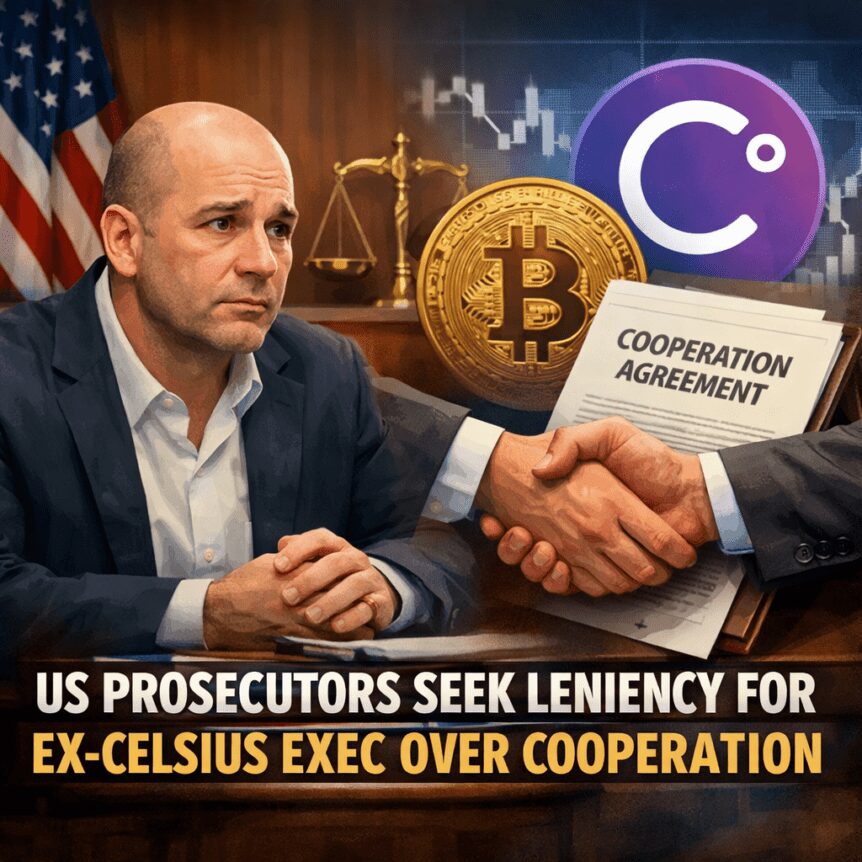
U.S. prosecutors are seeking a light sentence for Roni Cohen-Pavon, the former chief revenue officer of Celsius Network, in connection with fraud and price-manipulation charges tied to the CEL token. In a filing with the U.S. District Court for the Southern District of New York, Assistant U.S. Attorney Jay Clayton argued that Cohen-Pavon provided substantial assistance to the government, including readiness to testify against Celsius founder Alex Mashinsky.
The government did not request a specific custodial term, instead asking the judge to apply the sentencing guidelines for substantial assistance to determine an appropriate reduction.
“As soon as he pled guilty, Cohen-Pavon’s cooperation was public and known to Mashinsky,” U.S. Attorney Jay Clayton stated. “Cohen-Pavon’s cooperation was likely a significant factor in Mashinsky’s decision to plead guilty a few months prior to his January 2025 trial date.”
Cohen-Pavon pleaded guilty to fraud and conspiracy to commit price manipulation related to Celsius’s CEL token in September 2023 as part of the crypto lending platform’s activities that led to the loss of billions of dollars when the company collapsed in 2022. He had been scheduled to be sentenced before Judge John Koeltl on May 7, but on Monday the judge moved the sentencing hearing to May 13.
Related: Celsius founder Alex Mashinsky settles FTC case with $10M payment
Mashinsky, the public face of Celsius and one of the most prominent figures in the cryptocurrency industry at the time, was sentenced to 12 years in prison in May 2025 after pleading guilty to commodities and securities fraud. Many experts saw the fall of Celsius as intertwined with the 2022 crypto market downturn that resulted in the collapse of several exchanges, including FTX and Voyager Digital.
Cohen-Pavon’s lawyers asked for time served ahead of his sentencing hearing, saying that the former Celsius executive took “full responsibility for his conduct and the harms caused by his participation in the CEL token manipulation scheme.”
No new trial for former FTX CEO
The sentencing hearing for Celsius-related cases comes as another SDNY federal case moves forward. A separate development saw Judge Lewis Kaplan deny former FTX chief executive Sam Bankman-Fried’s request for a new trial. Bankman-Fried, who has faced multiple charges in connection with the FTX collapse, continues to pursue appellate avenues to challenge his conviction and sentence.
Related: Judge denies new trial for Sam Bankman-Fried
Prosecution and regulatory context in the Celsius saga
According to the court filings and contemporaneous reporting, the Cohen-Pavon proceedings reflect a broader pattern of regulator-led scrutiny of token sales, market manipulation, and executive accountability within the crypto sector. The CEL token episode is part of a string of enforcement actions that have underscored the risk to investors when platform-level incentives and token economics intersect with public disclosures and governance practices.
The Celsius case unfolded amid a difficult 2022-2023 period for the crypto industry, marked by the collapse of multiple lenders and trading venues. In the regulatory sphere, authorities have increasingly tied enforcement actions to token manipulation, misrepresentation to investors, and the integrity of token ecosystems. The cross-border dimension—between U.S. enforcement and ongoing European approaches to crypto asset supervision—has sharpened attention on licensing, disclosure, and the supervisory framework for stablecoins and related activities. Analysts expect discussions around harmonizing standards to gain clarity for issuers, exchanges, and financial intermediaries operating across borders, including in the context of MiCA-era policy development.
From an institutional and compliance perspective, the case highlights how cooperation with authorities can influence outcomes for senior executives in crypto companies. As enforcement policies evolve, firms may weigh the potential benefits of voluntary disclosure, remediation, and cooperation in any internal investigations or external proceedings. The Celsius proceedings illustrate how authorities calibrate penalties when cooperation is demonstrated and major figures acknowledge responsibility, even as the underlying losses from platform failures continue to shape risk assessments for investors and counterparties.
Regulatory posture and implications for market structure
For exchanges, lenders, and other crypto-financial service providers, the Celsius narrative reinforces several practical considerations. First, the enforcement trajectory around price manipulation and token-specific fraud is unlikely to recede, implying heightened enforcement risk for executives who influence token economics or market signaling. Second, the emphasis on substantial assistance indicates a potential lever for prosecutors to secure admissions or testimony that can streamline cases against other, higher-profile figures in the sector. Third, the intersection with broader policy initiatives—such as MiCA in the EU and ongoing U.S. regulatory developments by the DOJ, SEC, and CFTC—suggests that accountable governance, robust AML/KYC controls, and clear disclosures will increasingly factor into licensing and supervisory outcomes for crypto firms and their leadership.
In this context, the Celsius matter contributes to a growing library of precedent on how token-related misconduct will be treated under criminal law, and how cooperation can shape sentencing in complex multi-party cases. Regulators and market participants alike will be watching for how the courts interpret substantial assistance in future crypto prosecutions, as well as how cross-border policies evolve to address similar conduct in a globally connected market.
As the litigation landscape around Celsius–Mashinsky–Cohen-Pavon continues to unfold, stakeholders should monitor the May sentencing outcome for Cohen-Pavon, the ongoing ramifications of Mashinsky’s sentence, and related appellate developments in the SBF matter. The evolving posture of enforcement—coupled with cross-jurisdictional policy conversations—will continue to influence corporate governance, risk management, and strategic compliance for crypto firms and their investors.
Closing perspective: The Celsius saga exemplifies how precision in regulatory compliance, clear token governance, and cooperative engagement with authorities can shape outcomes in high-profile crypto prosecutions, with implications that extend beyond individual defendants to the structure of crypto markets and the regulatory environment in which they operate.