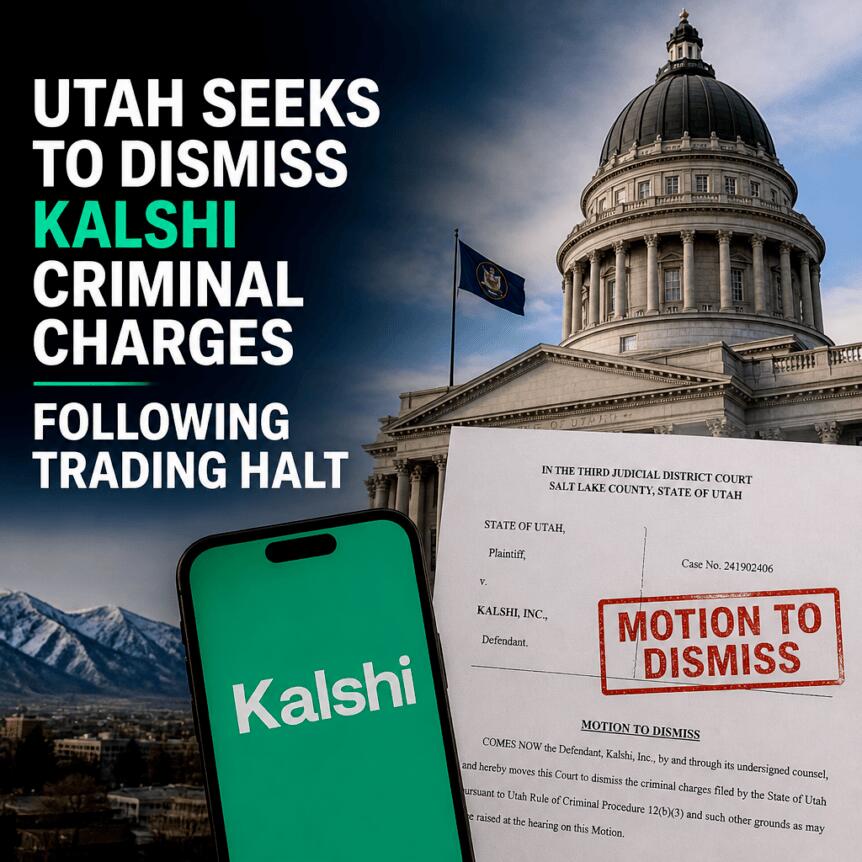
Utah’s attorney general has asked a state court to dismiss criminal charges against prediction market platform Kalshi and its two co-founders, after the company agreed to block Utah users from accessing its services. The motion, filed Monday, would end the case in its current form but keep prosecutors’ option to restart proceedings if Kalshi returns to operate in the state.
The legal fight highlights a growing, multi-layer dispute over how prediction markets should be regulated in the US—particularly when federal agencies argue they have exclusive authority over federally regulated derivatives and states assert their own gambling laws still apply.
Key takeaways
- Utah moved to dismiss 14 criminal charges against Kalshi and two co-founders without prejudice, keeping the possibility of refiling.
- Utah’s case began after Kalshi allegedly offered illegal gambling to Utah residents; the company responded by restricting state access.
- Utah’s attorney general said charges would resume only if Kalshi re-enters the Utah market.
- The dispute runs alongside a separate civil lawsuit brought by Utah, and a parallel federal challenge involving the CFTC.
Why Utah is seeking dismissal
According to Utah’s attorney general’s office, prosecutors filed a motion Monday in Utah’s Third District Court to dismiss 14 criminal charges against Kalshi and its two co-founders without prejudice. That structure matters: it prevents the charges from moving forward at present, but it also allows the state to bring them back later if conditions change.
Utah’s office initiated a criminal investigation into Kalshi in September and then filed charges on Oct. 28. The filing alleged that Kalshi offered illegal gambling to people in Utah.
Following the charges, Kalshi agreed to block access to its platform from inside Utah. The company also said it would monitor attempts by Utah-based IP addresses to reach its services—an operational concession that appears to have been the main factor behind Utah’s decision to seek dismissal.
Attorney General Derek Brown said the practical effect of the deal is simple: “Kalshi has pulled out of Utah, and if it returns, so will the charges.” He also indicated the state would continue enforcing Utah gambling laws against other prediction market operators.
Kalshi disputes criminalization, points to jurisdiction disagreements
Kalshi’s legal team has characterized the dispute as a matter of competing legal jurisdiction rather than wrongdoing that should be handled through criminal prosecutions.
In a Tuesday post on X, Kalshi General Counsel Yaakov Roth argued that “good faith jurisdictional disagreements should never be criminalized.” He added that Kalshi was willing to work with state attorneys general while courts resolve the broader regulatory conflict.
While Utah’s motion suggests the immediate criminal track can be paused—at least while Kalshi stays out—the underlying question is still unsettled: whether prediction markets can operate under federal rules that treat certain event contracts as derivatives, or whether states can apply traditional gambling statutes to the same activities.
Utah’s broader enforcement push against prediction markets
Utah’s criminal case is not isolated. The attorney general’s office also sent cease-and-desist letters to several of Kalshi’s competitors. The state said six other prediction market companies agreed to stop operating in Utah.
This matters for market participants because it suggests that Utah is testing a broader compliance approach—requiring access restrictions or exit from the state—rather than litigating only one company’s model. For traders and users, it also means availability of event markets may depend on geography as much as on the products themselves.
Parallel battles: civil claims and the CFTC’s federal lawsuit
Utah’s criminal case is separate from litigation in other courts.
Earlier coverage noted that Utah brought a civil lawsuit against Kalshi and its market-making partner Susquehanna International Group on Oct. 20. That complaint seeks restitution, damages, and recovery of proceeds tied to allegedly illegal gambling activity. According to the complaint, Kalshi collected between $30.6 million and $61.2 million in fees from Utah-based accounts as of Oct. 19. (Source: Cointelegraph.)
At the federal level, the US Commodity Futures Trading Commission (CFTC) announced its own lawsuit against Utah on Oct. 27. The federal regulator is seeking to prevent Utah from enforcing its gambling laws against federally regulated prediction markets.
The CFTC’s position, according to its public announcement, is that it has exclusive jurisdiction over event contracts. The lawsuit is part of a wider legal pattern: the CFTC has sued at least 12 states over disputes involving state attempts to regulate or restrict prediction markets.
Taken together, the picture is of a multi-front legal conflict. Utah is pursuing criminal remedies and state enforcement; Kalshi is challenging the boundaries of state authority; and the CFTC is arguing that federal oversight should control where event contracts fall under its remit. The fact that Utah is seeking to dismiss criminal charges without prejudice—while other cases proceed—underscores that the endgame is likely not a single court ruling, but a series of decisions across jurisdictions.
What to watch next
The next critical question is whether the court grants Utah’s motion to dismiss and what happens if Kalshi’s access controls evolve or are challenged. Readers should also monitor how federal and civil cases progress, since those outcomes will likely determine whether “pulling out” of Utah becomes a temporary compliance step or a longer-term constraint on prediction market operations.