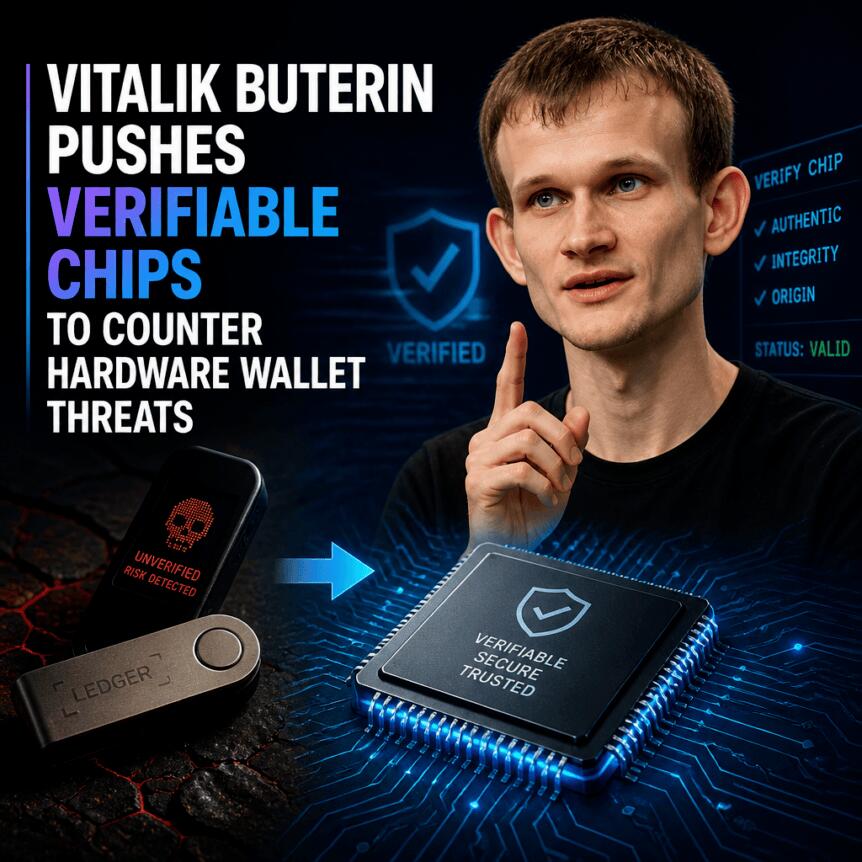
Ethereum co-founder Vitalik Buterin has used a fresh blog post to argue that the crypto industry should demand stronger verifiability standards for the chips inside hardware wallets. His focus is less on whether chip designs are “open” in the abstract, and more on whether buyers and independent inspectors can verify what the hardware actually contains.
Buterin said that publishing the software behavior of a chip is not the same as providing the kind of detail needed to check its physical construction. He linked the concern to real-world incidents in which malicious hardware modifications were inserted into devices before they reached consumers, potentially capturing sensitive wallet data.
Key takeaways
- Buterin argues that many commercial open-source chip efforts stop short of enabling independent verification of physical hardware.
- The concern is tied to past hardware wallet implant cases where tampered devices were used to extract recovery phrases.
- Future attacks could become harder to spot if malicious chips or replacements closely resemble legitimate parts.
- Buterin suggests the industry may need a clearer split between “performance” hardware and “secure” hardware designed for verifiability.
- Even with open designs, Buterin expects chip inspection to remain a specialized task for auditors and civil society groups.
Why “open-source” chips may still be hard to verify
In his post, Buterin drew a distinction between disclosing what a chip is programmed to do and providing enough information for inspectors to check the hardware itself. He said most commercial open-source chips do not publish sufficient detail to allow third parties to verify their physical construction.
That distinction matters for hardware wallets because their security depends not only on correct cryptography, but also on the integrity of the underlying components. If the hardware can be altered before sale, then software-level openness may not be enough to provide end-to-end assurances for users.
Real incidents in the hardware wallet implant playbook
Buterin warned that the issue is not theoretical, citing attacks that used spy implants inserted into hardware wallets prior to consumer distribution. In such scenarios, compromised devices can be engineered to capture recovery phrases and exfiltrate them during normal use.
The broader industry has seen multiple disclosures tied to this threat model. In October, Ledger said that malicious implants had been identified in devices sold through reseller CryptoBilis. According to Ledger’s account, the devices captured recovery phrases and transmitted them over cellular networks. Ledger responded by suspending reseller sales in Southeast Asia and Hong Kong, tightening distribution rules, and offering X-ray inspections after reports of tampered devices went beyond that initial region.
Ledger’s case was followed by additional action from Trezor. In November, Trezor reported that it found similar implants in three devices sold through the same reseller. Trezor then said it released a firmware update intended to prevent the implants from capturing data, and it reduced its reseller network by roughly 80%.
Together, these episodes highlight a recurring pattern: compromised supply chains can undermine trust even when users do everything “right” at the software level.
Buterin warns replacement chips could be “invisible”
Buterin also suggested that attackers may evolve their methods. As defenders add controls, adversaries can respond by building malicious behavior into replacement chips that appear legitimate. In his words, such changes “you cannot detect with the naked eye.”
This matters for how the industry approaches assurance. If visual inspection is insufficient, then the burden shifts toward measurable, verifiable properties—ideally ones that can be checked independently rather than relying entirely on the manufacturer’s internal testing.
A security trade-off: performance chips vs. secure verifiable chips
Buterin’s proposal does not stop at diagnosing the problem. He argued that hardware inspection would likely remain a specialist task, handled by professional auditors, journalists, and civil society groups, even if the underlying chip designs were fully open-source.
Still, he emphasized that broad participation in the hardware layer is necessary if the technology is meant to be “democratized.” In his view, the hardware layer must be open for tinkering and participation as well—not only the software stack.
At the same time, he acknowledged market realities. Companies under “extreme commercial pressures,” he said, cannot reasonably be expected to make all hardware fully open source. Instead, he expressed hope that the ecosystem would separate into performance-focused hardware and security-focused hardware.
Buterin suggested that secure hardware might come with substantial efficiency costs—he described it as potentially “10x less efficient or more”—but he argued that it could still be enough for everyday applications. The underlying implication is that not every device needs to prioritize peak performance; rather, some devices could prioritize verifiable security properties that users and inspectors can evaluate.
For readers, the key question now is what “enhanced verifiability” will look like in practice: whether wallet makers, chip vendors, and auditors move toward chip-level assurances that go beyond software transparency, and how quickly supply-chain monitoring and inspection can keep pace with evolving implant techniques.