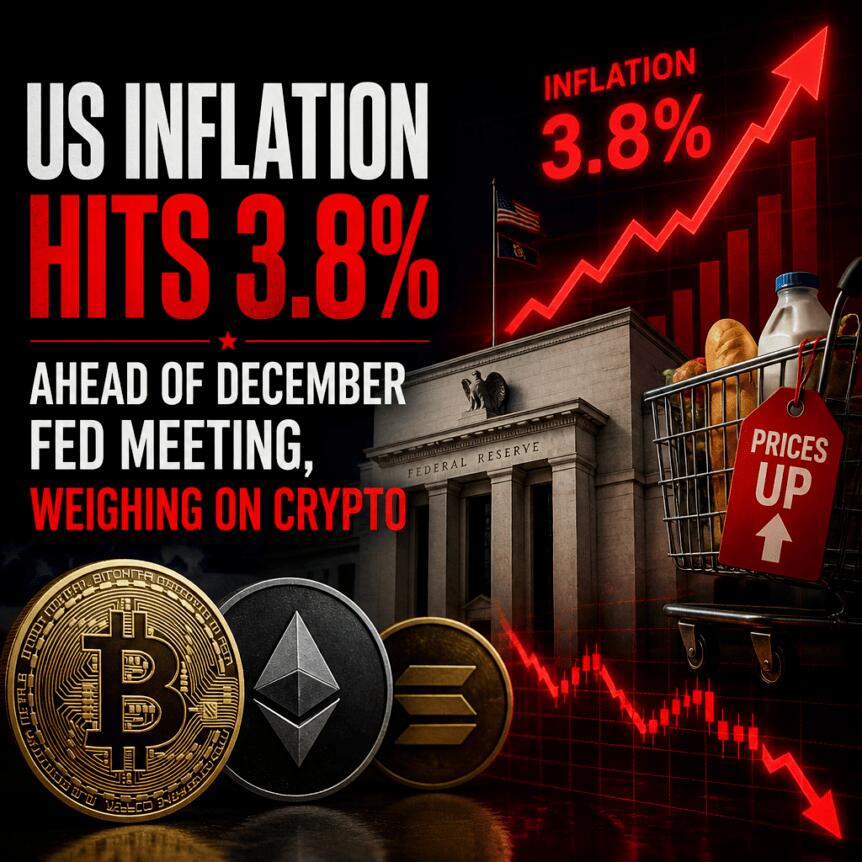
US inflation re-accelerated in October according to the Federal Reserve’s preferred gauge, the Personal Consumption Expenditures (PCE) index, tightening the outlook for easier monetary policy. The fresh inflation readings arrive ahead of the Fed’s Dec. 8-9 meeting and are already shaping expectations for higher borrowing costs—an environment that typically makes risk assets, including crypto, harder to recover.
In the Bureau of Economic Analysis (BEA) report released Wednesday, headline PCE inflation rose to 3.8% year-on-year, matching economists’ forecasts. Core PCE—excluding food and energy—climbed to 3.3% from 3.1% in September, edging above expectations and reaching its highest level in nearly three years. Both headline and core measures increased by 0.3% on a monthly basis.
Key takeaways
- BEA data shows October PCE inflation at 3.8% year-on-year and core PCE at 3.3%, the latter the highest in nearly three years.
- Core PCE’s rise above expectations strengthens the case for another Fed rate increase at the December meeting.
- With crypto market capitalization down about 32% since the start of the year, higher-for-longer interest rates could further delay stabilization.
- Traders were pricing in a December quarter-point hike with a 94.4% probability, according to the CME FedWatch Tool.
- Fed officials have diverged on how aggressively to fight inflation, leaving the exact path for policy still uncertain.
October PCE underlines “not yet under control” inflation
The October PCE figures matter because they come directly through the lens the Fed uses to evaluate whether inflation is moving toward its 2% target. While the headline number met market expectations, the shift in the core measure is the key detail for policy: core PCE rose to 3.3% annually from 3.1% in September, exceeding economists’ forecast of 3.2%.
Commenting on the report, Salman Parcy, managing partner at Cequire Capital, said the data indicates inflation is “not yet under control” as much as markets had hoped.
For crypto traders, the practical implication is straightforward: when inflation doesn’t cool as expected, the Fed’s room to cut rates narrows. That, in turn, can keep yields higher and liquidity tighter—conditions that tend to reduce appetite for volatile assets.
December rate expectations firm up, with growth data adding complexity
As of 4:01 p.m. UTC on Nov. 25, the CME FedWatch Tool showed traders assigning a 94.4% probability to a quarter-point increase in December. If that pricing holds, the Fed’s benchmark rate would move into a 4% to 4.25% range.
Support for this expectation is reinforced by other recent macro updates. Separate BEA data released Wednesday reported the US economy grew at a 4.3% annualized rate in the third quarter, revised up from an earlier estimate of 3.4%. Stronger consumption and business activity can influence how policymakers assess the trade-off between curbing inflation and avoiding a sharp slowdown.
Still, the Fed’s internal guidance has not been uniform. Fed Governor Christopher Waller has suggested raising rates by a quarter of a percentage point in both December and January, or by half a percentage point in December alone. By contrast, New York Fed President John Williams urged caution, saying last week that the situation does not call for “dramatic action,” as reported by Yahoo Finance.
The Fed will announce its decision before the next PCE inflation report, scheduled for Dec. 23—meaning investors will need to interpret December not only through the vote itself, but through the central bank’s updated forecast and messaging on how quickly inflation is expected to converge to target.
Higher borrowing costs remain a headwind for crypto
Higher interest rates typically work through two channels that are particularly relevant for crypto. First, expensive borrowing can cool demand across risk markets. Second, when yields on safer assets become more attractive, investors may reallocate capital toward lower-risk alternatives such as US government securities.
Parcy framed it as a near-term constraint rather than a decisive bearish trigger for the sector: while the latest inflation data may not be a “major bearish signal for crypto,” it can make a near-term recovery harder to achieve. The reason is that persistent inflation keeps policy restrictive for longer, which can reduce the flow of new liquidity into speculative and high-volatility markets.
That view aligns with how broader liquidity cycles often affect both crypto and other growth-sensitive assets. Ryan Kirkley, co-founder and CEO of Global Settlement Network (GSN), told Cointelegraph that Bitcoin and technology stocks face similar pressures because they can trade on the same liquidity conditions. “As long as borrowing costs stay elevated, I’d expect both to remain under pressure,” Kirkley said.
At the same time, the path forward isn’t purely monetary. Parcy also noted that renewed institutional participation and improvements in the wider economy could still help the market recover—even if the timetable becomes less favorable.
Crypto’s current backdrop underscores why timing matters. According to CoinGecko, total crypto market capitalization has fallen about 32% since the start of the year, dropping from roughly $3.09 trillion on Jan. 1 to around $2.09 trillion on Wednesday.
What to watch before the Fed meeting
In the lead-up to Dec. 8-9, investors should focus on whether future inflation prints confirm that core PCE is still trending downward or whether it continues to re-accelerate. The Fed’s December forecasts and guidance will also be critical, because the market’s willingness to take risk in crypto often hinges less on the immediate rate decision and more on the central bank’s signal about how long restrictive policy will remain in place.