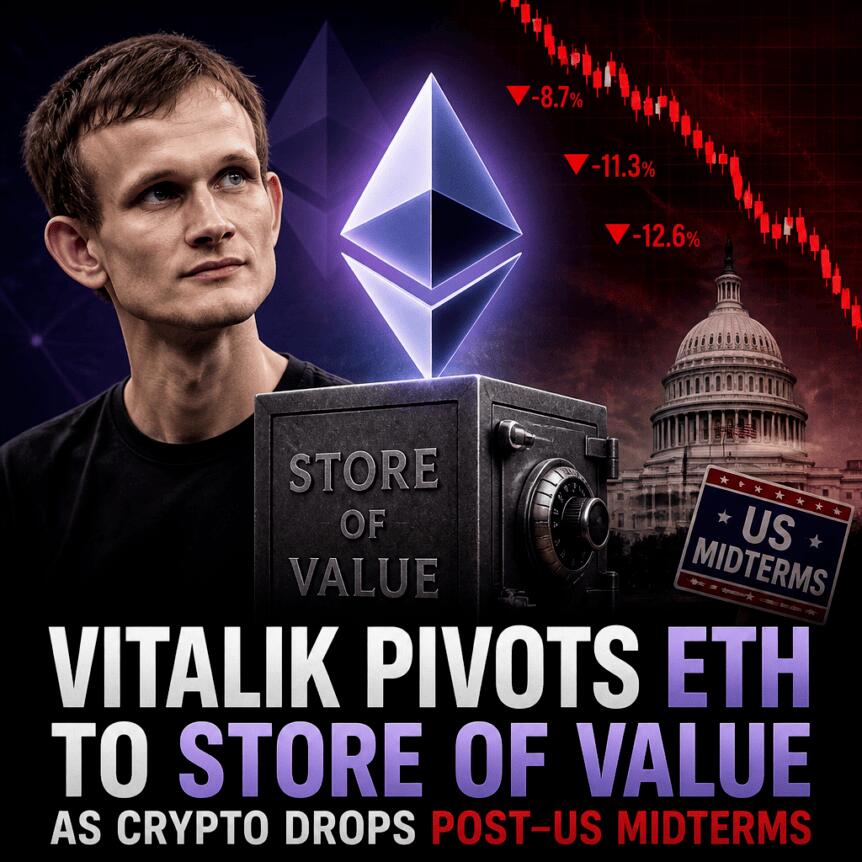
Ethereum’s creator Vitalik Buterin is pushing back on an increasingly popular narrative that the network’s value should primarily be tied to transaction-fee burn. In a public thread, Buterin argued that optimizing Ethereum around fee-burning “never was as strong as it seemed,” warning that a narrow focus on burns could dilute two core priorities: decentralization and resistance to censorship and capture.
The debate comes as Ethereum supporters face an uncomfortable reality for the “ultrasound money” storyline: fee revenue has fallen significantly as activity patterns have shifted. At the same time, broader market and policy developments—from exchange-security concerns to U.S. regulation expectations—have kept crypto’s attention split between long-term protocol direction and immediate institutional risk.
Key takeaways
- Vitalik Buterin says Ethereum should sell investors on store-of-value attributes built on decentralization and “capture resistance,” not on fee burning.
- Supporters of fee-burn narratives cite the EIP-1559 era, but falling transaction fees have challenged the sustainability of the “ultrasound money” framing.
- Recent U.S. election outcomes are expected to raise scrutiny even if many lawmakers are described as pro-crypto, leaving regulators with leverage.
- Binance’s reported hack is being treated as a test for exchange security practices, while the impact on market confidence remains unresolved.
Buterin’s argument: Ethereum’s value can’t be built on fee burn alone
Buterin’s critique centers on what he described as overstated strength in the idea of “ETH as fee-burning token.” He argued that Ethereum’s design choices should not be optimized around burning as the main value proposition, because doing so could undermine the network’s decentralization and what he frames as its “capture resistance.”
Instead, Buterin pointed to Ethereum’s broader foundation—stability anchored in decentralization—summarized by his acronym “CROPS,” standing for censorship and capture resistance, open source, privacy and security. He also suggested this framing may resonate more in an “era of AI disruption,” where the ability to coordinate without centralized control could matter to users and institutions.
The underlying dispute is not new, but it has become more prominent as markets reassess how monetary narratives translate into real-world fundamentals. In 2021, the EIP-1559 upgrade flipped Ethereum into deflationary territory at times by changing how fees are treated, and “ultrasound money” messaging spread as fee revenue surged.
However, design realities have since weakened that story. According to the article’s cited observation tied to fee levels, median transaction fees declined from 35 cents to 3.5 cents between January and October this year, while daily transactions rose by more than half. With lower fees and falling revenue, the “burn as a core engine of scarcity” narrative faces a structural challenge: higher usage does not necessarily translate into higher burn.
Buterin’s position essentially reframes the question from “How much gets burned?” to “What makes Ethereum credible as long-term, neutral infrastructure?” For investors, that distinction matters because it changes what they should evaluate: not just fee dynamics, but the resilience and governance properties that supporters believe protect the network across cycles.
Community reaction: store-of-value debates return, but Ethereum insiders emphasize fundamentals
The thread sparked a familiar clash. Some Bitcoin-aligned voices argued that Ethereum is trying to pivot toward Bitcoin’s store-of-value narrative after earlier themes lost traction. Dan Held—described in the piece as the founder of Held Media—derided the comments, saying it was “wild” to suggest a protocol with a monetary policy that changes over time could be “sound money,” warning that such approaches resemble fiat behavior.
On the other side, Ethereum-focused proponents welcomed Buterin’s messaging as a clearer direction. MetaLeX attorney Gabriel Shapiro called it a “nature is healing moment,” asserting that “on fundamentals ETH can be a much better SoV than both ZEC and BTC.”
Even outside the Ethereum camp, Solana co-founder Anatoly Yakovenko agreed with a key part of Buterin’s critique. He reportedly said Buterin was “absolutely right that can’t focus on fees as the product,” while making a more subtle jab at Ethereum’s product framing.
What remains unclear is whether markets will treat decentralization-first messaging as sufficient to replace fee-burn expectations. Narratives often matter in crypto, but credibility for long-term “store of value” claims typically needs a combination of credible monetary mechanics and perceived institutional legitimacy.
Policy uncertainty persists as lawmakers shift in Washington
Beyond protocol debates, the U.S. regulatory environment is expected to change following election results. The article notes that crypto super PAC spending had a limited visible effect, even as Democrats now control both the Senate and the House.
Stand With Crypto’s figures, as cited in the piece, suggest the new landscape is still heavily weighted toward lawmakers labeled pro-crypto: 50 of 100 senators are described as “pro-crypto” and 33 as “anti-crypto,” while among 241 representatives counted as supportive of the industry, only 106 are characterized as actively hostile.
That said, the piece highlights that “anti-crypto” lawmakers may still hold strategic positions of power. Brown is expected to join the Senate Agriculture Committee, and Elizabeth Warren is tipped to chair the Senate Banking Committee.
Decentralization Research Center executive director Kyle Bligen warned that the next Congress will bring “significantly more scrutiny” for the industry. The article also says Democrats are reportedly considering expanding proposals from Representative Maxine Waters into a broader market-structure bill, while mentioning an outside chance that the CLARITY Act could return if ethics provisions aimed at President Donald Trump’s alleged corruption are strengthened.
Separately, Fidelity Digital founder Hadley Stern is quoted in the piece emphasizing that certain political-economy issues could become a “real governance problem,” pointing to reported memecoin and stablecoin activity connected to a sitting president’s family.
For readers, the practical takeaway is that even with more pro-crypto lawmakers, oversight can intensify when agenda-setting committees remain skeptical. Traders may hear more noise, but builders and institutional allocators should watch how committee leadership and bill text evolve.
Security and market confidence: Binance hack fallout, THORChain restart, and Ethereum’s post-quantum timeline
Exchange security remained a dominant theme in the reporting. Binance has described a months-long intrusion: North Korean hackers, it says, first breached systems in June after an employee downloaded a tampered Homebrew installation while installing an AI coding tool. Binance reports that it detected the incident quickly but that the attackers already gained information about employees working on wallet infrastructure.
In September, attackers allegedly posed as recruiters and tricked another software engineer into downloading malicious software disguised as a coding assignment. On Oct. 20, attackers reportedly used the compromised computer and an internal AI tool to access additional engineers’ systems and deploy malware, eventually reaching Binance’s internal wallet-signing service to facilitate theft.
Binance co-CEO Richard Teng called it a “months-long campaign” in a Tuesday X post cited by the article.
Grayscale framed the incident as potentially constructive over time. In an accompanying report cited in the piece, Grayscale’s head of research Zach Pandl argued that while the hack could temporarily hurt confidence, it should ultimately push the market toward stronger security practices across exchanges. Pandl also tied the point to institutional custody, saying vehicles associated with U.S. crypto ETPs typically hold assets with state-chartered banks and qualified custodians, often using offline storage, multi-signature wallets, SOC attestations, and insurance policies—according to the report cited.
On the decentralized side, THORChain restarted after a reported warning from the FBI not to process funds linked to the Binance hack. As described, the permissionless protocol restored trading on most networks on Nov. 4. The piece notes that Bitcoin, Ethereum, Bitcoin Cash, Dogecoin, Litecoin, Tron and Zcash swaps were re-enabled, while Avalanche, Base, and XRP were already operating.
Chainalysis is cited as saying THORChain had processed more than $46 million from the hack within the first 72 hours, and gained $200,000 in fees according to the Wall Street Journal. The article says trading was paused automatically due to an unrelated Ethereum block reorganization, and includes a quote from THORChain co-founder JPThor suggesting that ignoring the FBI warning demonstrated decentralization.
Meanwhile, Ethereum’s long-range security planning also drew attention. An Ethereum Foundation researcher, Justin Drake, is reported as targeting December 2028 to complete Ethereum’s post-quantum and post-AI transition—one year earlier than a September roadmap deadline of December 2029. The article says this acceleration was discussed at Devcon 8 in Mumbai, with Drake stating developers would have 24 months to deliver three additional network upgrades.
However, the same reporting notes that the roadmap is currently stalled: core developers have reportedly been delaying the Glamsterdam upgrade indefinitely until security concerns tied to eight smart contract invariants are resolved. That tension—ambitious timelines versus implementation risk—will likely remain central as Ethereum moves toward quantum resistance.
Readers should watch the next few steps on two tracks: how Ethereum’s fee-and-scarcity narratives evolve as fee conditions persist, and whether upcoming governance and security decisions—both in Washington and across exchange infrastructure—confirm or undermine confidence in crypto’s long-term resilience.