A Winklevoss-backed super PAC tied to Gemini co-founders has increased its political spending ahead of the 2026 midterms, targeting Senate races in Texas, Ohio and beyond, according to a Federal Election Commission (FEC) filing reported this week.
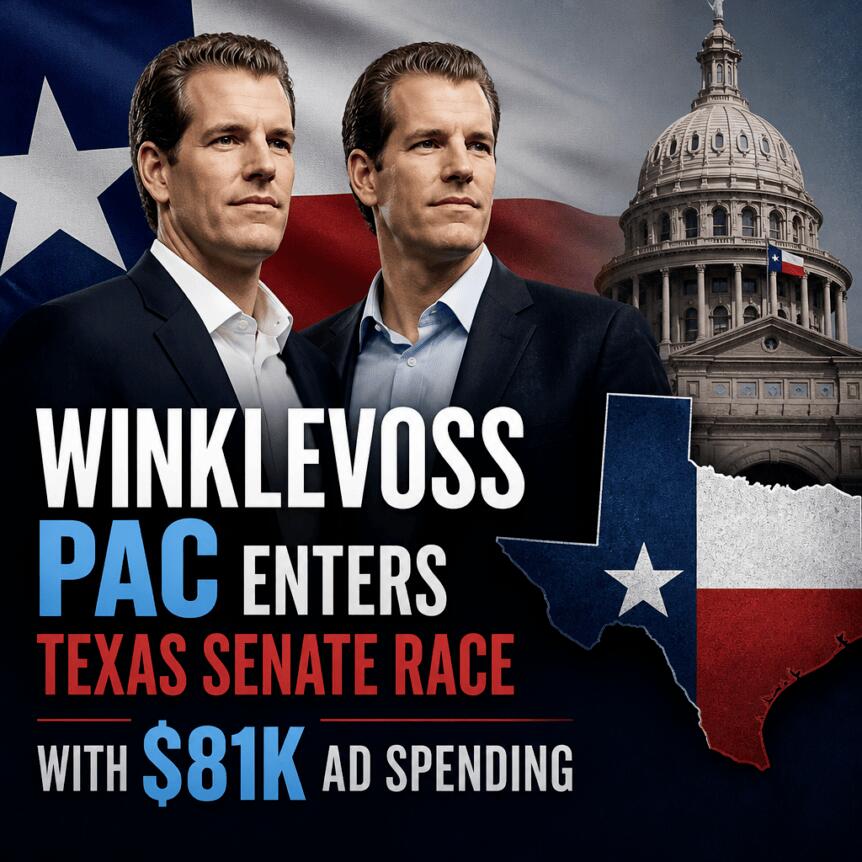
Digital Freedom Fund, launched in 2025 by Cameron and Tyler Winklevoss, disclosed its first reported ad spending supporting Republican Texas senator candidate Ken Paxton—while also reporting large cumulative support for Republican Sen. Jon Husted in Ohio’s Senate race against Democrat Sherrod Brown.
Key takeaways
- Digital Freedom Fund filed new FEC disclosures showing initial ad spending supporting Texas Republican Ken Paxton.
- The super PAC reported more than $81,000 in direct mail media for Paxton and opposition to Democrat James Talarico, with early voting already underway in Texas.
- In Ohio, Digital Freedom Fund reported additional expenditures for Husted, bringing its total support for Husted to about $7 million.
- Crypto-linked spending is expanding beyond single-state efforts, with other PAC activity connected to the broader fight over Senate control.
- Event-contract platforms have shown heavy market interest in Democrats retaking at least one chamber by 2027, a backdrop for crypto policy debates.
Texas: first reported ad spending for Paxton
In a Tuesday FEC filing, Digital Freedom Fund reported its initial spending on ads supporting Ken Paxton for Texas’ Senate seat. The PAC said it had spent more than $81,000 on direct mail media to back Paxton and oppose Democratic candidate James Talarico, as early voting in Texas had already started.
The filing places a spotlight on how crypto-adjacent political fundraising continues to translate into targeted campaign materials—particularly as Texas remains a crucial battleground for statewide and federal control in the 2026 cycle.
Why Senate control matters for crypto policy
Digital Freedom Fund’s expenditures come as prediction-market platforms Kalshi and Polymarket have reportedly shown a strong tilt toward Democrats regaining control of the U.S. House and Senate in 2027. While event contracts reflect traders’ expectations rather than formal political outcomes, they signal heightened attention to potential shifts in legislative priorities.
That matters for crypto policy because major market-structure proposals remain active in Washington. The piece notes that legislation such as the Digital Asset Market Clarity Act failed to pass a procedural vote in the Senate last month—an example of how partisan control and legislative sequencing can determine whether bills move forward.
For readers tracking policy risk, this is a reminder that campaign spending by crypto-aligned groups is not only about local races—it is also about shaping the composition and leverage of committees and floor majorities that decide which proposals progress.
Ohio spending lifts the PAC’s support for Husted
Digital Freedom Fund’s filing also detailed additional expenditures in Ohio’s Senate contest between Republican Jon Husted and Democrat Sherrod Brown. The PAC said the new spending brought its total support for Husted to about $7 million.
Ohio has become one of the higher-profile Senate battles partly because of the direct involvement of crypto-aligned political spenders, including another industry-linked committee highlighted in the same reporting. The pressure across multiple races suggests a broader campaign to influence the policy direction of Congress rather than focusing only on a single state.
Parallel activity from Fairshake and other political spending
The report situates Digital Freedom Fund’s disclosures alongside another crypto-aligned super PAC: Fairshake. According to the filing activity described, Fairshake reported more than $13 million combined in spending on a direct mail campaign to support candidates it views as “pro-crypto.” It also disclosed over $4 million to oppose Independent candidate Dan Osborn in Nebraska’s Senate race and an additional $9 million to support Husted versus Brown.
While the Ohio contest has seen significant PAC spending, Texas races have also attracted attention from Republican donors concerned about the possibility of Democrats making gains in both Senate and gubernatorial contests in the state for the first time in more than 30 years, the reporting states.
Beyond crypto-industry PACs, the report also points to broader Senate-election funding. It states that FEC filings show Elon Musk—founder of SpaceX—contributed more than $150 million to the Senate Leadership Fund, and that the PAC supporting Republican Senate candidates reportedly sent the same amount Musk donated to the Texas-linked super PAC described in the filing.
Earlier Texas support and links to prior ad activity
Digital Freedom Fund’s new Texas disclosures follow earlier supportive advertising for Paxton. The reporting notes that Paxton previously benefited from $500,000 in ads ahead of the May Republican primary, funded by the Anchorage Digital- and Cantor Fitzgerald-backed Fellowship PAC. Those ads reportedly ran through the Nxum Group, a marketing company co-founded by Bo Hines.
Hines has a background as a crypto adviser in the Trump administration and later became CEO of Tether US after leaving the White House. The piece references an October Wall Street Journal report alleging Nxum profited from Hines’ government role, including a claim that Nxum received $6.3 million tied to an arrangement with Tether, with the first payment described as having gone through while Hines was still in the White House.
What to watch next as campaigns enter Election Day
With early voting already underway in Texas and Election Day approaching on Nov. 3, the key question for voters and crypto-policy watchers is whether these PAC spending patterns expand further into additional competitive races—or concentrate more heavily on Senate leverage. Future FEC updates will be crucial for tracking how quickly crypto-aligned political funding is scaling and where it chooses to apply pressure.