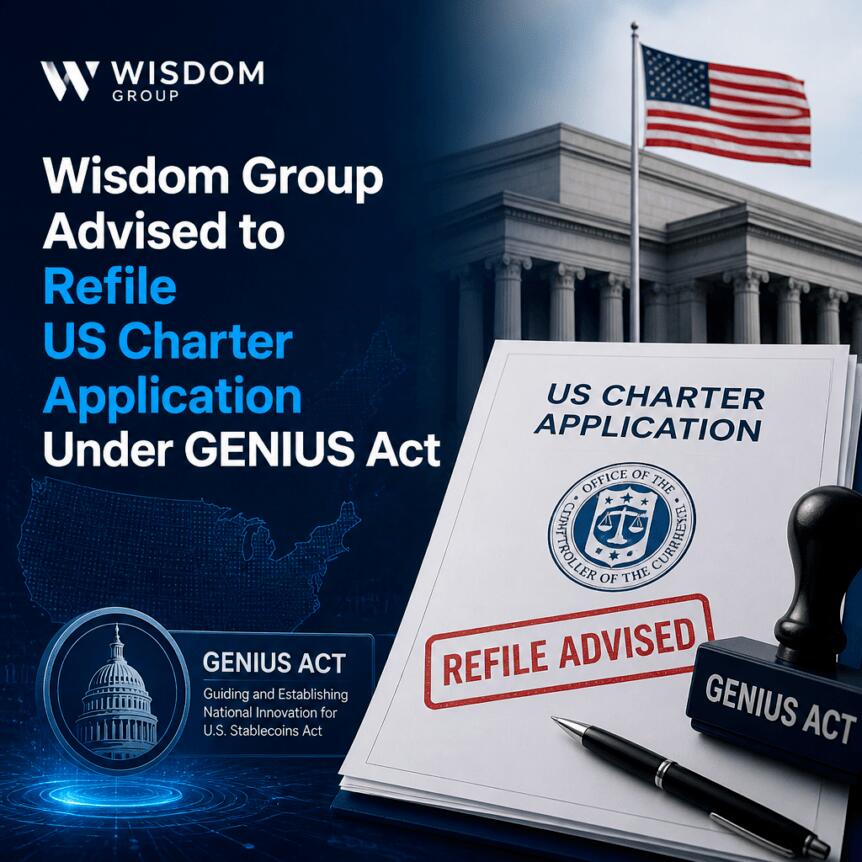
Payments company Wise says it will revisit its application strategy with the US Office of the Comptroller of the Currency (OCC) after the regulator rejected its push to become a national trust bank. In a notice issued Thursday, Wise said it intends to reapply under a GENIUS Act framework—US legislation designed to create a regulated pathway for payment stablecoin activities.
The shift matters because Wise’s original charter plan has now been explicitly denied, and the GENIUS Act is meant to offer clarity for stablecoin issuers and payment providers once regulators finalize the rules. Wise’s next steps will therefore be closely watched by other fintechs weighing stablecoin-related business models in the US.
Key takeaways
- Wise was rejected by the OCC for a national trust bank charter tied to its use of stablecoin-related rails.
- The company plans to submit a new OCC application using a “GENIUS Act framework,” according to its Thursday notice.
- William Blair said Wise is likely to remain “focused on lowering the cost of cross-border transactions” without changing its position on payment stablecoins.
- The OCC cited gaps in Wise’s anti-money laundering (AML) and countering the financing of terrorism (CFT) program and other illicit-finance risks.
- The GENIUS Act—signed in July 2025—provides a regulatory framework for payment stablecoin providers, but pending regulations and missed guidance deadlines leave implementation details uncertain.
Wise pivots toward GENIUS Act framing after OCC denial
Wise’s charter application was denied by the OCC on Tuesday. In its rejection, the agency said Wise failed to demonstrate that it had an effective AML/CFT compliance program and referenced “other illicit finance activity risks.” Those deficiencies formed the basis of the refusal to grant the national trust bank charter.
Rather than abandon the pursuit of a banking charter altogether, Wise now says it will change the way it approaches the application. According to a notice on Wise’s investor relations platform, the company plans to submit a new national trust bank charter application under a “GENIUS Act framework,” tying the filing more directly to the statute that regulates certain payment stablecoin activities in the US.
Investment banking group William Blair indicated that this procedural change is not expected to alter Wise’s underlying stance on payment stablecoins. As reported by William Blair in connection with Wise’s move, Wise remains focused on reducing the cost of cross-border transfers, “agnostic of the rail.”
What the GENIUS Act is intended to do
The GENIUS Act, signed into law in July 2025, is intended to create a clearer regulatory pathway for payment stablecoin providers. The legislation provides a framework for how stablecoins used for payments should be overseen in the United States, with additional regulatory steps required before full implementation.
However, the timeline for operational certainty is not fully in place. Cointelegraph previously reported that federal agencies missed a key deadline to provide guidance on how the GENIUS Act should be implemented before its effective date in January 2027. As a result, even with the law now on the books, market participants may still face uncertainty about how regulators will interpret and apply the framework in practice.
Wise’s reapplication strategy therefore highlights a practical tension in the current US environment: companies are trying to position themselves in line with upcoming stablecoin-focused rules while still needing to satisfy established banking supervision expectations—particularly around AML/CFT controls.
Why the OCC’s AML/CFT reasoning is likely to remain central
Wise’s original denial pointed directly to compliance readiness. The OCC said Wise could not show it had an effective AML and CFT compliance program, and it also cited other illicit finance activity risks.
Even if Wise moves forward under the GENIUS Act framework, the OCC’s stated concerns underline a broader reality for any entity seeking a national trust bank charter: the regulatory bar for compliance programs does not disappear just because a stablecoin statute exists. In effect, Wise’s challenge is twofold—aligning with the GENIUS Act’s payment stablecoin posture while also meeting the OCC’s supervisory expectations around money laundering, terrorist financing, and risk management.
This is likely to be a key point for investors and partners assessing Wise’s prospects. The GENIUS Act framing may change how the application is structured, but it does not negate the OCC’s focus on effective compliance systems.
Stablecoin policy momentum is real—yet approvals have been selective
Following passage of the stablecoin legislation, the OCC has approved several applications for national trust charters from major digital asset firms, including Circle, Ripple Labs, Crypto.com, and Coinbase, according to earlier reporting referenced in the source material. Those approvals suggest that the OCC is actively working through charter requests in the post-stablecoin-bill environment.
At the same time, Wise’s rejection shows that not all applicants will clear the process on the first attempt, especially when regulators identify weaknesses in AML/CFT effectiveness. The differentiation between successful charter applicants and Wise’s denied bid may come down to the OCC’s assessment of risk controls and readiness.
For the broader market, this combination—policy momentum on one side, compliance scrutiny on the other—may influence how payment and stablecoin-adjacent businesses plan their US expansion. Companies may increasingly try to align product plans with GENIUS Act expectations while treating regulator-reviewed compliance architecture as a decisive factor.
As Wise prepares its next filing, the market will watch closely for how the company documents its AML/CFT program and addresses the specific “illicit finance activity risks” cited by the OCC. With final GENIUS Act regulations still pending and federal guidance arriving late relative to the law’s effective date, the coming months could determine how the framework is operationalized for applicants and what additional assurances regulators will require.