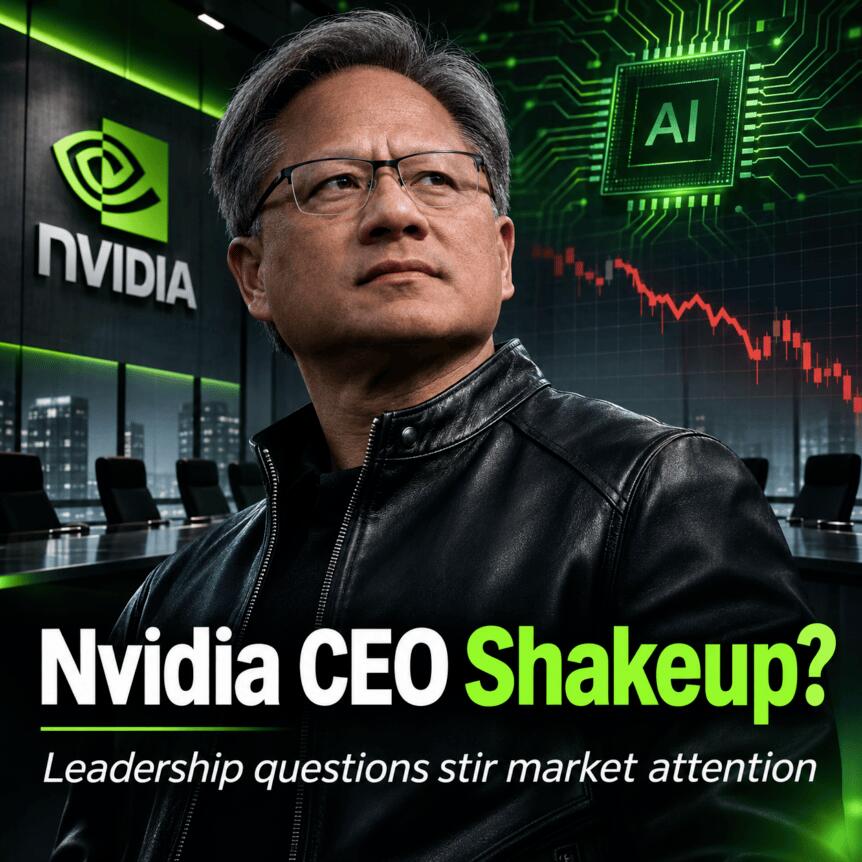
Nvidia’s leadership stability is under pressure after reports that the company’s board is preparing to remove founder and CEO Jensen Huang, following allegations involving extramarital affairs and national-security concerns. The Wall Street Journal said directors may meet as soon as Wednesday to decide Huang’s future, citing people familiar with the situation.
If the board acts, it would be a significant change for a chipmaker that has become synonymous with the artificial intelligence boom—largely tied to Huang’s public leadership and the company’s AI-focused product momentum.
Key takeaways
- Reports indicate Nvidia’s board may decide on Jensen Huang’s removal as early as Wednesday, according to the Wall Street Journal.
- U.S. intelligence officials are cited as believing an executive at Megaspeed—Alice Huang, a related figure in one alleged affair—worked as a spy for Beijing.
- Additional reporting from The New York Times says Huang had an affair with Nvidia vice president of health care Kimberly Powell, citing people familiar with the matter.
- Huang acknowledged in a letter to employees that he was unfaithful to his wife and said the board launched an independent investigation into national-security concerns.
- Nvidia shares reportedly fell sharply in after-hours trading following the disclosures, according to Google Finance data.
Board decision reportedly being prepared
The Wall Street Journal reported that Nvidia’s board is preparing to oust Jensen Huang after allegations that include extramarital affairs. The outlet said directors could meet as soon as Wednesday to determine his future, based on accounts from people familiar with the matter.
For investors, the potential shift matters beyond personal conduct: Huang has been a central figure in Nvidia’s AI narrative, and leadership changes can quickly raise questions about strategy continuity, governance, and how quickly executives adjust priorities under market pressure.
Affairs allegations and national-security concerns
The reporting centers on two separate allegations. One involves Alice Huang, described as an executive at Singapore-based data company Megaspeed and a major Nvidia customer. The article states that U.S. intelligence officials believe she was a spy for Beijing.
Separately, The New York Times reported that Huang had an extramarital affair with Nvidia vice president of health care Kimberly Powell. The Times said this information was based on accounts from five people who worked at the company.
These claims are important because they link private conduct to potential national-security risks—an area that typically triggers heightened scrutiny, especially for companies at the intersection of advanced computing and global competition.
Huang’s response and the independent investigation
On Sunday, Jensen Huang acknowledged infidelity to his wife in a letter to Nvidia employees. The letter was published on Nvidia’s own news site and, according to the report, included an apology for breaching trust.
Huang also confirmed that Nvidia’s board had launched an independent investigation tied to national-security concerns raised in news reports. He said he would cooperate fully and reiterated his commitment to the company.
While the letter does not address the specific allegations in detail, it does signal that Nvidia is treating the matter as both a governance issue and a security-related risk. That combination often affects how quickly boards reach conclusions—and what kinds of internal findings become public.
Market reaction after the reports
After the news circulated, Nvidia’s stock reportedly dropped in after-hours trading. According to Google Finance data referenced in the report, shares fell 8% to $159.76 after hours, reversing a 2.9% gain during the regular session.
This reaction highlights how quickly markets can reprice even before any formal board action occurs. In cases involving top leadership and investigations, investors often weigh worst-case scenarios—such as abrupt executive turnover—against the possibility that outcomes may be limited to internal changes rather than a full leadership replacement.
At the same time, the market focus may also expand beyond governance: given Nvidia’s role in AI infrastructure, any perception of disruption can influence broader sentiment across the semiconductor and AI supply-chain ecosystem.
As the board’s reported Wednesday meeting approaches, readers should watch for whether Nvidia provides additional official confirmation of timing and scope, and whether the independent investigation yields findings that change the balance of possible outcomes for Huang’s role.