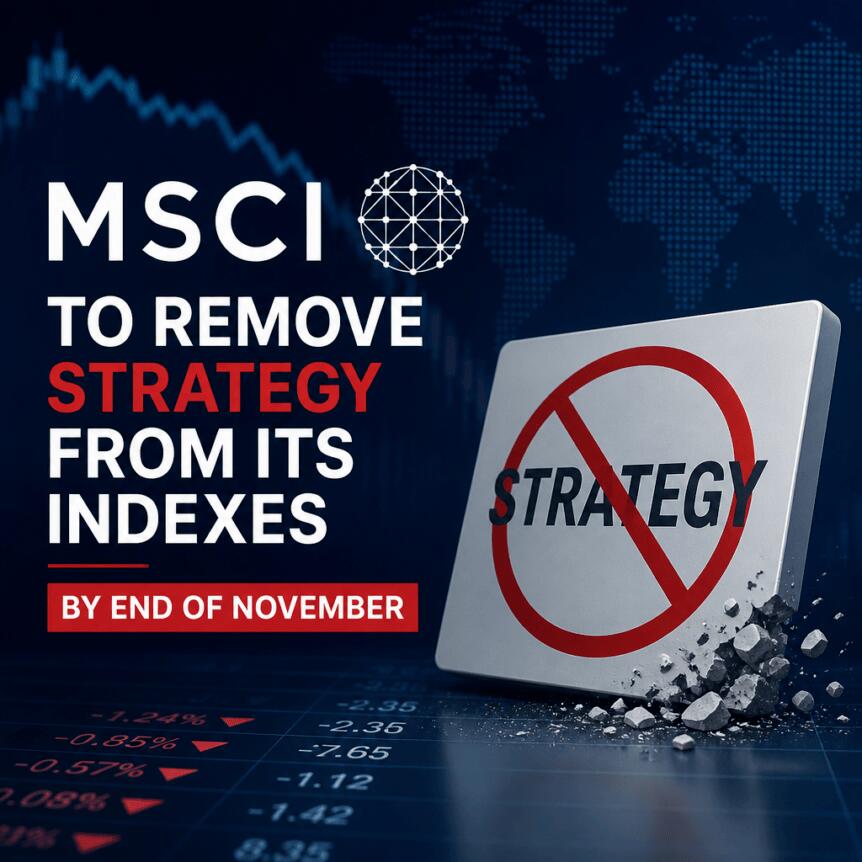
MSCI has confirmed that Strategy—a prominent “Bitcoin treasury” company—will be removed from its global equity indexes after a prolonged debate over whether crypto treasury firms should be treated as operating businesses for index purposes. The decision is part of MSCI’s November index review, with the change scheduled to take effect after market close on Nov. 30.
MSCI’s final list of affected securities marks “STRATEGY A” with the action “Deleted.” Japan-based Metaplanet and crypto treasury firm Upexi are also set for deletion, while Ether treasury company Sharplink is placed on a watchlist. The shake-up matters because index membership can directly influence passive investment flows.
Key takeaways
- MSCI’s November review confirms the removal of Strategy from its global equity indexes, with the effective date set after the Nov. 30 close.
- MSCI is also deleting Metaplanet and Upexi; Sharplink is not removed yet and remains under watch.
- Benchmark-tracking funds may be required to sell the affected names, potentially reducing a steady source of passive demand.
- The decision follows months of scrutiny about whether crypto treasury companies qualify as “operating” businesses for index construction.
MSCI’s November index decision and the implementation timeline
In the company’s final index review results released as part of its November schedule, MSCI specified the treatment of multiple crypto-exposed treasury firms. According to the published affected-securities list, Strategy A is being “Deleted,” with Metaplanet and Upexi also removed from the relevant MSCI equity indexes.
These changes are not immediate. MSCI stated that the updates follow its implementation timetable announced in October, and the new composition takes effect after market close on Nov. 30. For market participants, that timing matters: it provides a window for funds and risk systems to adjust holdings and for trading desks to anticipate liquidity and rebalance flows around the effective date.
Why index eligibility is becoming a fault line for crypto treasury firms
The core issue underlying MSCI’s move is how index providers classify digital-asset treasury companies. The debate—highlighted in earlier coverage—centers on whether firms that hold crypto on balance sheets, rather than generating revenue primarily through conventional operating activity, should be included alongside standard businesses.
Cointelegraph previously reported in October that MSCI adopted index exclusion rules that could push Strategy out of indexes. In the latest decision, MSCI has effectively applied those principles to Strategy and other similar issuers, signaling that the classification question has moved from consultation and interpretation into concrete index maintenance.
For investors, this distinction has practical consequences. Index membership influences not only sentiment but also mechanical capital allocation: when a security is removed, funds that are benchmarked to the relevant MSCI measures often need to sell to maintain tracking accuracy. That creates a potential source of systematic selling distinct from discretionary trading.
What selling pressure could look like for Strategy
Anticipation of passive outflows had already built ahead of MSCI’s final ruling. As Cointelegraph noted earlier in October, JPMorgan had estimated that Strategy’s exclusion could trigger roughly $2.8 billion in selling. While that figure is a projection rather than a confirmed outcome, it illustrates why index changes can reverberate beyond the affected company.
The risk is not limited to Strategy alone. Since MSCI also deleted other crypto treasury companies, broader basket-style selling could occur for portfolios that hold multiple names linked to the same thematic classification. That can influence volatility around the implementation date, especially if liquidity thins as rebalances converge.
Strategy responds: limited ownership tied to MSCI-linked funds
Strategy challenged the basis for exclusion during MSCI’s consultation process, arguing that MSCI’s approach repackaged earlier efforts to exclude digital asset treasury firms and injected policy judgments into index construction. The company also characterized MSCI-linked exposure as relatively contained.
In its consultation response, Strategy said that MSCI-linked funds held approximately 13 million shares. The company described that figure as representing about 3.1% of its basic shares outstanding and less than one day’s trading volume. Strategy’s framing suggests it expects the index-driven impact to be manageable in the context of overall trading activity.
Even so, the difference between an ownership percentage and the speed of required selling can be meaningful during rebalances. Passive funds may need to act quickly within index maintenance windows, and the effects can differ from what headline ownership shares imply for liquidity.
Market pricing reflected the uncertainty as well. Strategy shares fell 1.65% in after-hours trading on Wednesday, according to the Yahoo Finance quote cited in the original reporting. While a single move doesn’t establish causality, it highlights that investors were adjusting to the final MSCI confirmation.
What to watch next for the remaining names and broader index policy
With Sharplink placed on a watchlist rather than deleted, the question for investors shifts from “whether” to “when and how.” The watch status implies continued monitoring under MSCI’s framework, meaning more decisions may follow in subsequent index reviews depending on how MSCI further clarifies its interpretation of crypto treasury business models.
For market participants, the key is the calendar: the Nov. 30 effective date will likely determine how fast benchmark-tracking flows unwind and how liquidity behaves during the transition. Investors should also watch for whether other index providers adopt similar rules, since one provider’s exclusion can change expectations across the broader index ecosystem.