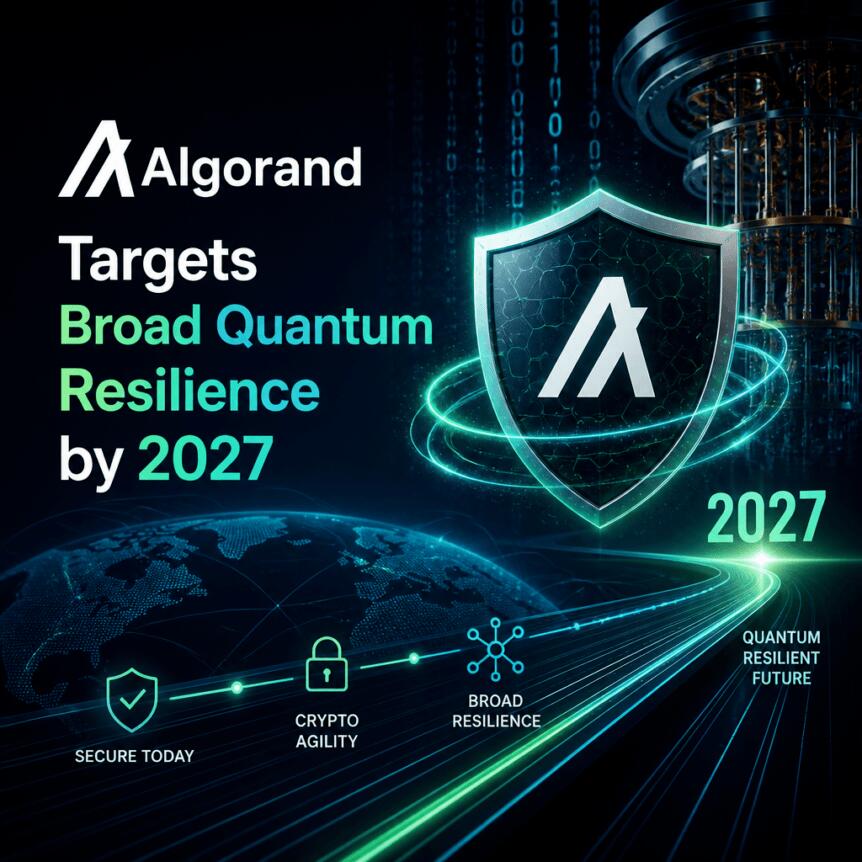
Algorand has unveiled a roadmap aimed at making its network resistant to future quantum computing attacks. The plan, discussed by Algorand Foundation technology chief Bruno Martins, targets upgrades to the protocol’s infrastructure by the end of 2027.
The move comes as researchers and security agencies increasingly warn that sufficiently capable quantum computers could eventually undermine today’s widely used cryptographic schemes. While quantum hardware is still in early development, businesses and regulators are already planning for “migration” to quantum-safe cryptography rather than waiting for a break to occur.
Key takeaways
- Algorand says it will pursue broad “quantum resilience” with protocol and cryptographic upgrades scheduled through end-2027.
- The roadmap includes shifting to quantum-resistant signatures based on Falcon for new accounts involved in consensus.
- Algorand also plans to update parts of its consensus design that currently rely on cryptography it says is not quantum-resistant.
- The network is considering migration approaches such as a “hybrid mix” of classical and quantum-resistant signatures.
- The announcement adds to a growing list of crypto and government efforts to prepare for quantum-era cryptography timelines.
Algorand targets quantum upgrades by end-2027
In remarks posted Thursday, Bruno Martins said the foundation has been researching the quantum threat for several years and is now formalizing an infrastructure update path. According to Martins, governments, standards bodies, and security experts are already planning for a world where quantum computers could break cryptographic systems that protect modern digital infrastructure.
Algorand’s approach focuses on ensuring that the network can keep operating securely as the cryptographic assumptions underpinning current systems become obsolete. The project frames the roadmap as a way to prevent quantum-enabled attackers from exploiting weaknesses in how blockchain participants authenticate and how the network reaches agreement.
Falcon signatures and changes to consensus cryptography
A central part of Algorand’s plan is a shift toward quantum-resistant digital signatures. Martins said the roadmap includes introducing new accounts that use Falcon, a signature scheme designed for post-quantum cryptography.
Algorand also intends to update its consensus mechanism, noting that its current cryptography is not quantum-resistant. In addition, the network will revise how accounts involved in consensus operate, alongside research into possible transition strategies.
One of the options under exploration is a “hybrid mix” that combines classic signatures with quantum-resistant ones—an acknowledgement that migrations in distributed systems often require careful coordination rather than a single abrupt switch.
Why this matters as “migration deadlines” spread
Algorand’s announcement lands amid heightened concern across the crypto market. Quantum computing is expected to be vastly more powerful than today’s supercomputers, but it is still early enough that practical “break crypto” scenarios remain uncertain. Even so, multiple efforts are underway to reduce the risk of being caught unprepared.
Earlier coverage highlighted that Google researchers, in a March paper, suggested quantum computers may need fewer resources than previously estimated to compromise certain cryptographic protections used by blockchains. That same paper pointed to Algorand as likely among the most quantum-ready networks, while also noting that Ethereum and Solana are exploring preparations.
Beyond crypto, governments have been setting expectations for quantum-resistant upgrades. The French cybersecurity agency ANSSI said it will stop certifying security products that do not include quantum-resistant encryption, aiming to push businesses toward quantum-safe systems by 2030. In the United States, the NSA has required new national security systems to use its quantum-resistant algorithms starting Jan. 1, 2027, with non-quantum-resistant systems expected to be phased out by end-2030.
Meanwhile, Google has reportedly set an internal readiness deadline of 2029, citing the pace of progress in quantum computing hardware and error correction. While these deadlines are not directly comparable across organizations, they underline the same core logic: once quantum capabilities grow, timelines for migration may not be long enough to handle complex security changes later.
Quantum readiness is becoming a competitive network feature
Algorand is not alone in addressing quantum risk. Tezos has launched a prototype blockchain for quantum-resistant private payments, while Circle has released a roadmap aimed at making its Arc blockchain quantum-ready. Academic research also continues to explore whether a functional quantum computer might require fewer resources than originally believed, with some scenarios suggesting deployment could occur before 2030.
What distinguishes Algorand’s plan is its focus on both authentication and consensus mechanics. Many “quantum-safe” efforts start at the cryptographic layer—upgrading signatures or encryption—yet blockchain security depends on a broader set of protocol assumptions. By highlighting consensus updates and considering transitional methods such as hybrid signature approaches, the roadmap emphasizes that quantum resilience is not just about swapping algorithms, but about maintaining safe system behavior throughout the transition.
Looking ahead, market participants will likely watch for how Algorand phases these changes from research into implementation, including whether the network targets staged activation milestones beyond the end-2027 timeline. Just as importantly, readers should monitor how closely other major protocols align their migration strategies, since the risk posed by quantum advances will depend not only on theoretical capability, but on how quickly systems can evolve without disrupting users and validators.