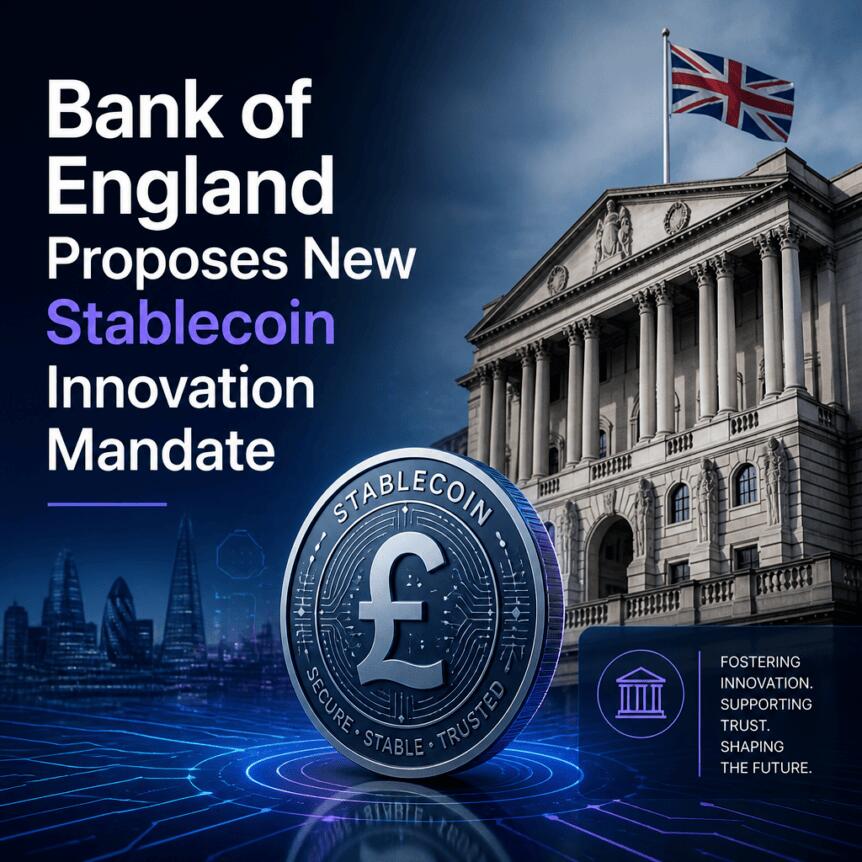
The UK government is proposing to give the Bank of England a secondary mandate focused on innovation in digital payments, explicitly covering payment systems that rely on “digital settlement assets” such as stablecoins. The move, announced by HM Treasury on Thursday, keeps financial stability as the Bank of England’s primary responsibility while carving out room for experimentation and development of emerging forms of digital money.
According to HM Treasury, the change would apply to the central bank’s oversight of payment infrastructure, with the expectation that the Bank of England will report progress to Parliament each year on how it is advancing the new payments innovation objective. The government plans to embed the mandate through amendments to the Financial Services and Markets Bill, which is set for further debate in the House of Lords on Sept. 7 and 9.
Key takeaways
- The Bank of England would gain a secondary objective to support innovation in payment systems and digital money, while financial stability remains the top priority.
- The mandate is intended to cover systems that use digital settlement assets, including stablecoins, linking UK stablecoin policy more directly to payments development.
- The Bank of England would provide annual updates to Parliament on its innovation work, potentially increasing public accountability for how stablecoin-related rules are implemented.
- The proposal is set to be incorporated through amendments to the Financial Services and Markets Bill, with House of Lords debates scheduled for Sept. 7 and 9.
- Industry reaction may hinge on the practical details of how the Bank of England’s annual reporting is used alongside existing stablecoin requirements.
Why the Bank of England’s “innovation” role matters for stablecoins
The announcement effectively broadens the Bank of England’s remit beyond purely stability-focused oversight. Under the proposal, the Bank of England would extend an existing regulatory approach applied to core market infrastructure—specifically central counterparties (CCPs) and central securities depositories (CSDs)—to also incorporate a payments innovation goal.
The significance for stablecoins is that the mandate is not limited to abstract research or central bank digital money alone. HM Treasury states that the mandate would cover payment systems using digital settlement assets, a phrasing that includes stablecoins and helps clarify that they are part of the UK’s wider payments technology agenda.
For market participants, this matters because regulatory emphasis can shape how quickly new payment rails move from pilot to deployment. A formal “innovation objective,” paired with parliamentary reporting, may also influence how the Bank of England balances caution with experimentation as stablecoin rules and related infrastructure testing develop.
Parliamentary reporting could intensify scrutiny
While the innovation mandate is described as secondary to financial stability, the details of implementation may determine how much room it creates for the stablecoin market to grow under the UK’s framework.
According to Maksym Sakharov, co-founder and CEO of WeFi, the annual reporting requirement could shift the balance toward greater public scrutiny. Sakharov told Cointelegraph that because the innovation objective is “secondary to financial stability,” it “overrides nothing,” but the Bank of England would still have to publish annual accounts of its work on payments innovation and digital money.
He suggested that this publication requirement could matter particularly because it would place additional attention on the stablecoin rules the central bank finalized in June. In other words, even if the innovation mandate cannot dilute stability obligations, the reporting component could increase the visibility of how those obligations are applied in practice.
Existing stablecoin requirements and a key reserve debate
Sakharov focused on specific requirements for “systemic stablecoin issuers,” including a reserve structure that—per his comments—requires issuers to keep at least 30% of their backing assets in non-interest-bearing deposits at the central bank.
He argued that the “reserve split is the first thing to fix,” adding that the requirement could influence whether a stablecoin business is commercially viable. This is a notable point for investors and operators because reserve rules directly affect cost structure, risk management, and the economics of issuance—factors that can shape which issuers can scale while still meeting compliance expectations.
Importantly, the Bank of England’s innovation mandate does not automatically change those reserve mechanics. However, by tying central bank reporting to digital payments innovation, the proposal could create additional pressure—politically and publicly—for regulators to explain how stablecoin market design aligns with broader payments modernization goals.
UK stablecoin momentum: from interoperability tests to cross-border alignment
The new mandate arrives as the UK increases its operational and policy work around stablecoins. In August, a group participating in the Bank of England’s Digital Pound Lab began testing whether a stablecoin could interoperate with a simulated digital British pound for a cross-border trade payment. HM Treasury and project reporting described the experimental platform as not using real customers or money.
Earlier, in mid-July, the UK and US published a joint statement on stablecoins that signaled intent to enable their use in cross-border finance and called for closer alignment between regulatory frameworks. The statement indicates the UK is seeking interoperability not just at the technical level, but also in how rules may converge across jurisdictions.
The UK’s approach also shows a pattern of adjusting earlier constraints. Cointelegraph previously reported that the Bank of England dropped plans to cap individual holdings at 20,000 British pounds and business holdings at 10 million British pounds, replacing those limits with a temporary cap of 40 billion pounds (about $52.9 billion) on issuance for each “systemic stablecoin.” That shift, paired with the July and August policy and testing activity, suggests UK regulators are working toward a structure that emphasizes systemic risk while allowing broader participation than earlier retail- and business-specific limits.
Additionally, the UK government’s direction to expand the Bank of England’s mandate fits within a broader effort to support innovation in tokenized and distributed ledger-based approaches—an idea echoed by City Minister Lucy Rigby, who said tokenisation and DLT could transform financial markets globally.
As lawmakers prepare for House of Lords debates on Sept. 7 and 9, market participants should watch not only whether the mandate is adopted, but also how the Bank of England translates “innovation” into measurable actions—especially in areas like systemic issuer requirements and reserve design that currently influence stablecoin business economics.