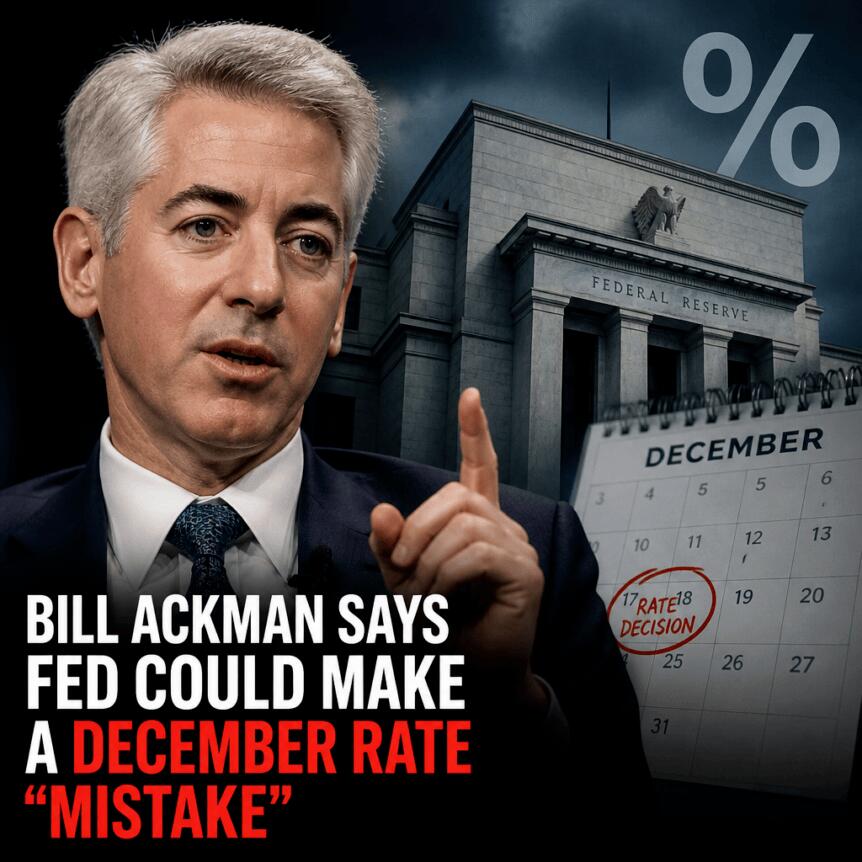
Billionaire hedge fund manager Bill Ackman used a Sunday post to argue that the Federal Reserve risks recession if it continues raising interest rates in pursuit of a 2% inflation target—warning that financial conditions have already tightened “massively.” His comments landed amid ongoing public division among Fed officials over whether additional hikes are necessary and how long policymakers can credibly wait.
Ackman said the global investment backdrop—including higher spending priorities such as military outlays, tariffs, and large-scale investment in AI infrastructure and energy—makes 3% a more realistic inflation goal than 2%. The statement followed remarks earlier in the week from US Treasury Secretary Scott Bessent, who pointed to hawkish Fed rhetoric as one contributor behind last week’s stock market sell-off.
Key takeaways
- Ackman warned that continued rate hikes to force inflation back to 2% could push the US—and global economy—toward recession.
- Treasury Secretary Scott Bessent linked hawkish Fed messaging to last week’s market strain, underscoring how tightly financial markets are watching policy signals.
- Fed officials remain split: at least one dissenting voice in October argued conditions were still too accommodative to return inflation to 2%.
- The next Fed decision is scheduled for Dec. 9, with CME FedWatch at the time of writing pricing in roughly a 91.2% chance of a quarter-point hike.
Ackman’s recession warning enters the rate debate
In a post on X, Ackman argued that the Fed’s plan to keep increasing rates could be counterproductive given how much borrowing conditions have already changed. He framed his concern around the idea that policy tightening may be reaching levels that harm growth even before inflation returns to the central bank’s preferred figure.
His alternative target—suggesting 3% inflation may be more workable—was tied to the current macro environment and spending priorities. Ackman pointed to required investment in areas such as global military spending, the impact of tariffs, and large-scale buildouts related to AI infrastructure and energy supply. In his view, those structural and investment-driven forces could make a rapid drop to 2% more difficult without imposing unnecessary economic damage.
Ackman’s warning came just after Treasury Secretary Scott Bessent told CBS on Sunday that some market participants believe the country could be making a “policy mistake if they overtighten.” Bessent’s framing suggested the risk isn’t just whether inflation falls, but also whether monetary tightening goes too far relative to the economy’s resilience.
Why markets are sensitive: hawkish messaging and tightening expectations
Financial markets have been reacting not only to expected policy moves, but also to the tone of Fed communications. Bessent’s remarks referenced hawkish statements from Fed officials as a factor behind last week’s sell-off in equities, highlighting how quickly changes in rate expectations can flow through risk assets.
That matters for crypto investors and traders because crypto markets often trade as a high-beta proxy for broader liquidity conditions. When central bank policy expectations shift—especially around the likelihood of further hikes—discount rates and risk appetite can move swiftly, influencing everything from speculative positioning to broader capital allocation.
Ackman’s intervention adds to that backdrop by directly challenging the idea that policymakers can keep applying pressure to inflation without triggering recession risk. Even if his argument does not change the Fed’s official framework, it reinforces the debate that a “more aggressive path” could be costly.
What the Fed’s internal split suggests about inflation targets
The current rate discussion reflects a broader lack of consensus inside the Federal Reserve. The source notes that in October the Fed held the benchmark rate at 3.75% to 4% in a 10–2 vote, with both dissenters favoring an increase of a quarter point.
One of those dissenters was Federal Reserve Governor Lisa Cook. In a speech dated Friday, Cook argued that financial conditions were still too accommodative to bring inflation back to 2%. She said it was estimated that inflation reached 3.8% in October and warned that delaying rate increases could force the central bank to raise rates more sharply later.
Cook’s caution emphasized that patience may be less feasible in the current economic climate. In her view, the cost of postponing tightening could be higher later if inflation proves more persistent than officials anticipate.
This tension—between concerns about overtightening and arguments that policy is not yet restrictive enough—creates uncertainty around what “enough” tightening looks like. For investors, that uncertainty is often as important as the immediate policy decision because it shapes the entire path markets expect the Fed to follow.
What to watch before Dec. 9
According to CME FedWatch, the odds of a December quarter-point hike were about 91.2% at the time of writing. The next scheduled Fed decision is set for Dec. 9, meaning markets may increasingly focus on forward guidance, inflation data interpretations, and any further signals about whether officials see 2% as the near-term target or a longer-term objective.
With Fed officials divided—Cook arguing for additional tightening and Ackman warning against continued hikes—readers should watch for how the Fed frames the remaining inflation work: whether it leans on the idea that financial conditions must tighten further, or whether it signals growing concern about recession risk if rates move too high for too long.
In the crypto context, shifts in the probability distribution for rate hikes can quickly affect market sentiment through expectations for liquidity and the relative attractiveness of risk assets. Even without a direct policy link, the mechanism is the same: changes in central bank expectations often reprice risk rapidly across financial markets.
Until the Fed’s next meeting, the key unknown is not simply whether a hike is expected, but how policymakers justify the pace and magnitude—especially given the competing views that financial conditions are either already tight enough to slow inflation or still too loose to restore it to 2%.