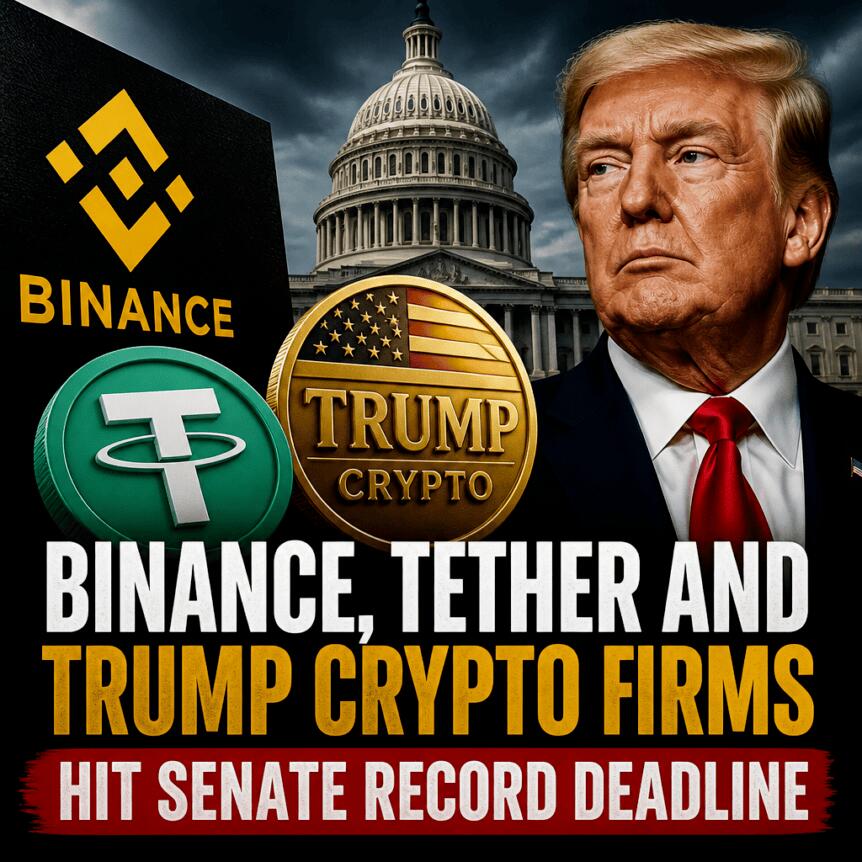
U.S. Sen. Richard Blumenthal has issued a fresh deadline for major crypto firms and Trump-linked projects to provide records requested in Senate investigations. The ranking Democrat and incoming chair of the Senate Permanent Subcommittee on Investigations (PSI) says Binance, Tether, World Liberty Financial, and Fight Fight Fight LLC must begin turning over documents by Nov. 30 and comply by Jan. 4, 2027.
In follow-up letters sent Thursday, Blumenthal warned that missing the January deadline could lead to “alternative measures to obtain compliance.” PSI rules would allow the subcommittee’s chair to issue subpoenas if needed, giving the correspondence a clear escalation pathway as the Senate’s power balance is expected to shift when Democrats are due to take control.
Key takeaways
- Blumenthal set a compliance timeline of Nov. 30 for record production and Jan. 4, 2027 as the overall deadline for Binance, Tether, World Liberty Financial, and Fight Fight Fight LLC.
- The letters explicitly raise the prospect of additional steps if companies do not comply, including potential subpoena authority under current PSI rules.
- The subpoenas-and-records push centers on two broad themes: alleged links to sanctions evasion and concerns about potential conflicts involving Trump’s crypto activities.
- Binance previously disputed some sanctions-related allegations, and Tether previously rejected claims that USDT facilitates Iran-linked “shadow banking” activity.
- The requests arrive as Senate control is expected to change, potentially affecting the subcommittee’s leverage and follow-through.
New letters and a looming January compliance date
Blumenthal’s follow-up letters come after earlier PSI requests that targeted recordkeeping and transaction details. According to the correspondence, the subcommittee expects the companies to start providing requested materials by Nov. 30, with a hard compliance deadline of Jan. 4, 2027.
That date is framed as particularly consequential because it lands the day after Democrats are due to take control of the Senate. Blumenthal’s warning that PSI may consider “alternative measures” suggests the subcommittee is preparing to move from voluntary information-sharing toward formal enforcement tools if responses remain incomplete.
Cointelegraph reports it sought comment from Binance, Tether, World Liberty Financial, and Fight Fight Fight LLC but did not receive responses before publication.
Sanctions scrutiny: Binance and Tether under renewed pressure
Blumenthal’s latest actions build on a longer-running effort by the PSI to probe potential misuse of cryptocurrency in connection with sanctioned actors.
In February, Blumenthal asked Binance for records related to transactions linked to Iranian entities and Russia’s so-called shadow fleet. Binance later said it had identified the underlying reports as false in a March response, adding that, to its knowledge, no Binance account had transacted directly with an Iran-based entity. Despite Binance’s rebuttal, Blumenthal wrote in Thursday’s letter that the requested records still had not been turned over.
For Tether, the renewed request focused on how USDT is used by sanctioned entities, as well as Tether’s dealings with Nxum—a consulting firm co-founded by former White House crypto adviser Bo Hines. Blumenthal’s renewed emphasis suggests the subcommittee sees potential compliance and governance risks around both stablecoin usage and personnel or vendor relationships tied to U.S. policy circles.
In September, the PSI’s Democratic staff released a report alleging that USDT had become a key part of Iran’s shadow banking network. Tether disputed those claims, arguing that USDT does not provide a haven for sanctioned actors. Tether also said it helped authorities freeze nearly $550 million in Iran-linked tokens in 2026, a figure reported in earlier coverage referenced by Cointelegraph.
Trump-linked investigations: World Liberty Financial and Fight Fight Fight
Alongside sanctions-related concerns, Blumenthal has also pursued questions tied to Trump’s crypto activities and possible conflicts of interest.
In May 2025, he opened an inquiry into potential conflicts involving Trump’s crypto ventures, seeking records from both firms regarding ownership, foreign investments, and safeguards against conflicts of interest. The scope of the request included World Liberty Financial, where lawyers disputed Blumenthal’s claims and said the company had no affiliation with Fight Fight Fight LLC.
Further, in June 2026, Blumenthal and four other Senate Democrats urged hearings into a reported $500 million deal involving an Abu Dhabi investment firm seeking to buy a 49% stake in World Liberty Financial. While details of that reporting are not elaborated in the source text, the push for hearings indicates that lawmakers were scrutinizing how capital flows and corporate relationships might intersect with political interests.
The involvement of World Liberty Financial and Fight Fight Fight LLC in Thursday’s letters suggests Blumenthal views record production as important both for evaluating corporate connections and for understanding how these projects operate amid questions about ties to the Trump orbit.
What changes—and what remains uncertain
The practical change in Thursday’s letters is the addition of a clearer compliance schedule with explicit consequences. While PSI has been requesting information for months—across sanctions, stablecoin governance, and conflict-of-interest questions—the new deadlines sharpen the timeline for when lawmakers expect actual documentation rather than continued back-and-forth.
At the same time, important uncertainties remain. Binance’s earlier response contested the accuracy of the underlying sanctions-related allegations, and Tether’s prior statements disputed claims that USDT functions as a haven for sanctioned groups. Without seeing what records—if any—were produced, it is not possible to determine whether regulators and lawmakers will find the firms’ explanations persuasive or whether the PSI will escalate to subpoenas.
For market observers and participants, the key question is whether these demands translate into concrete enforcement actions or additional findings. The January deadline, combined with the possibility of Senate control shifting, may affect how quickly PSI moves from requests to formal legal processes.
Readers should watch next for whether any of the companies begin producing records by Nov. 30 and, if not, whether PSI initiates subpoena procedures under its chair’s authority—along with any subsequent disclosures about sanctions-related findings or governance concerns.