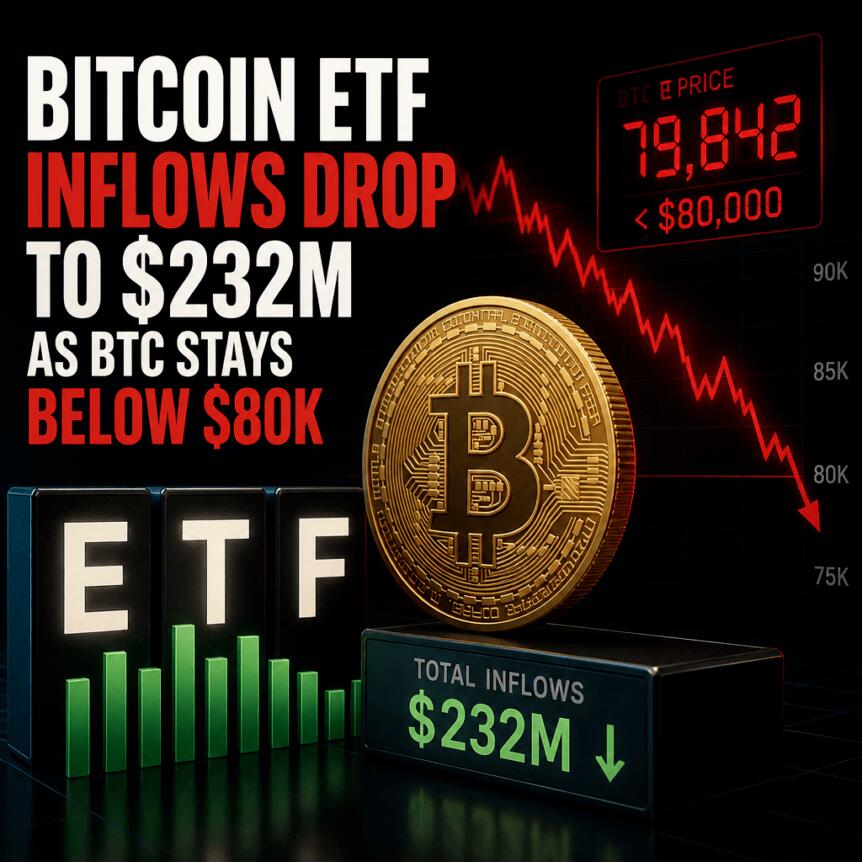
US-listed spot Bitcoin exchange-traded funds (ETFs) continued to pull in fresh capital on Wednesday, recording $232.1 million in net inflows. While that figure was down from the prior day, it still extended the funds’ streak of consecutive positive sessions to eight trading days, according to SoSoValue data.
The latest inflow total represented about a 26% decline versus Tuesday’s $314.4 million and was the smallest daily inflow since Aug. 18. Even with the slowdown, cumulative flows remain strongly positive, with eight-day net inflows totaling roughly $2.8 billion. Year-to-date, net outflows have narrowed to about $2.03 billion, while cumulative net inflows have risen to $54.6 billion and total net assets reached $98.6 billion, according to SoSoValue.
Key takeaways
- US spot Bitcoin ETFs logged $232.1 million in net inflows on Wednesday, extending an eight-day streak.
- Inflows slowed versus Tuesday’s $314.4 million, but cumulative performance remains firmly positive.
- Bitcoin’s price action has been relatively flat after briefly moving above $80,000, while ETF demand continues.
- US spot Ether ETFs also posted a continued run of inflows, while XRP ETFs saw their largest daily inflow since Jan. 5.
Bitcoin ETF inflow streak continues despite softer daily totals
Wednesday’s $232.1 million inflow follows a day when US spot Bitcoin ETFs received $314.4 million, and it marks a visible cooling from the stronger buying pace seen earlier in the streak. SoSoValue data also indicates Wednesday’s total was the smallest since Aug. 18, underscoring that while investor appetite has not disappeared, the intensity of daily purchases is fluctuating.
That matters for market participants because ETF flow patterns often serve as a real-time barometer of institutional and retail allocation behavior. With the eight-session run now in place and cumulative net inflows reaching $54.6 billion, the broader direction remains constructive—even as day-to-day numbers vary.
Price pauses above $80,000 as sentiment edges higher
ETF inflows came as Bitcoin’s momentum appeared to stall. After briefly climbing above $80,000 on Tuesday, Bitcoin traded around $78,759 at the time of publication, down 0.3% over the preceding 24 hours, based on CoinGecko data.
Despite the less exciting price tape, broader sentiment improved. The Crypto Fear & Greed Index rose to 71 from 65 a day earlier, staying in “Greed” territory, according to Alternative.me. For traders, this divergence—steady ETF inflows alongside a pause in near-term price strength—can be a sign that demand may be driven by longer-horizon positioning rather than purely momentum-chasing.
Earlier coverage from Cointelegraph noted the market’s brief push above $80,000 during Tuesday’s session, providing context for the subsequent consolidation.
Ether and XRP ETFs add to a mixed but supportive picture
Beyond Bitcoin, other major US spot crypto ETF products also saw inflows. US spot Ether ETFs recorded an eighth consecutive day of net inflows on Wednesday, bringing in $192.4 million, according to SoSoValue. The continuation across multiple fund categories suggests that the demand driving ETFs may not be limited to a single asset.
Meanwhile, US-listed spot XRP ETFs attracted $28.1 million on Wednesday. SoSoValue data characterizes this as the largest daily inflow since Jan. 5. XRP’s cumulative net inflows now stand at $1.62 billion, providing another datapoint that flow strength is persisting across the broader ETF landscape rather than being concentrated entirely in Bitcoin.
Taken together, the Wednesday results show a market where institutional-style allocation—reflected in ETF inflows—remains active even as Bitcoin’s price action cools after a near-$80,000 move.
What investors should watch next
With Bitcoin ETFs continuing to post positive days, the key question is whether the next sessions bring a re-acceleration in daily inflows or signal a gradual normalization after the early streak. Readers should also monitor whether sentiment indicators like the Fear & Greed Index remain in “Greed” territory as price volatility returns, and whether Ether and XRP flows keep extending their respective runs.