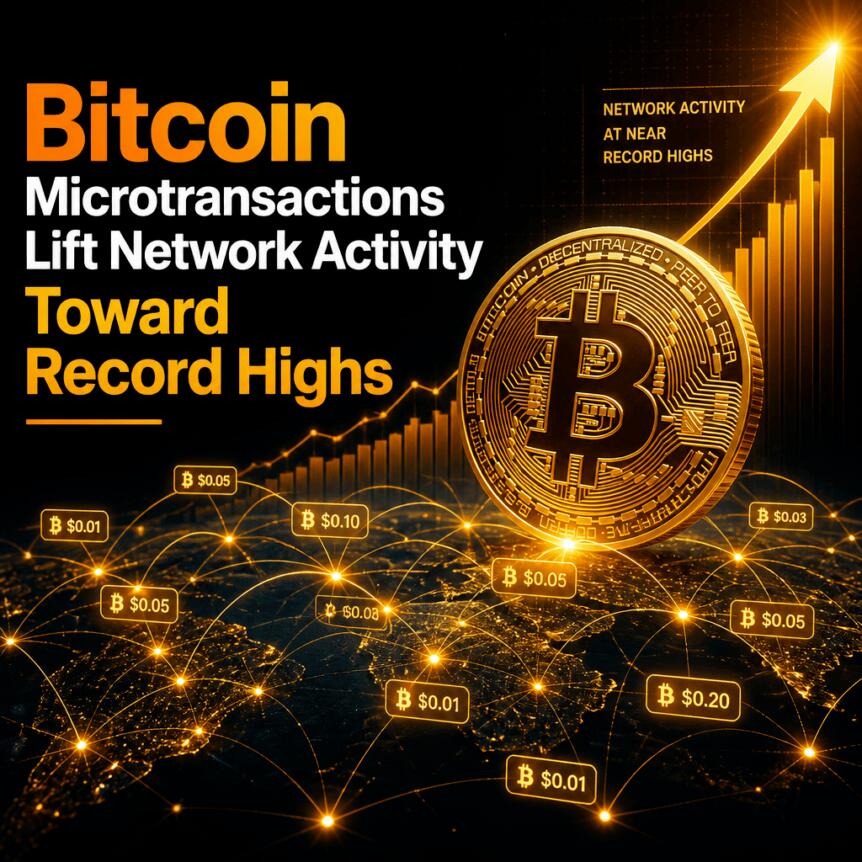
Bitcoin’s day-to-day activity is accelerating again, even as the asset’s price action remains relatively unimpressive. According to CryptoQuant, transactions smaller than 0.01 BTC—often associated with “dust” or data-driven on-chain activity—now make up about 80% of all daily transfers on the network, taking overall network activity close to record levels.
In a report released Thursday, CryptoQuant said its Bitcoin “Network Activity Index” has turned positive for the first time since 2024. The change matters because it signals that block space demand is increasingly being driven by non-financial usage—an environment that can translate into more competition for space and higher fees for users who rely on standard economic transactions.
Key takeaways
- CryptoQuant reports that sub-0.01 BTC transactions represent roughly 80% of daily Bitcoin activity, up sharply from earlier years.
- CryptoQuant’s Network Activity Index has moved into positive territory for the first time since 2024, despite weaker price performance.
- Data-inscription and related protocols—especially Ordinals, Runes, BRC-20 activity, and timestamping services—are cited as major contributors.
- Growing micro-transaction volumes can increase block space competition, potentially pushing up fees for “economic” transactions.
- Bitcoin’s mempool is reported at around 128,000 transactions, the highest level since February 2025.
Microtransactions rebound as share of daily volume grows
The most striking development is the shift in the composition of transactions. CryptoQuant notes that transactions below 0.01 BTC accounted for about 44% of daily transactions in 2023, but their share has nearly doubled since then.
CryptoQuant attributes this acceleration largely to inscription-centric demand and other data-writing approaches. In particular, the report highlights Ordinals and Runes—along with BRC-20 activity and data-timestamping protocols—as major drivers of low-value, high-count transactions. This helps explain why overall network activity can rise even when traders are not broadly chasing price momentum.
Research lead Julio Moreno wrote that sustained growth in non-financial activity could “increase block space competition and raise fees for economic transactions.” He also cautioned that the economic value of these transactions is “disproportionately small,” underscoring a key tension: the network can appear busier while the value per transaction remains low.
From earlier inscription booms to today’s renewed congestion
CryptoQuant’s report places the current wave in context by comparing it to past periods when inscription activity pushed Bitcoin toward congestion. The company says congestion levels today remain below the peaks associated with earlier inscription booms, when users embedded data such as images, text, and token-like information directly in blocks.
According to the report, transaction backlogs surged in 2023 as Ordinals and BRC-20 competed with routine transfers for limited block space. It then points to another spike emerging in late 2024 following the launch of the Runes protocol. The latest increase appears to follow that same pattern: bursts of on-chain data activity generate large numbers of transactions, which can swell network queues and raise the likelihood of fee pressure.
Importantly for readers, congestion is not just an abstract metric. When block space demand concentrates in low-value transactions, it can still alter fee dynamics for everyone—particularly those sending standard payments that depend on timely confirmation.
OP_RETURN usage and the mechanics behind higher transaction counts
Beyond the headline micro-transaction shares, CryptoQuant’s research also points to the specific transaction design choices fueling the trend. The report says Runes, Ordinals, BRC-20 tokens, and data-timestamping services produce large volumes of low-value transactions, helping drive the rise in the smallest cohort.
A central element in this mechanism is OP_RETURN, an opcode that allows users to embed data on-chain without creating spendable outputs. CryptoQuant reports that OP_RETURN usage has climbed to near-record levels in 2026.
That increase ties back to a contentious development within Bitcoin’s infrastructure: in 2025, Bitcoin Core developers removed a long-standing 80-byte relay limit. Critics argued the change would make it easier to use Bitcoin for non-financial data storage, effectively lowering friction for larger data embeddings. CryptoQuant frames OP_RETURN as the standard approach for many Bitcoin data-layer protocols, meaning changes in relay behavior can influence how much data activity the network can absorb.
These protocols generate high volumes of dust-value transactions (as low as 546 satoshis), directly explaining the low-value cohort surge.
Put differently, the “how” of transactions matters as much as the “how many.” Even when users are not transferring large amounts of value, on-chain data operations can still consume block resources—resulting in a higher count of transactions competing for inclusion.
Mempool pressure rises alongside the micro-transaction wave
CryptoQuant’s report also connects micro-transaction growth to observable network conditions. It says Bitcoin’s mempool—where unconfirmed transactions wait—has risen to roughly 128,000 transactions. That figure is described as the highest transaction count since February 2025.
For market participants and users, mempool size is often treated as a practical proxy for near-term congestion. While the report notes that current conditions are still below earlier inscription peaks, the combination of a high share of sub-0.01 BTC transactions and a swollen mempool suggests that fee markets may remain sensitive, especially for transactions that need confirmation during busy periods.
Another important implication is that the network’s “busy” signal may increasingly reflect data-layer usage rather than straightforward economic demand. That distinction can affect how participants interpret on-chain metrics: rising activity may not correspond to higher on-chain settlement value, even if it does correspond to greater resource competition.
Looking ahead, readers should watch whether this micro-transaction-driven activity persists and whether mempool levels remain elevated long enough to translate into sustained fee pressure for standard payments. CryptoQuant’s index turning positive after a multi-year stretch is a meaningful early sign—but the key question is whether non-financial activity continues to outpace demand for economic transactions, reshaping fee dynamics as the cycle progresses.