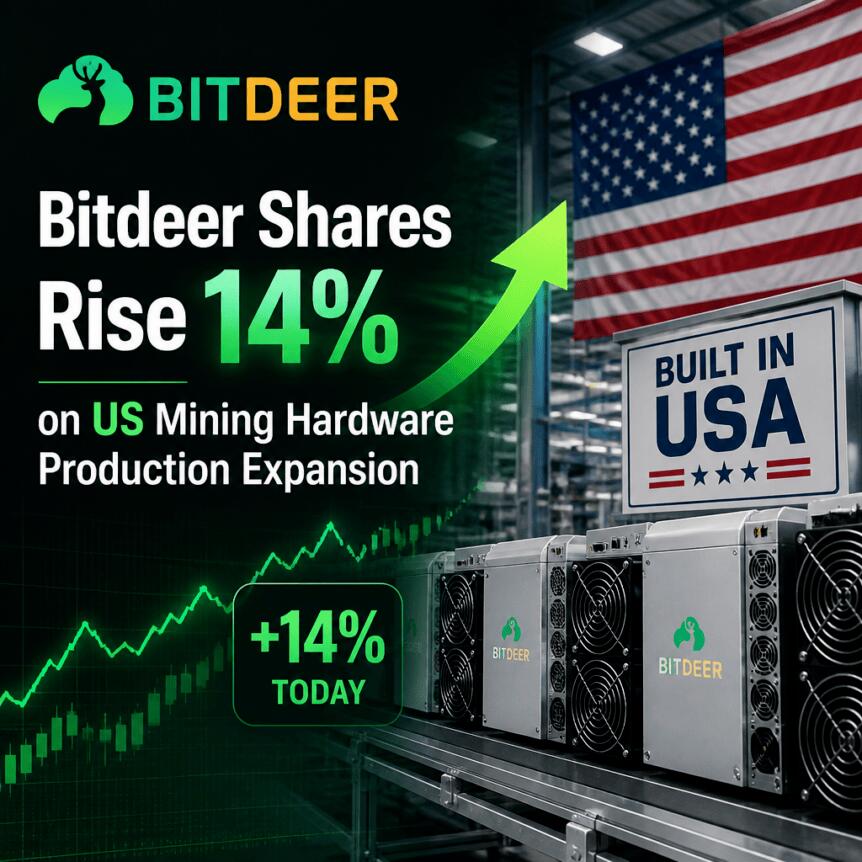
Bitdeer Technologies Group shares rose sharply on Thursday after the Bitcoin mining infrastructure company said it will build a new manufacturing facility in Nevada. The project is designed to expand US production capacity for Bitdeer’s mining hardware and, according to the company, reduce dependence on third-party suppliers.
The stock climbed 14.1% to $14.33, wiping out much of an earlier selloff in the week. Even with the rebound, Bitdeer remains about 27% below its June high, though it is up roughly 26% year-to-date.
Key takeaways
- Bitdeer plans to build a Nevada manufacturing facility in Sparks to assemble its SEALMINER mining machines.
- The plant is expected to begin commercial production by the end of the year.
- Bitdeer says the facility includes production of key mining hardware components, potentially lowering reliance on external hardware sources.
- While competitors push into AI and high-performance computing, Bitdeer’s Nevada expansion is specifically focused on mining hardware.
- Bitdeer also reported mining output of 921 BTC in May, representing a 370% increase versus the prior year.
Why a Nevada manufacturing push matters
Bitdeer’s announcement centers on a new facility in Sparks, Nevada, intended to assemble its SEALMINER line of Bitcoin mining equipment. The company says the site will also produce major components used in the machines, with commercial production slated to start by the end of the year.
For investors and mining-industry watchers, the importance of this shift is straightforward: hardware supply and lead times are often pivotal to mining operations, particularly when market demand accelerates. By bringing more manufacturing in-house within the US, Bitdeer is positioning itself to better control key parts of its supply chain rather than relying entirely on external vendors.
The facility also signals a broader strategic bet—mining infrastructure companies are increasingly expected to compete not only on hashrate and operating costs, but on the ability to scale equipment production reliably.
Incentives and local partnership cited by management
According to remarks attributed to Bitdeer CEO Catherine Guo by local media, the company worked with Nevada Governor Joe Lombardo’s administration and local authorities to secure tax incentives, including a reduction in qualifying sales taxes, as part of its decision to establish operations in the state.
These kinds of incentives can materially change the economics of industrial expansion, especially for manufacturing-heavy projects with significant upfront capital requirements. They also help explain why some mining-related manufacturers prioritize certain jurisdictions—cost structures and time-to-production can be decisive when trying to scale.
Bitdeer stays on hardware while rivals diversify
Bitdeer’s Nevada facility comes as several large Bitcoin miners and mining-adjacent companies broaden their businesses into AI, high-performance computing, and related digital infrastructure. In those cases, access to power and data center infrastructure can make it easier to pivot toward compute-intensive services beyond mining.
However, Bitdeer’s plans for Sparks are explicitly tied to Bitcoin mining hardware production rather than a broader AI-focused overhaul. The company has reportedly expanded into AI cloud services and high-performance computing, but the new Nevada plant is intended specifically for manufacturing SEALMINER equipment and components.
This creates an interesting contrast within the sector. While some publicly traded miners are using their infrastructure footprint to chase contracts in the AI ecosystem, Bitdeer is emphasizing the practical bottleneck on the mining side: getting capable hardware built and delivered at scale.
Earlier coverage from Cointelegraph has highlighted how the AI pivot among Bitcoin miners faces investor scrutiny, including concerns around insider sales. Against that backdrop, Bitdeer’s more narrow manufacturing focus may appeal to investors looking for tangible supply-chain expansion inside the core mining industry.
Output update underscores the company’s operating momentum
Alongside the manufacturing announcement, Bitdeer also provided a production update stating it mined 921 BTC in May. The company said this represented a 370% increase compared with the previous year.
That matters because new manufacturing capacity typically takes time to translate into higher throughput. In the meantime, investors often look for evidence that operations are already improving—either through added capacity, better utilization, or improved efficiency. Bitdeer’s May output increase offers some near-term confirmation that the company’s mining business is not only expanding on paper but also generating stronger results.
Even so, the market reaction to Thursday’s news suggests investors are treating the Nevada facility as more than incremental: the prospect of end-of-year commercial production could mark a meaningful step in the company’s ability to scale its hardware footprint.
Cointelegraph previously reported on how MARA Holdings announced plans to acquire a Texas site with up to 2 gigawatts of capacity to expand its AI and digital infrastructure business, and how TeraWulf signed a 20-year data center lease with Anthropic that the company said could generate roughly $19 billion in contract revenue. Those developments highlight how quickly many miners are moving toward AI-driven business models—even as hardware production remains central to the mining sector’s long-term competitiveness.
What to watch next
As Bitdeer works toward end-of-year commercial production in Nevada, the key question for investors is whether the facility meaningfully changes hardware availability, delivery timelines, and cost structure. The next signals to track are updated production metrics, progress on the manufacturing timeline, and any further detail on how the Nevada plant is expected to reduce dependency on third-party components.