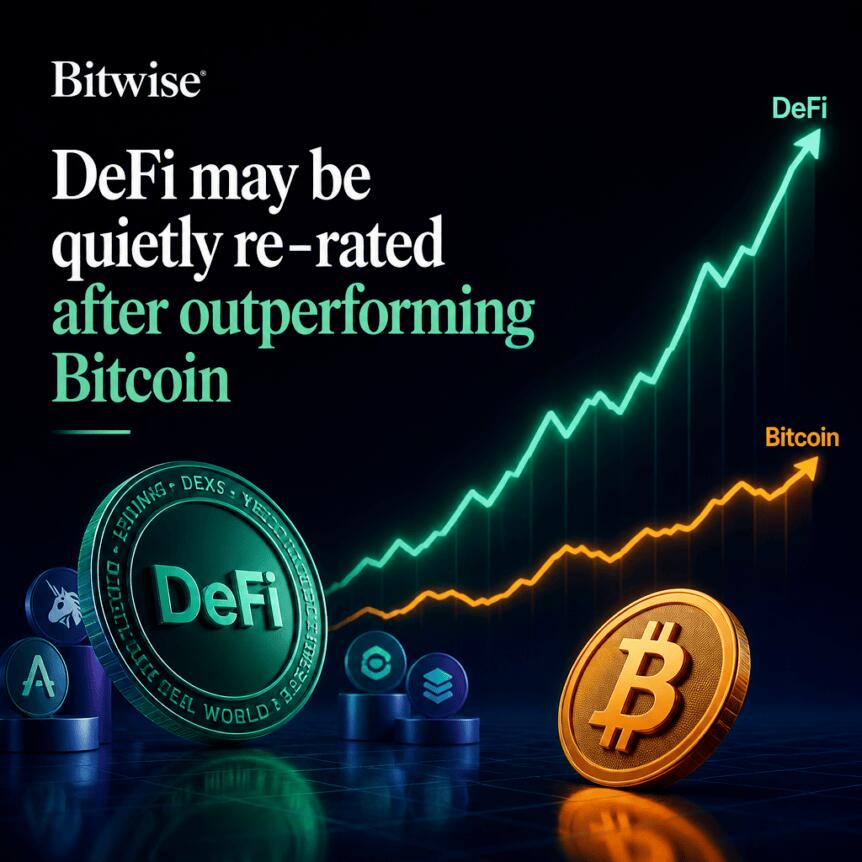
Decentralized finance tokens have outperformed Bitcoin over the past month, a divergence Bitwise says may reflect a “quiet re-rating” of the sector rather than a short-lived bounce. In its latest crypto market review, the firm pointed to a steep change in relative performance during June: Bitcoin fell about 22%, while Bitwise’s index of tokens tracking major DeFi protocols declined roughly 4% over the same period.
Bitwise described the relative stability as unusual because DeFi tokens are typically among the first assets traders trim when risk appetite drops. The report argues that the sector’s volatility profile may be shifting as more traditional institutions use DeFi infrastructure—support that, in Bitwise’s view, has helped stabilize the broader ecosystem.
Key takeaways
- Bitwise’s DeFi token index fell about 4% in June versus Bitcoin’s ~22% drop, suggesting DeFi held up unusually well.
- Bitwise links the resilience to improving token economics and a narrowing gap between DeFi usage and token value.
- Institutional participation is cited as a stabilizing force as firms build on major DeFi names such as Morpho and Jupiter, with Aave highlighted for generating roughly $900 million in the past year.
- Despite token strength, total DeFi value locked has fallen—CryptoRank reported a decline to just over $70 billion from around $115 billion in January.
- Bitwise expects stablecoin-focused announcements to intensify before the GENIUS Act takes effect in January 2027, and it flags the CLARITY Act as a near-term volatility catalyst.
Why Bitwise thinks DeFi is being re-priced
Bitwise’s core observation is that DeFi’s traditional pattern—bigger swings than Bitcoin during downturns—has not played out in the most recent month. The firm said the relative performance difference is both “unusual” and largely absent from mainstream discussion, implying that market positioning may be lagging what token-level pricing is already signaling.
The report also frames this as more than a simple momentum story. Bitwise argues that DeFi token economics have been improving and that the historical disconnect between how much the platforms are used and how valuable their tokens become is narrowing. In that framing, outperformance is less about speculation and more about demand for DeFi services translating into token relevance.
Bitwise further points to real-world institutional usage as a stabilizer. It specifically names Morpho and Jupiter as examples of areas where institutions have started building, and it cites Aave’s activity—stating that Aave generated approximately $900 million in the past year—as evidence that core DeFi markets remain economically active even when the broader crypto market cools.
What’s inside Bitwise’s DeFi index
Bitwise’s DeFi index fund is market-cap weighted, and its current composition sheds light on why the basket has been resilient. The index allocates about 61% of weight to Hyperliquid’s native token (HYPE), which is tied to the perpetuals exchange ecosystem. Bitwise noted that HYPE has gained more than 160% so far this year.
The index also includes other prominent DeFi exposure, including Uniswap (UNI), Ondo (ONDO), and Aave (AAVE), among others. Despite being major constituents, these names have generally declined over the year-to-date period, with Bitwise stating that several of them are down double digits. That matters for investors because it suggests the overall index performance is being supported by a concentrated outlier (HYPE) while other widely followed protocols face their own drawdowns.
Value locked is down—resilience may not mean growth
Token performance does not automatically translate into increased capital deployment. While Bitwise’s index held up better than Bitcoin in June, CryptoRank reported that total value locked (TVL) in DeFi declined sharply throughout 2026.
According to CryptoRank data cited on June 24, DeFi TVL dropped nearly 40% so far this year, falling to just over $70 billion from roughly $115 billion in January. The data provider attributed much of the decline to a major correction in early October that followed a prior peak in the broader crypto market—when Bitcoin reached a high of more than $126,000.
CryptoRank also suggested the current drawdown is smaller than what occurred during the 2022 bear market, implying relative durability. Taken together, the token-vs-TVL split points to an important nuance for readers: DeFi can experience weaker liquidity and still see token pricing stabilize or improve—especially if parts of the ecosystem (like derivatives venues or specific liquidity markets) remain relatively favored by traders and institutions.
Policy catalysts: stablecoins and the CLARITY Act
Bitwise’s report extends beyond performance comparisons by highlighting regulatory and legislative developments it expects to influence market conditions. One major focus is stablecoins ahead of the GENIUS Act, a stablecoin-regulating bill that was made law in the US last year and is set to take effect in January 2027.
Bitwise said it expects “a steady run of large firms” to announce stablecoin projects ahead of GENIUS implementation. The firm also noted that stablecoin supply has remained supported through the recent downturn. In Bitwise’s view, continued supply growth should benefit major settlement rails such as Ethereum and Solana during the current quarter as regulators finalize rulemaking around the GENIUS Act.
On market structure, Bitwise said the next three months could be “make-or-break” for the CLARITY Act, currently under review and negotiation in the Senate. Bitwise said it believes the bill has an unlikely chance of passing before the November elections.
The report outlines a two-path scenario. If CLARITY passes, Bitwise argues it could signal the bottom of the current bear market. If it fails, Bitwise expects volatility at first, followed by a period of “clearing of uncertainty” as the industry continues building under a regulatory environment it characterizes as more pro-SEC and CFTC focused.
For investors, the practical takeaway is that the market may be balancing near-term uncertainty on structure policy with longer-term momentum from stablecoin-related deployment. With DeFi tokens holding up comparatively well against Bitcoin even as TVL falls, traders may increasingly look at whether liquidity breadth returns—or whether token strength continues to concentrate in specific segments.